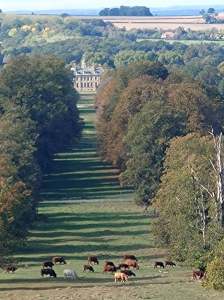
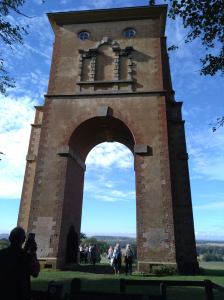
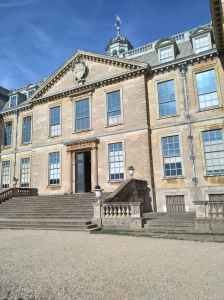
 On 6th October, Sue joined the U3A New Experience group and travelled to Belton House in Rutland. She spent the day on a five-mile guided walk through the estate, followed by a lecture in the house about its history and that of the surrounding landscape.
Meanwhile, I travelled to Kibworth, picking up Jim and Sean on the way, to visit Paul, who is currently undergoing treatment for cancer. As is often the case with chemotherapy, he has lost his hair and tires easily, but otherwise he looked well and seemed very much like the old Paul we have known for many years. We spent a couple of hours chatting over coffee and biscuits about the usual subjects, rugby, politics and gardens, before we eventually had to leave. Jim had to get his flu and COVID vaccinations, while Sean needed to get back to dog-sit for his daughter.
I spent the afternoon riddling the blue slate on the drive at the front of the house, separating it from the weeds and soil that had accumulated over a very wet winter. It was hardly glamorous work, but at least it provided a useful excuse to be outside. Later, I drove into town to collect Sue when she returned from her Rutland jaunt.
It was a good reminder that, these days, even booking a perfectly ordinary hotel room can apparently involve a small digital detective story.
The 7th was a rare rainy day. Having noticed a leaking gutter, I got out the ladder to investigate. Thankfully, after a bit of precarious and largely random scraping of leaf debris, the problem seemed to have been eased, at least for the time being. With that minor crisis apparently resolved, I spent the rest of the day reorganising my study.
Since my retirement, the room is now used mainly for printing documents, so much of the furniture and equipment had accumulated without any real purpose and was in need of a good ‘thinning out’. I had planned a trip to the charity shop, but when Sue returned from a visit to see her friend Sue in Lutterworth, she suggested that I put the cane shelving unit I no longer needed on Facebook Marketplace. Within twenty minutes it had been sold for £20, and half an hour later it had disappeared from Willow Bank. That was considerably more efficient than my usual method of accumulating unwanted possessions in the hope that one day they might become useful again.
Late that evening, we decided to extend our forthcoming trip to Anglesey by stopping overnight in Mold to visit our friends Noel and Gay. I duly booked a nearby hotel.
As seems to be the way of the world at the moment, nothing is ever straightforward. Using Booking.com, I found a suitable hotel and booked it online. Confirmation was immediate, with the usual emails arriving promptly. On this occasion, however, I also received one apparently from the hotel asking me to confirm the booking by clicking on a link and entering some details within 24 hours.
My suspicions were immediately raised. I checked the web address and spotted the tell-tale ‘.vu’ country code, Vanuatu rather than Wales. I deleted the email and notified both Booking.com and the hotel that their system appeared to have been compromised.
Almost immediately afterwards, I received two emails warning me about a possible scam. A little late, I thought.
SCAM:
The accommodation provider takes full responsibility for the content of this message, sent through Booking.com.
Dear David Palmer,
We look forward to welcoming you soon. We require all guests to complete a few steps before their booking is confirmed prior to arrival. To complete the outstanding steps through our secure online portal, please click on the following link:
[scam link removed]
Please note that if the above steps are not completed within 24 hours, we reserve the right to cancel your booking.
Book Direct and Save up to 10%!
+44 (0)333 4444 324
sales@northophallhotel.com
northophallhotel.com
Chester Road, Mold, Wales, United Kingdom, CH7 6HJCustomEyes.me 09550831
Powered by ZeevouBooking.com will receive and process replies to this email as set forth in the Booking.com Privacy Statement.
It was a good reminder that, these days, even booking a perfectly ordinary hotel room can by necessity involve a small digital detective story.
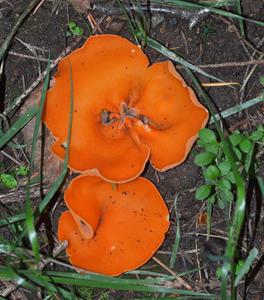 Sue continued her recovery on the 8th with an outing with the U3A Nature Group to Wakerley Woods, near Peterborough. It was a perfect day for a ramble through ancient woodland in search of flora and fauna, with a clear, crisp sky and just the right amount of warmth from the early autumn sunshine.
To her delight, she discovered a fungus growing among the leaf litter that she had never seen before, the orange peel fungus (Aleuria aurantia). Although widespread throughout Europe, it had somehow escaped her attention until now. Its bright orange, cup-shaped fruiting bodies often look remarkably like pieces of orange peel scattered across the woodland floor, hence its rather appropriate common name.
The group rounded off their adventure with lunch, but Sue decided instead to indulge in a spot of retail therapy in Corby and Market Harborough before returning to Willow Bank in the middle of the afternoon.
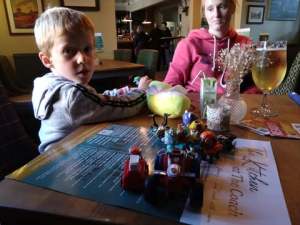
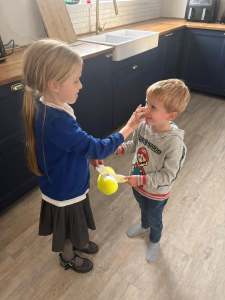
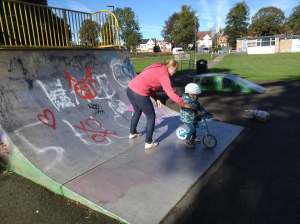 While Sue gallivanted around the wilds of Northamptonshire, I entertained Sarah, Archie and Mia. They arrived mid-morning and, after playing with a sweet little soft banana toy I had bought for Archie and Alice, which plays a tune when two people hold its hands and make them poke each other, we set off for Welland Park. Archie enjoyed the play equipment while I took Mia for a walk.
 Once everyone was thoroughly played out, we continued into town. Sarah and Archie visited the various charity shops in search of Halloween knick-knacks and toys, while I once again took charge of Mia. After thoroughly circumnavigating the town centre and investigating most of its remaining shopping facilities, we made our way back to the park, where Archie enjoyed riding his bike around the skateboard area.
When lunchtime beckoned, Sarah drove us to the Coach and Horses in her new Tesla for a pleasant meal. Afterwards, they headed home in time to collect Alice from school, leaving me with the welcome prospect of a quieter afternoon, and, hopefully, no more leaking gutters or suspicious emails.
The results of last week’s blood test came back exactly a week later, accompanied by the reassuring comment that everything was satisfactory. This indicated that the cancer had not progressed, with another PSA test scheduled for January. It is a relief to have some good news for a change, particularly in such turbulent times.
For most of the past couple of decades, a group of pals and I have met for a game of pool at 9 pm every Thursday evening. Initially, we played at the Catholic Club, but when the club was sold, we moved our regular gathering to the Garden Room at Willow Bank. In recent weeks, two of our number have been prevented from joining us by illness: Paul, who is being treated for bladder cancer, and David Thomlinson, whose cough developed into pneumonia and resulted in a spell in hospital.
Friday, 10 October, sadly turned out to be a day to remember for all the wrong reasons.
The morning began much like the rest of the day, bright and chilly, with the occasional irritating shower. Sue completed her essential morning shopping duties before attending a U3A Wellness seminar at the Baptist Church, which, on her return, she described as disappointing.
Meanwhile, I busied myself linking a couple of the house security cameras to the faster 5G network, before copying files to an external drive and deleting them from the study’s Windows 10 PC. I then restored the machine to its factory settings in preparation for scrapping it. This exercise took three hours, after which I replaced it with a mini Dell PC and connected the printer, keyboard and mouse. Another small victory in my ongoing battle with the ever-changing world of technology!
That evening, Sue settled down with her laptop to catch up on her favourite television programmes, while I ensconced myself in the Garden Room with Sean to watch Leicester Tigers take on Gloucester. We were watching the post-match analysis when a message appeared on our WhatsApp group from David’s wife, Anna, informing us that he had passed away peacefully that afternoon, surrounded by his family.
 The previous evening, at 9.35 pm, while we were playing pool, the group had received a message from David: “Unfortunately, I cannot join you tonight. 🍺”
I cannot help wondering whether he knew that the end was near and whether this was his quiet farewell to his friends. Perhaps we shall never know, but the timing made his message all the more poignant.
Some members of our group knew David and his family extremely well. Their friendships went back to the days when their children attended the same primary school, and some had even enjoyed holidays together. David was a genuinely kind and humble man who loved our weekly get-togethers. He would invariably bring snacks for pool night and always thank me as he left to go home. Such small, thoughtful gestures said a great deal about the sort of person he was.
His death came as a shock to us all, not least because of the suddenness of the news and the circumstances in which he passed away. He was a valued member of our little gathering, and his absence will leave a considerable gap. He will be greatly missed.
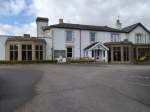 The following morning, after dropping off a card for Anna and the family, Sue and I set off on a three-and-a-half-hour drive to the Northop Hall Country Hotel in North Wales.
On arrival, we sat in the car and ate our packed lunch while a passing shower did its worst outside. With our appetites satisfied and the rain having moved on, we pulled on our hiking boots, fired up my GPS and set off to explore nearby Ewloe Castle.

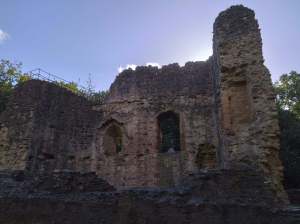 Although Ewloe has many of the distinctive features associated with the native-built castles of Wales, its location makes it rather unusual. Whereas the Welsh princes generally favoured lofty vantage points for their fortresses, Ewloe occupies a hollow surrounded by deep woodland. Its history is also somewhat murky, thanks to the lack of surviving records from the period.
The castle was probably built by Llywelyn the Great sometime after 1210, with the curtain walls and circular western tower added by Llywelyn the Last nearly 60 years later.
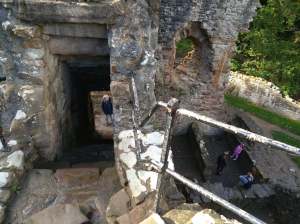 The walk through the woods to the castle was easy and pleasant, and we enjoyed wandering around the extensive ruins, reading the information boards and, naturally, taking a few photographs. Leaving the ancient monument, however, presented us with a rather more demanding challenge: a strenuous climb out of the valley on the opposite side of Wepre Brook.
Sue’s knees complained all the way to the top of the escarpment, but she bravely soldiered on and, thankfully, managed to negotiate the remainder of the journey back to the hotel without further incident.
By 6.30 pm, we had changed and were heading through heavy rain to the Peny y Bont Farm pub for a meal with our friends Noel and Gaye Headley. It had been nearly a year since we had last met, so there was plenty of family news to exchange. The three hours flew by, as they tend to when good friends get together, although the rain stubbornly refused to follow our example and let up. Our return journey to the hotel was consequently rather less enjoyable than the evening itself, after which we were more than ready for bed.


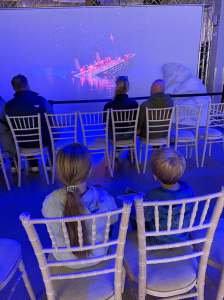
 Meanwhile, the start of our Welsh adventure coincided with the beginning of other family travels and activities. Charlotte, Suraj and Ellis flew into a flooded Bangkok before continuing to Krabi to begin their two-week holiday. Sarah and her family enjoyed a much shorter journey to Leicester Racecourse to visit the touring Titanic Museum. They reported on Family Messenger that they would recommend a visit to the grandparents, which sounded promising. Jamie and Joey, meanwhile, were behaving rather like squirrels, gathering yet more sweet chestnuts in preparation for winter.
 After breakfast the following morning, Sue and I checked out of the hotel and drove for an hour to our next accommodation, the Bishop’s Gate Hotel in Beaumaris, where we had booked two nights.
It was a windy but clear, sunny morning, and the contrast with the previous day’s journey was remarkable. The drive along the scenic North Wales Expressway was stunning, with beautiful views, relatively little traffic and a road surface that was almost immaculate. For once, I could engage the cruise control at 70 mph and actually enjoy the journey rather than concentrating on avoiding potholes and other assorted obstacles.
We arrived in Beaumaris by 11 am. After parking and confirming with the hotel what time we could enjoy our included Welsh afternoon tea, we set off on a short walk to Beaumaris Castle.
At the entrance, we discovered an artisan market, which Sue took full advantage of by purchasing several items that she assured me were both unique and essential. Armed with her newly acquired bag of plunder, we each paid the £9.30 concessionary admission for senior citizens and entered this impressive Welsh monument.
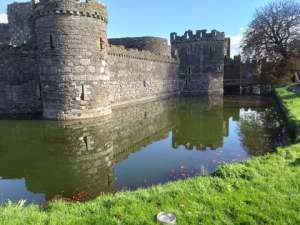
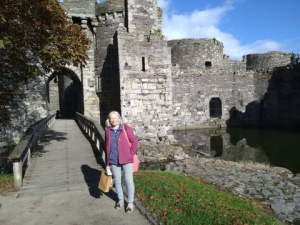 Construction began in 1295, and Beaumaris is often described as the greatest castle never built. It was the last and, technically, the most perfect of Edward I’s Welsh strongholds, but the project was left unfinished when the money and royal attention ran out as the king turned his sights towards war with the Scots.
We spent an hour or so exploring its magnificent, moated ruins, wandering through the many corridors and chambers and clambering in and out of the various spaces. It was difficult not to wonder what a masterpiece it might have become had Edward left the Scots to their own devices long enough to finish the job. The design, guided by James of Saint George, the most celebrated architect of his day, was undoubtedly ambitious. Sadly, the castle remains a tantalising glimpse of what might have been.
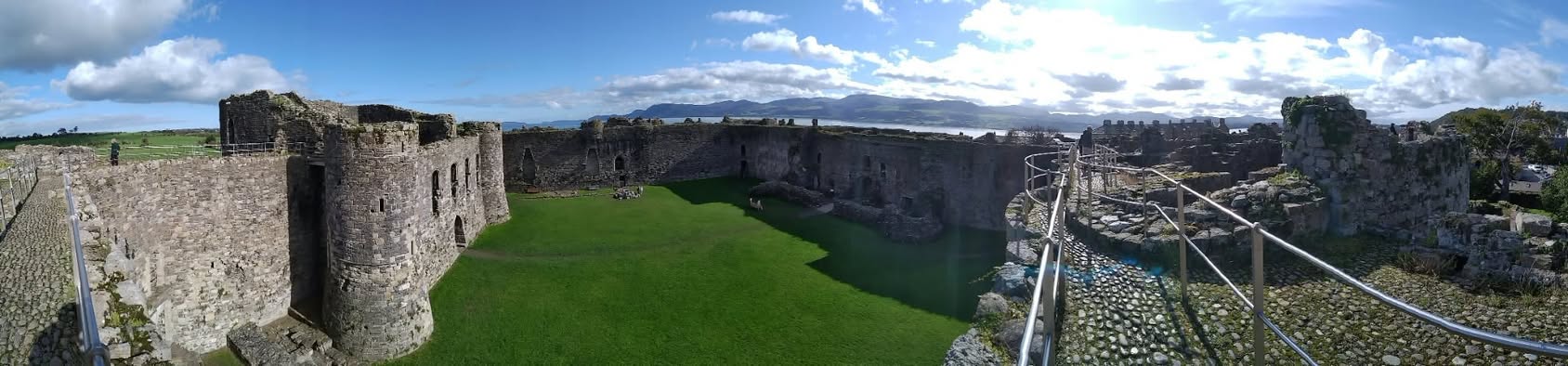
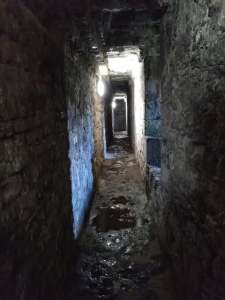 Nevertheless, it was well worth the visit.
Leaving the castle behind, we strolled down Castle Street towards the town centre, taking in the pier and the lifeboat station before eventually reaching the courtyard of the Castle Court pub. There, I enjoyed a local beer while Sue treated herself to an ice cream. Sitting in the sunshine and indulging in a spot of people-watching proved a pleasant way to spend some time after our castle exploration.
Eventually, we continued along Castle Street until we found Beaumaris Gaol, where we checked that it would be open for a visit the following day. After making a detour to browse another artisan market, we finally checked into the Bishop’s Gate Hotel.
We had barely settled in before it was time to enjoy our splendid Welsh afternoon tea, accompanied by a bottle of Prosecco. After the journey, the castle and Sue’s successful shopping expedition, it was a rather civilised way to round off the day.
Thanks to Sue misreading the time, Monday got off to an unexpectedly early start. She began making her customary 7.30 am cup of tea an hour ahead of schedule, leaving plenty of time for a second cup before we arrived promptly for breakfast at 8 am. Sue, replete with a full English, and I, having tucked into a couple of kippers, were soon ready to set off for our first destination of the day: Beaumaris Gaol, just a three-minute walk away.
Built in 1829 to the designs of Joseph Hansom, the architect who later gave his name to the Hansom cab, the gaol survives as one of the most complete Victorian county prisons in Britain. Inside, the original cells, punishment cell, treadwheel and condemned man’s final walk have all been preserved, offering a sobering insight into the lives of both the people who worked there and those unfortunate enough to serve their sentences within its walls.
It took us nearly two hours to explore the building thoroughly, and apart from the lone receptionist, we had the place entirely to ourselves throughout our visit. Particularly poignant was the story of Richard Rowlands, who was accused of murder and hanged here in 1862, protesting his innocence to the end. Local legend has it that he cursed the church clock, which thereafter refused to keep time. We had plenty of time to absorb the history and reflect on the harsh realities of island life and its criminal justice system as we wandered from room to room.
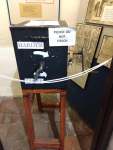
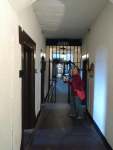
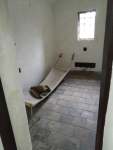
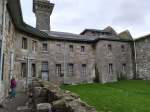 Seeing the treadwheel, instruments of whipping, the crank and the rooms where prisoners were condemned to the mind-numbing labour of picking oakum and breaking rocks brought the brutalities of Victorian punishment vividly to life. It was a fascinating, if occasionally uncomfortable, reminder of just how unforgiving the penal system could be.
From the gaol, we made our way a few hundred metres to the courthouse, where we learned more about the unfortunate Richard Rowlands, whose grave we had been contemplating only moments earlier within the gaol’s walls. We began our visit by watching an excellent video recreating his trial. By the time it finished, we had become thoroughly convinced that he was innocent. There isn’t a great deal to see in the courthouse itself, but it is a fine example of Victorian justice, and the video alone makes it well worth a visit.
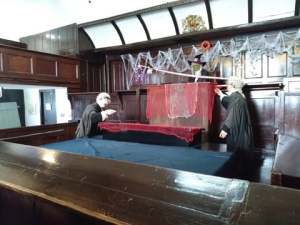 With Halloween approaching, there was also an unexpected seasonal twist to our historical explorations. The mannequins and much of the décor in both buildings had been lavishly embellished with spooky decorations, adding a distinctly ghostly atmosphere to proceedings. Given the gaol’s history, it seemed an entirely appropriate place for such festivities!
Having successfully completed our planned morning activities, we returned to the hotel to change into our hiking gear before driving to the car park at Penmon Priory. From there, we paid the £3.50 toll to access the road leading towards Penmon Beach, stopping first to visit the impressive dovecote.
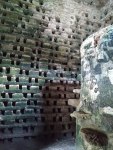
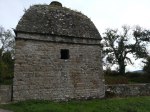 Built around 1600 for the Welsh politician Sir Richard Bulkeley, this enormous structure was designed to house pigeons and doves, providing an important source of meat and eggs. Its huge domed roof accommodated up to 1,000 nesting places. Inside, a substantial stone pillar, around 12 feet high, would have supported a revolving ladder, allowing the owner or his servants to reach the nests lining the walls. It was an ingenious arrangement, although I suspect the daily collection of eggs and birds would have been rather more laborious than popping down to the supermarket!
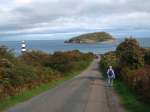 Following the route plotted on my GPS, we continued towards Penmon Point and its steeply shelving pebble beach. The views across the Menai Strait towards mainland Wales were magnificent, with Puffin Island providing an attractive focal point just offshore. The lighthouse, erected in 1838 for £11,589, stands prominently on the point. Shipmasters operating out of Liverpool had long called for a navigational light here, particularly following the tragic wreck of the steamer Rothsay Castle, which ran aground in 1831 with the loss of 130 lives.
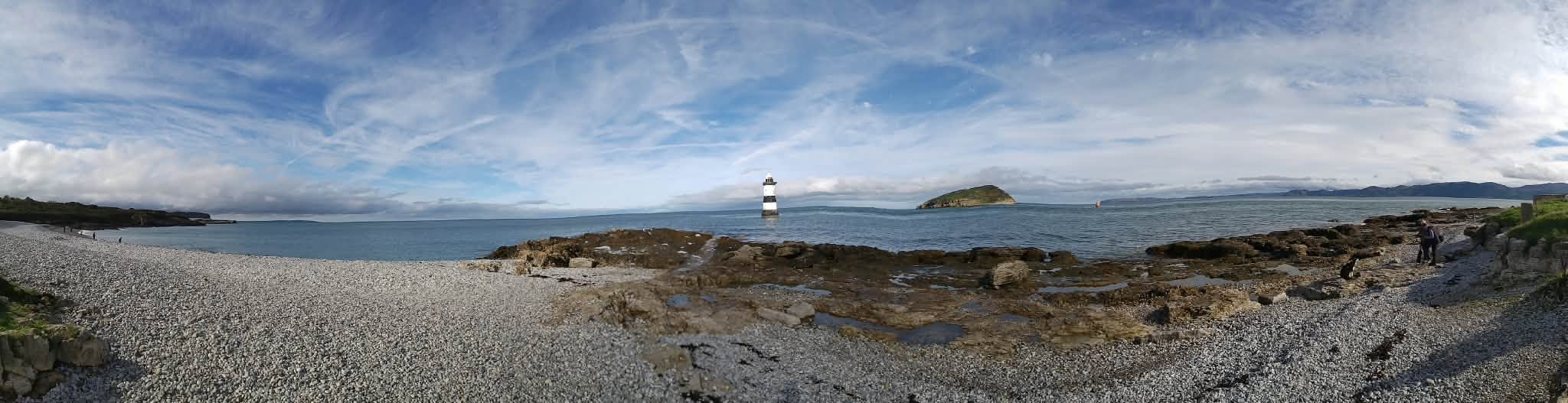
We began our beach visit with ice creams from the little café overlooking the shore, which we enjoyed in the sunshine at an outdoor table. We were soon joined by a friendly sheepdog, who made himself comfortable underneath our table and promptly fell asleep. Clearly, he had mastered the art of enjoying a day out without overexerting himself!
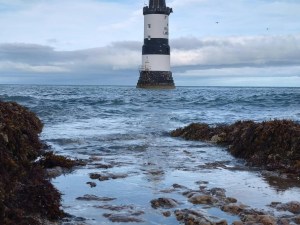 Unfortunately, the tide was high, preventing us from negotiating the narrow path leading towards the lighthouse. We therefore had to content ourselves with taking photographs from the water’s edge, some 30 metres away. It was disappointing not to get closer, but the views were still impressive.
October, however, is not the season for puffins on the island that bears their name, so a thorough scan through our binoculars drew a blank. Not a puffin was to be seen, nor, indeed, any other seabirds apart from the ubiquitous gulls. Our hopes of spotting some wildlife had therefore been somewhat overambitious, although the scenery more than compensated for the lack of feathered celebrities.
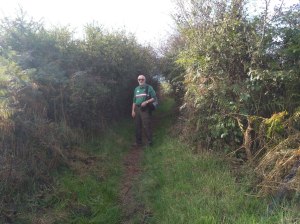 Before leaving the beach, we acquired another canine companion, who was determined that we should participate in a game of fetch. He insisted on us throwing a stick, which he was considerate enough to lay at our feet, and we duly obliged by playing our part in the entertainment. Between the two dogs, it seemed that Penmon’s four-legged residents had taken it upon themselves to ensure we enjoyed our visit.
Our return to the car followed the coastal cliffs before the path branched inland through fields of sheep contentedly munching the lush green grass. After the scorching summer drought, the countryside was finally recovering, the verdant fields a welcome contrast to the parched brown landscape of only a few weeks earlier.
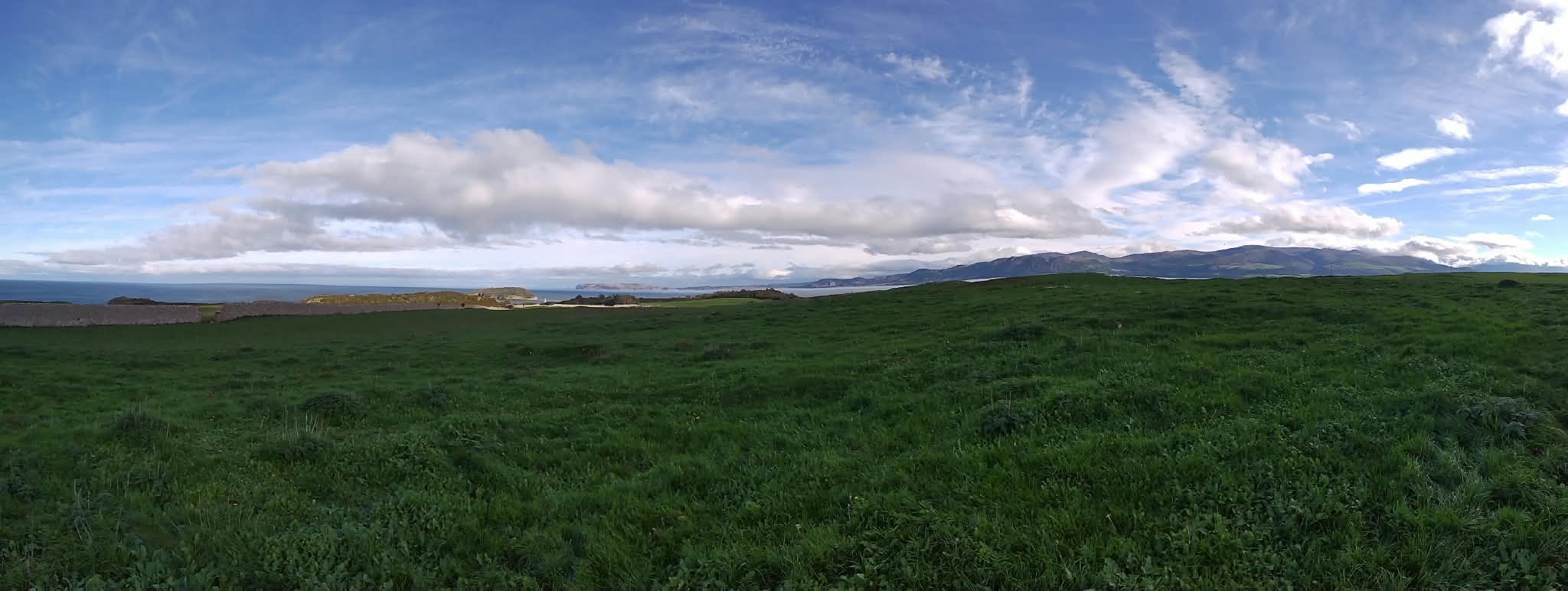
Shortly before reaching the car park, we made a brief detour into the ruins of Penmon Priory. Its history stretches back to the sixth century, when St Seiriol established a monastery here. The surviving remains date largely from the thirteenth century, when the priory became part of the Augustinian order.
 Inside the adjoining church, which continues to serve the local parish, stands an impressive stone cross dating from the tenth century. Its shaft is intricately carved with elaborate fretwork and plaited patterns, a remarkable example of early medieval craftsmanship that has survived for more than a thousand years.
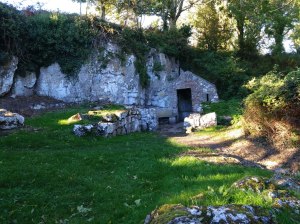
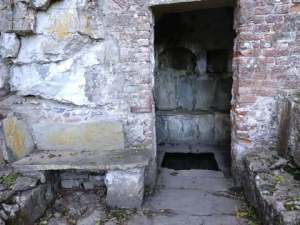 Before heading back to Beaumaris, we also visited St Seiriol’s Well, which is reputed to possess healing properties. The well is traditionally associated with the saint and the early monastery, although the small stone structure housing it was built much later. There is a suggestion that the lower stone walls nearby may have formed part of Seiriol’s original sixth-century church. If that interpretation is correct, they could represent the oldest surviving Christian building in Wales, although this remains a matter of historical debate.
We took a few photographs before making our way back to the car and returning to our accommodation. After a full day of exploring gaols, courthouses, ancient religious sites, coastal paths and pebble beaches, a warm bath was most welcome. It provided an opportunity to soak away the day’s exertions and reflect on everything we had seen.
That evening, we enjoyed a splendid meal in the hotel restaurant before retiring to our room to round off the day in the traditional manner: relaxing in front of the television. After all, even the most enthusiastic explorers need a little downtime!
After another sumptuous breakfast, with both of us opting for the Full Welsh, we set off on a relatively short drive to our next overnight accommodation. Once we reached the mainland, we were treated to some of the picturesque scenery for which North Wales is renowned.
Our destination was the Gladstone in Penmaenmawr, a late choice after our original preference in Conwy proved unsuitable because it lacked private parking, despite being conveniently located for a visit to the castle. I have a simple rule when choosing accommodation: if a hotel neither provides breakfast nor offers free parking, I generally discount it as more trouble than it is worth.
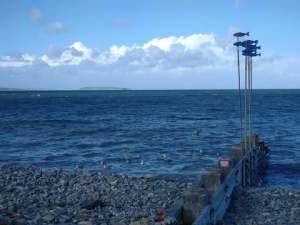 We stopped en route for half an hour to enjoy a stroll along Penmaenmawr’s promenade. The wind had whipped up the sea, creating waves that made dipping one’s toes into the surf decidedly unappealing. The shoreline, consisting of large, rounded pebbles that looked distinctly uncomfortable underfoot, offered little further encouragement to venture closer to the water.
A number of anglers were braving the blustery conditions, standing patiently with their lines cast out into the choppy waves and watching intently for any sign of a bite. Despite their concentration and perseverance, we saw none of them strike lucky. The only creatures that appeared to be thoroughly enjoying the conditions were a small flock of immature gulls, being buffeted about by the wind beneath a sculpture entitled The Shoal. They seemed perfectly content to let the elements toss them about, while we were happy to admire the spectacle from a more comfortable distance.
Five minutes later, we pulled into the Gladstone’s car park and set the SatNav for the Fairy Glen Hotel in Capelulo. Our intention was to walk into the glen, take a few photographs and then continue to Conwy.
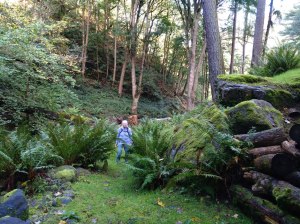
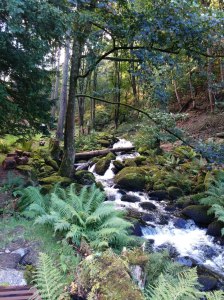 Unfortunately, our plans were soon derailed. Shortly after following the public right of way into the glen, we were confronted by an irate woman who accused us of trespassing. I pointed out that, although the land might be privately owned, the public had a right of access along the designated footpath to this popular tourist attraction. She disputed this vehemently, becoming increasingly abusive as the exchange continued. Rather than prolong the argument with someone seemingly determined to have a confrontation, we decided to leave her to her neurotic rage and beat a hasty retreat. Our anticipated peaceful stroll had turned into an unexpectedly hostile encounter, and we had neither the inclination nor the desire to spoil the day further.
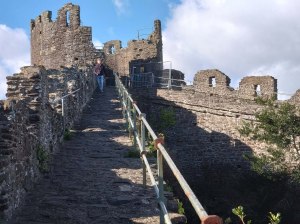 Back at the car, we drove on to Conwy and parked in the car park beneath the castle. Sue announced that she was officially ‘castled out’ and had little enthusiasm for exploring yet another Welsh fortification. After refreshing ourselves in a pub in the town centre, we decided instead to walk along the top of the town’s medieval curtain walls, which promised an alternative way to appreciate Conwy’s historic character without subjecting Sue to another dose of battlements and towers.
Unfortunately, our luck continued to desert us. A section of the walls was closed off for reasons that were not apparent, preventing us from completing the full circuit. It seemed that the day’s attractions were conspiring to ensure we saw rather less than we had planned.
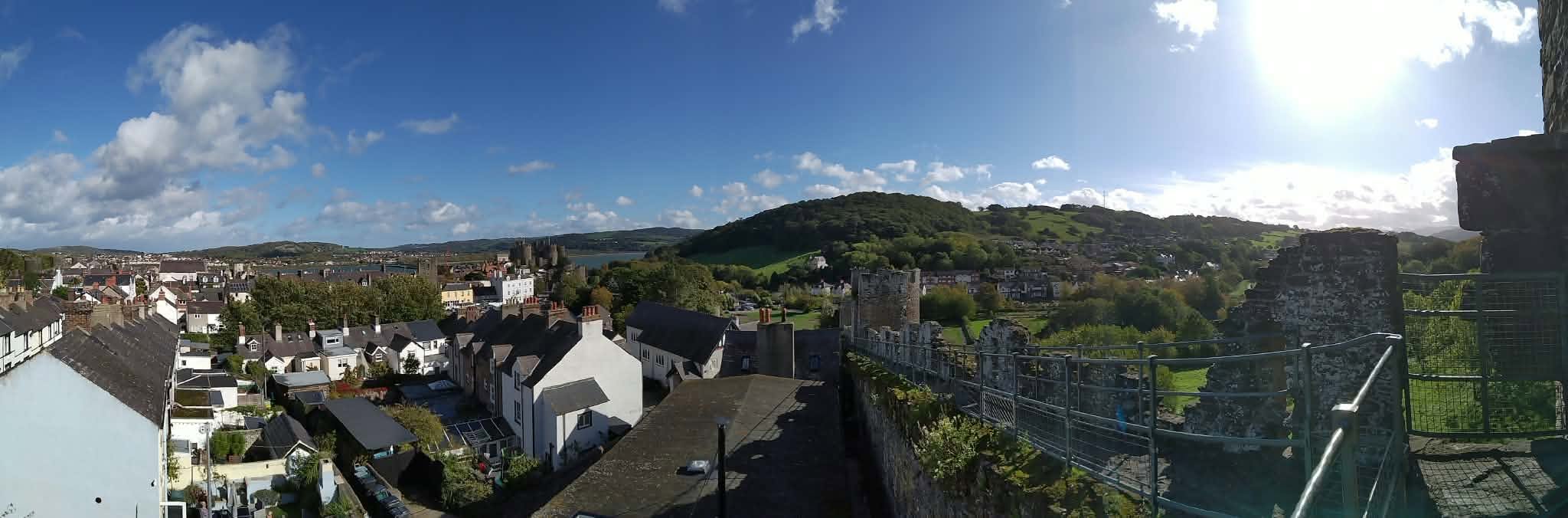
On our way back to the car, we made a brief detour into the Tourist Information Shop to enquire whether the advertised ghost walk around Conwy’s historic streets was taking place that evening. Once again, disappointment awaited us: the walk was scheduled for the following evening. As we would be moving on by then, we had little choice but to abandon that idea as well. So much for our carefully improvised sightseeing!
Returning to Penmaenmawr, we decided to make the most of what remained of the afternoon by visiting the local museum. Having tracked it down, we discovered, with some frustration, that it was closed on Wednesdays. By this stage, we were beginning to wonder whether the local attractions had collectively decided to take the day off.
We consoled ourselves with a stroll around the town before returning to the Gladstone to check into our room. It had been a day of thwarted plans, an unexpected confrontation and several closed or inaccessible attractions, but at least we had enjoyed a good breakfast and a pleasant drive through North Wales. Not every day of an adventure can be a triumph, and sometimes the best one can do is laugh at the obstacles and look forward to a better tomorrow.
We opted for the substantial Welsh breakfast for our early-morning repast. Inevitably, as the years roll by, my appetite has diminished to the point where, on this occasion, the challenge proved too great. For once, common sense prevailed over my usual determination to clear the plate, and I admitted defeat.
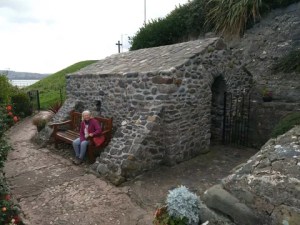
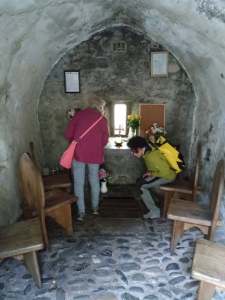 We planned to break up the journey home with a couple of stops, the first being a visit to the seaside resort of Rhos-on-Sea. We parked beside what appeared to be a recently refurbished promenade and set off for a stroll along its length. We paused briefly to watch a flock of cormorants diving for fish off a rocky stretch of beach, before coming across a little attraction we had discovered on a previous excursion but had since forgotten about: St Trillo’s Well and Chapel.
Described as the smallest church in Britain, the tiny chapel has seating for just six people. Dating from the early sixteenth century, it may have been built on the site of an older church, on the orders of the Cistercian monks of Aberconwy Abbey. It is dedicated to St Trillo, an early sixth-century saint with connections to the area. The altar stands above a natural spring, thought to have been an ancient holy well, whose water has been used for baptisms in the parish.
As we entered, we disturbed a lone woman praying at the altar, who promptly made her exit, presumably deciding that her devotions would be better continued in private. We stayed for no more than a few moments before resuming our exercise, moving on to the beach to hunt for shells, interesting rocks and, with any luck, buried treasure. Sadly, the latter remained elusive, and we returned empty-handed.
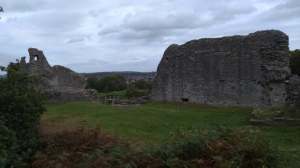 We rounded off our visit with a wander around the shops. Sue observed that, while considerable money had clearly been spent updating the promenade, the rest of the town looked rather tired and run-down. It seemed that the facelift had yet to extend beyond the seafront.
An hour’s drive brought us to Caergwrle Castle, where we paid our respects. Eleven years ago, we had scattered my mother’s ashes within its ruined walls. It hardly seems possible that so much time has passed. The council has carried out quite a bit of work around the ruins, improving the path by installing a railing and keeping the grass and bracken under control. The site is much improved from the neglected state in which we had found it a couple of years ago, making it a more fitting place to remember Mum.

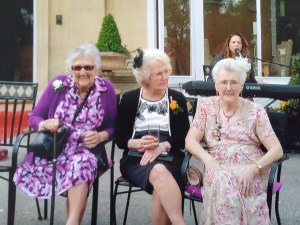 Another twenty minutes behind the wheel brought us to Aunty Josie’s home in the hilltop village of Brymbo. At 93, she looked remarkably well and was eager to hear all about our adventures on Anglesey. Shortly afterwards, cousin David arrived, providing a fresh audience for the stories and keeping the conversation going until it was time to tackle the longest leg of our journey home. We left armed with a collection of previously unseen photographs of my mother and her two sisters, a particularly welcome addition to the family archive.
Before leaving Brymbo behind, we made one further brief stop so that I could show Sue where I had dropped Lucas off during the summer. He had volunteered to help at an archaeological dig on the site of the old steelworks, and I thought it would be interesting for Sue to see where he had spent his time uncovering the past.
The remainder of the journey home proved to be a stop-start affair through Birmingham’s rush-hour traffic. Progress was painfully slow in places, but eventually, at 6 pm, we arrived back at Willow Bank, bringing our Anglesey excursion to an end. We had enjoyed a varied journey, with seaside strolls, a little history, a poignant return to a place of remembrance and, best of all, a family visit that had yielded some unexpected photographic treasures.
With such depressing international news flooding the media day after day, a quotation that popped up on my computer today offered little in the way of reassurance:
“I know not with what weapons World War III will be fought, but World War IV will be fought with sticks and stones.” — Albert Einstein.


Leave a Reply