5th June 2017
The Incas have not disappeared; they are still very much alive, particularly in Peru’s Sacred Valley. Their presence is most notable in the town of Ollantaytambo, which was the focus of today’s tour.
After breakfast, our group gathered in the foyer and set off for the day’s adventure at 8:00 am.
Our first stop was a challenging one. Chinchero, a small and picturesque village, is home to significant Inca ruins dating back to the 15th century, as well as an unchanged Catholic church. The difficulty lay in its elevation of 3,800 metres, where the thin air made walking around the village a breathless task for all but the locals.
Despite the altitude, the visit was well worth the effort. The views of the snow-capped Andes provided a stunning backdrop to the impeccably preserved Inca terracing. The church was particularly fascinating, as it remains in its original condition. The tapestries, paintings, and icons have been untouched since their construction. Unfortunately, photography was prohibited inside.
The church itself was dimly lit, which undoubtedly contributed to its preservation. However, it has, to my mind, a dark history. Built on the site of an Inca religious temple, nearly all traces of the original structure were destroyed, save for one small section of wall that still stands in a side chapel.

After navigating the gauntlet of eager local vendors lining the village streets, we returned to the coach feeling rather fatigued. Along with some others from our group, Sue and I sampled a delicious local treat, a village cheese served with sauce on a maize leaf, for the modest price of just 1 sol.


Our next stop, still at altitude, was the tiny village of Urpi. Here, we observed traditional Andean spinning and weaving techniques, an age-old craft passed down through generations. Naturally, there was an opportunity to purchase some of their beautiful handmade wares.
Continuing our journey, we made a brief stop at Racchi Point, perched high above the Sacred Valley on the mountain pass. Here, we paused to take photos and admire the breathtaking views before beginning our descent into the valley. The twisting road wound past numerous shelters and buildings precariously clinging to the mountainside. It was easy to imagine that one severe storm or even a minor tremor might send these fragile, poorly constructed little dwellings tumbling down to the valley floor below.

We arrived at Ollantaytambo after a short detour caused by a local ceremony. The site is one of the most iconic architectural complexes of the Inca Empire and holds great historical significance as the location where the Spanish Conquistadors suffered one of their rare defeats.
Ollantaytambo is renowned for its terraced fields, unfinished religious buildings, and its role as a formidable fortress. While it may not be as expansive as Machu Picchu, it is no less spectacular. The site offers remarkable examples of Inca ingenuity, particularly in the unfinished temple complex.
What makes it truly fascinating is the origin of its massive stones. They were quarried from a mountain across the valley, and from the temple complex itself, you can trace the stones’ incredible journey. The route they took down the mountain is still visible, as is the path they crossed over the river, the road constructed across the valley, and the ramp leading up to the complex. It’s a feat of engineering that remains nothing short of amazing.
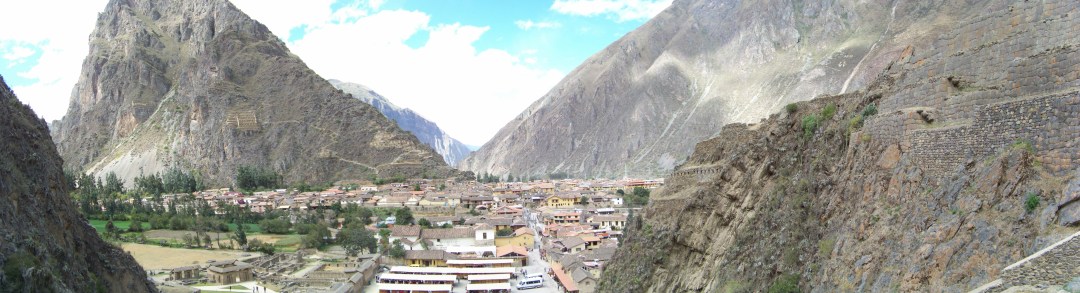


We explored the site before descending into the ‘only living Inca town,’ which stands as the best-preserved example of Inca urban planning.
As luck would have it, a local celebration entered the main square while we were there. It was a vibrant and colourful spectacle, with masked dancers cavorting among us. All the performers were men or boys, while the women, also dressed in ceremonial attire, were spotted at another location as we drove out of the town.
We would have loved to linger and take in more of the festivities, but unfortunately, the day’s schedule left little room for such indulgences.

As we drove through the valley, we stopped at a restaurant for an excellent rural Peruvian buffet meal. Afterwards, I came across two tethered llamas and decided to feed them what seemed like an entire meadow’s worth of grass. Llamas, as I discovered, have an impressive appetite for the stuff.
One of them had large, bulging eyes that immediately reminded me of Arsenal’s Mesut Özil. I couldn’t help but chuckle at the thought; it might well have been him on holiday! After all, footballers are known for their fondness for grass.

We returned to Cusco just as the sun dipped below the surrounding mountains. It had been an exhausting but rewarding day.
 Palmer Family
Leave a comment