

We were making our way to Aguas Calientes, the gateway for the final leg of our journey to Machu Picchu by bus. Our little train was packed to capacity, with everyone eagerly peering out of the windows, captivated by the spectacular scenery passing us by.
At one point, the train made a brief stop, giving us a chance to observe and photograph one of the most peculiar sights imaginable. Clinging precariously to the side of a sheer vertical mountain was a settlement, its existence almost defying belief. The only means of access appeared to be by rope, or so we guessed, as no other method seemed remotely plausible. It was a scene that left us marvelling at the ingenuity and resilience of those who called such a place home.

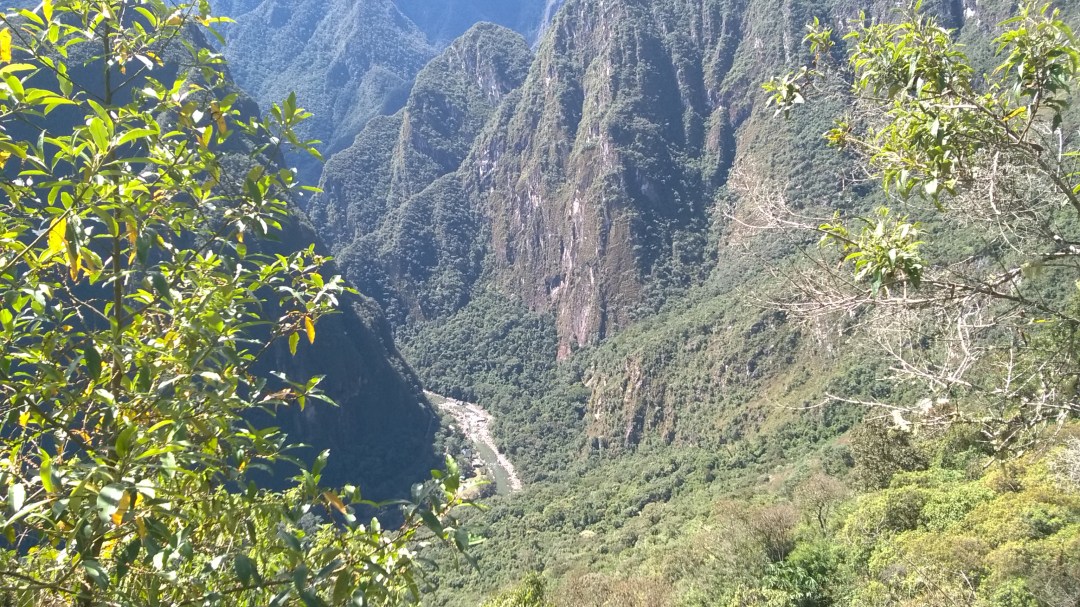
For the final two hours of our journey, we navigated a labyrinth of gaps between colossal, towering rock formations. These sheer, imposing giants were fringed with little more than grass, their strong roots gripping desperately to the rock face. There was no chance for trees to take hold in this rugged terrain.
Along the route, confusing side valleys and canyons branched off seemingly at random, forming what could only be described as the largest maze on Earth. It was a bewildering network, and we couldn’t help but marvel at how the Incas had managed to find their way through it. Even more astonishing was the thought of the Spanish, and later the American explorer, Hiram Bingham, navigating this formidable landscape to uncover the iconic site of Machu Picchu.
It was utterly awe-inspiring!
We arrived at our destination, a bustling little town with around 5,000 local inhabitants. Remarkably, there is no road access to this place; everything must arrive by the single train line, including the tourist buses that would later take us up to the archaeological site.
At the station exit, we were greeted by our guide, who led us to our hotel, El Mapi. This was not for check-in but merely a brief stop to drop off our overnight bags, should we wish to. Afterwards, we formed an orderly crocodile line and wound our way through the maze of narrow streets, which were thronged with other eager Inca enthusiasts.
Our destination was a waiting bus, parked just off the tiny central square, ready to take us on the next stage of our adventure. The air buzzed with anticipation as we prepared for the final ascent to the legendary site of Machu Picchu.

The bus journey took about 30 minutes, winding its precarious way up a narrow rainforest track to Machu Picchu. The lush greenery of the thick forest enveloped us as the bus climbed higher and higher, the anticipation growing with every hairpin turn.
Upon disembarking, a necessary stop at the loos was in order. The heat was intense, so I seized the chance to change into shorts and a T-shirt to better handle the sweltering conditions.
Then, following our guide, we entered the complex. For once, words truly fail to do justice to the experience. Machu Picchu is something you have to see and feel for yourself; no description can adequately capture its grandeur. I will leave it to the photographs and the video of our adventure to say it all. Video: 2017 Peru
We were privileged to wander the same paths and explore the same buildings that the ancient Incas, with their extraordinary ingenuity and craftsmanship, created so many centuries ago. It was a humbling and awe-inspiring experience, one that will linger in the memory forever. The Incas were truly master craftsmen.
Built in the 15th century under the reign of the Inca emperor Pachacuti, it sits high, around 2,430 metres above sea level. The site includes temples, terraces, and sophisticated stonework that demonstrate the Incas’ advanced engineering skills.
It is believed that Machu Picchu may have served as a royal estate or a religious retreat. It was abandoned in the 16th century, likely around the time of the Spanish conquest, though the Spanish never actually found it. It remained largely unknown to the outside world until American the intrepid explorer Hiram Bingham brought it to international attention in 1911.


Returning to Aguas Calientes, we enjoyed a buffet lunch before checking into the hotel. The heat of the day had taken its toll on Sue, so she rested in our room while I took the opportunity to explore a part of this small town. I returned just in time for our evening meal.
Joining the rest of our group in the restaurant, we shared a fine meal. However, the evening took a sombre turn when we discovered the horrific, terrorist events unfolding in London, orchestrated by radical extremists. Small minds, small people, their actions leave no meaningful legacy. Unlike the Incas, whose remarkable achievements endure, inspiring awe and wonder even 500 years later, such acts of destruction serve only as fleeting moments of darkness.
The following morning, we were treated to a leisurely breakfast at 8:00 a.m., a welcome indulgence! The day was ours to enjoy until 3:20 p.m., when we were due to catch the train back to Cusco. We spent the morning visiting a fascinating museum featuring paired (old and current) photographs of Machu Picchu. Each set displayed one image taken in 1912, when the site was first rediscovered, alongside a more recent photo from 2014.
It was captivating to see how the iconic site had either changed or remained unchanged over the decades. Immersed in these images, we found ourselves lost in discussion, reliving our fresh memories of this extraordinary place. It was a perfect way to reflect on the wonder of Machu Picchu before bidding it farewell.


Next, we explored the various markets and shops in search of presents. Along the way, we often bumped into other members of our group, taking the opportunity to stop, chat, and idle away a few moments under a warm sun in this glorious place.
Once our shopping was complete, we returned to the hotel to check out and then spent a relaxing interlude in the bar, quenching our thirst with refreshing drinks. Feeling revitalised, we embarked on another shopping mission, not for souvenirs this time, but to hunt down guinea pig, a renowned Peruvian delicacy.
After locating our quarry, we settled into a nearby restaurant to prepare for the culinary adventure. Sue, opting for a cautious approach, chose corn soup as her meal, leaving me to tackle the guinea pig solo. Its presentation on the plate is not for the faint-hearted; the upturned snout and protruding teeth made it abundantly clear that it had not enjoyed the encounter with death.
Nevertheless, spread-eagled on my plate alongside two large saffron potatoes and a vibrant medley of onions and peppers, the dish exuded a certain Inca authenticity. It felt like a meal steeped in history and tradition, and I was ready to embrace the challenge.

The flavour is somewhat like chicken, though eating it was no easy task. A knife and fork proved useless; you had to pull it apart, and even that required effort. These Peruvian guinea pigs are clearly built to last! Thankfully, the mocking head had been thoughtfully sliced off, which I strategically placed at the far end of my plate facing Sue while I dismembered and savoured my lunch.
I found it enjoyable, but it’s safe to say this was a once-only experience. We kept some of the leftover body parts, placing them in a plastic bag to share with a lucky dog later in the day.
After a quick dash to the station, we managed to catch our train that afternoon. The return journey was much the same as the outward trip, though it ended in darkness at 7:05 p.m. Upon arrival, our waiting coach transported us back to the José Antonio Hotel in Cusco.
Once checked in and unpacked (a luxury, as we were staying here for a few days and could finally put clothes in drawers), I took a short walk. During my stroll, I encountered a fortunate golden Labrador, who happily received the remains of my lunch. I couldn’t help but wonder if he had any idea what he was eating!
 Palmer Family
Leave a comment