7th June 2022
“It wasn’t quite such an early start today, we left the hotel at 8 am, heading for Fianarantsoa, one of the island’s largest cities. Although the journey was described as taking four and a half hours, we didn’t arrive at the hotel until 6 pm.”
 We began our journey with a tour of Antsirabe, stopping first at the old French train station before strolling down the central avenue leading to the Grand Hotel. We lingered for a while in front of a pair of monuments dedicated to the original tribes of the area. The Grand Hotel is still functioning, but from the front, it has clearly seen better days and, like much of the country, could do with some TLC.
Boarding our coach, we took a short drive to the city spa and pools. We were meant to observe the various healing processes offered there, but as foreigners, COVID-19 restrictions limited us to just a brief visit to the swimming pools.
Setting off on the journey proper, it wasn’t long before we had the first of several bush toilet breaks. These stops gave those who didn’t need to go the chance to stretch their legs and take photos of the surrounding scenery.
Our first scheduled stop was a fruitless search for carnivorous plants alongside a mountain stream. Despite a thorough inspection of the area, none were found, and we moved on.
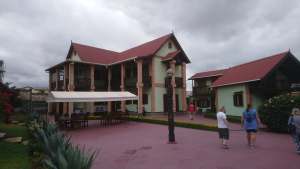 More successful was a visit to a small woodworking establishment, where we were treated to a demonstration of traditional wood carving and fretwork techniques. I found it quite interesting, and afterwards we had the chance to browse a small shop selling items made on-site, an opportunity Sue was happy to take advantage of. Just a few hundred metres from there, we had lunch at a local hotel owned by the gentleman who had founded the woodworking venture.
Our next memorable stop was to photograph egrets and herons in a stand of trees in the centre of a village. They squabbled loudly and fought ferociously to seize a perfect perch for their ungainly frames.
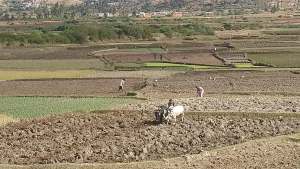 It was getting dark, and there was drizzle in the air, so we didn’t stay long, but long enough to attract a sizeable group of bemused locals, curious as to why we would be so fascinated by something they considered entirely ordinary.
We then settled in for a long stretch of lurching and bouncing along a winding, wholly unfit-for-purpose Madagascan road, en route to our destination: the Zomatel Hotel. While the authorities seem to accept that their road network requires no maintenance, we’ve occasionally encountered small children with shovels, tossing soil and rocks into the gaping potholes that pass for a road. Until now, these children had been on school holiday, but today, judging by the number of uniformed children we passed, they should have been in class. These impromptu road workers, who appeared to be between five and eight years old, all waved and shouted, pointing proudly to their small mounds of earth, urging our driver to drive over them to compact the surface. Are they skipping school for fun, or are they being paid for this patchwork maintenance?
As expected, we arrived at the hotel after nightfall. What Sue and I didn’t expect was to be allocated a penthouse suite, complete with a lounge, kitchen, bedroom, and bathroom, and offering fine views over the city. A shame we were only staying for one night. We dined in the hotel restaurant before turning in early, ready for another prompt departure in the morning.
8th June 2022
We left the hotel at 7 a.m. for a city tour. Fianarantsoa, at first glance, resembles most of the larger settlements we’ve passed through: narrow streets lined with darkened shops and crowded with street vendors. Whatever residential dwellings there are, tightly wedged between shops and stalls, appear poorly built and worse maintained. But given the challenges faced by so many of the country’s inhabitants, it’s clear that a fresh coat of paint and a tidy pavement are far from the top of anyone’s list of priorities.

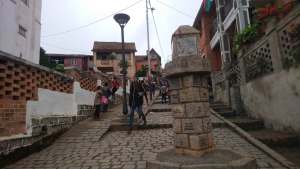 Disembarking from our coach in the old part of the city, we climbed upwards through busy cobbled streets to take in the first of six churches in this part of the town. Our guide informed us that the majority of the buildings around were built in the early 1800s, certainly not as old as those we are used to in Europe, but looking rather decrepit in comparison. We ventured into one to discover that the inside was rather plain, yet inspiring for the lack of any decoration. Children crowded the streets on their way to school, the air full of the chatter of excited voices as we squeezed our way along narrow alleyways. There was no doubt that we Europeans were a novelty and the focus of attention. Lots of smiles, waves, and ‘Salama’.
Returning to the coach, we followed the original road uphill to where the Queen’s Palace once stood (now long gone) and from the top, we took in the views over the city. It was still early, but the city had been awake for hours when the sun came up. People here begin work, it is the setting of the sun that sets their finishing time. Memory cards full of the panoramic scene in front of us, we boarded the bus and set off on a 4.5-hour drive to the south.
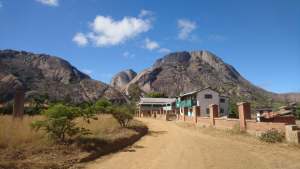 Today, we were heading to Ranohira, nestled in the Isalo Mountains. Along the way, we passed the sacred rock formations known as the Bishop’s Hat and its equally curious companion, the Kneeling Queen, both striking landmarks steeped in local legend and mystery.
The main focus of the day, however, was to see the Katta Lemurs in Anja Park, and we arrived there just after midday.
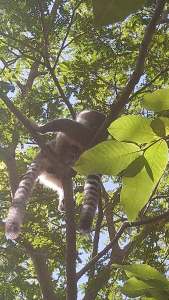 We had a gaggle of guides to help us track down these docile and beautiful creatures, though as soon as the coach parked up, we could hear their calls from the trees around. One of the guides latched onto my amateurish attempts to photograph these leaping ring-tailed bundles and took over my camera for the duration of our two-hour trek. I was grateful for the help, and it allowed me to observe these wonderful, placid mammals without the hindrance of seeing the world through an out-of-focus 2×2-inch frame.
The trail led us through dense forest, with bemused lemurs peering down at us from nearly every branch. As we reached the rocky slopes of the mountain, we split into two groups. Sue chose one, and I took the other. My group opted for the more challenging route, winding through narrow gullies and across a boulder field. We encountered an owl, peacefully asleep above the entrance to a cave we passed through, and were surrounded by an array of insects that provided plenty of opportunities for any enthusiastic photographers. Many of the caves we passed served as sleeping quarters for the lemurs, but in one, we stumbled upon an ancient tomb, the final resting place of two different mammals.
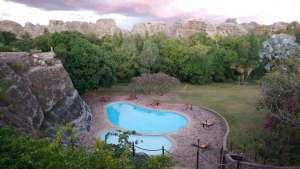
 I met Sue back at the start and she regaled on the number and variety of creatures that her group encountered over a packed lunch. All in our party exclaimed that this (so far) has been the highlight of our trip, such a privilege to see and be so close to these beautiful animals. Ahead lay another 5 hours to our next accommodation, the Hotel Relais de la Reine.
After a brief stop to purchase tickets for the following day’s activity, we arrived at our splendid hotel located within the Isalo National Park. The hotel, along with its gardens, was set amidst striking and beautiful sandstone rock formations, an ideal place to relax or explore. Once again, we had an early start ahead of us the next day, so after enjoying an evening meal in the hotel restaurant, we retired to our room, nestled in a quiet part of the garden.
9th June 2022
We were supposed to leave the hotel at 7:30 am, but breakfast was so substantial that it wasn’t until 8 am that the coach finally rattled up the driveway and onto the main road towards the next adventure on our itinerary. Today’s plan was to hike to a clear, natural water pool nestled within the mountainous part of the park.
It took us 30 minutes to drive to the turn-off, where we then bounced and juddered along a rutted and dusty road, heading toward a line of shimmering, towering cliffs we were about to explore.
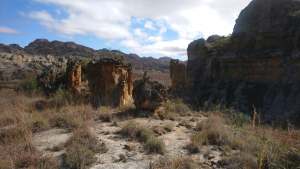
 Our route took us across a muddy river that I thought only serious 4X4 vehicles would be able to traverse, though getting stuck for a few moments with wheels spinning crazily, our driver managed to successfully convey his worried passengers to the far bank.
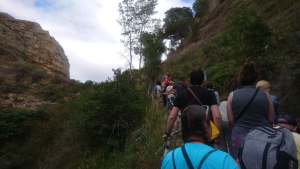
We had already met up with our guides for the day further down the road, so after parking, we quickly began stretching our limbs and tackling some challenging slopes. Our path led us toward a series of canyons that would eventually take us to the top of the plateau, offering magnificent views.
In the first of the canyons, we stumbled upon a small cave, where the local tribe would bury their dead in temporary graves. After several years, once the body had decomposed, they would remove the bones and place them in a permanent site high above the cliffs. This tradition was believed to allow the ancestors to enjoy breathtaking views in the afterlife, while also keeping watch over their descendants.

 It was a perfect day for hiking, and though the trail was strenuous, everyone in our group made it successfully to the pool. The crystal-clear water and stunning landscape invited us to dip our toes, and more. Some of the group took the plunge and swam, Sue rolled up her shorts and paddled, while I chose to relax on a rock with my binoculars, scanning the area for wildlife. In my earlier rush to catch the bus, I had forgotten my trunks in the room, and now I was paying the price.
Reluctantly, we left the cool respite of the water and continued along the trail for a bit. After a couple of kilometres, we branched off to meet up with a barbecue awaiting us.
A clearing in a wooded area had been prepared to furnish our group with food and drinks, and we were soon sitting, devouring zebu skewers, chicken legs, and rice salad. Very soon, the smell must have wafted on the breeze and attracted a troupe of Lemurs onto the roof of our gazebo and surrounding trees.
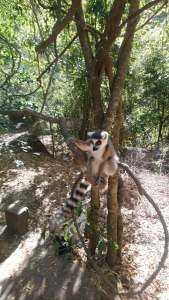
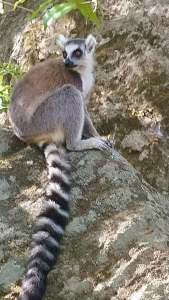 The Lemurs were brave and inquisitive, allowing us to approach closely enough for a photograph before they leapt away. We had been asked not to feed them, and we made sure to respect that request.
Once our meal was finished, our group split into two: one to hike to a waterfall, and the other to visit a traditional Bara village. Sue and I had chosen to visit the village.
We began with a half-hour hike along a wooded path that led us to the rickety, ancient minivan we would be taking. The seats were torn and lacked any stuffing, with the fabric of the vehicle seemingly held together by sheer hope. A 20-minute, cramped, bone-shaking ride along a dirt track brought us to a highway, and after another 20 minutes, we turned off the tarmac onto a field. From here, we followed a cart track overgrown with grass and strewn with rocks, making for an uncomfortable journey. Eventually, the van could go no further, and we had to walk the last couple of hundred meters to the small village of mud huts. Unfortunately, over the past hour, Sue had succumbed to illness and couldn’t manage the walk, so she stayed behind in the van.
 We met the chief of the village, who, accompanied by the other residents, walked us to their sacred tree. Here, through interpretation by our guide, he explained its importance in healing the sick of the village and the role of the wooden platform set behind it. It was this structure that, with the help of a special woman resident, exorcised the demons from those possessed.
Our tour continued with visits to some of the huts and an explanation of their basic features inside. Lastly, we visited the first hut in the village. Here, the strongest and bravest individual lives, whose job is to guard the village zebu against being stolen. The chief showed us the rifle that he used to fend off attackers, shooting through holes strategically placed in the walls. Even today, the youths of the tribes are not considered to be men until they have successfully stolen a zebu from another village. Some get killed for their efforts.
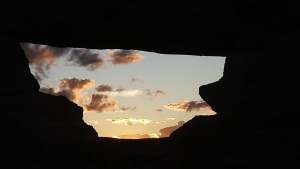 We bounced our way back in the van and then to the hotel, where we met up with the rest of our group before heading out to witness the sunset from the “Window of Isalo” (Sue stayed behind and went to bed). The rock formation, just a short distance away, frames the sun as it sets through a hole in the ridge. It was a pleasant way to end the day, although the sunset didn’t quite live up to the grandeur of the baobabs.
While Sue rested, I dined in the restaurant with the rest of the group. Unfortunately, another member of our party had also succumbed to illness, and it just so happened to be her birthday. Bad luck!
 Palmer Family
Leave a comment