28th February 2022
It had been quite a few years since I had driven for more than three hours on a journey, and this trip was no exception. Our target, the beautiful county of Durham, lay three and a half hours away, so an overnight stay in Knaresborough was planned.
We arrived at our accommodation at midday. The Kestrel is a pleasant country pub situated just outside Knaresborough, close to Plumpton Rocks. After enjoying salmon sandwiches and coffee, we drove the short distance to Knaresborough Castle.
Our journey was not without incident. As we neared the castle, travelling along a narrow lane that wound tightly through cottages clinging to the steep cliffside, we came across an unfortunate lady who had somehow managed to wedge her car across a low wall, effectively blocking traffic in both directions. I, along with a few other ‘patient’ drivers, attempted to lift her vehicle off the wall, but to no avail. However, on returning to our car and trying to find an alternative route, we discovered that in the meantime, reinforcements had arrived and had successfully managed to place her finely balanced vehicle back onto its four wheels.
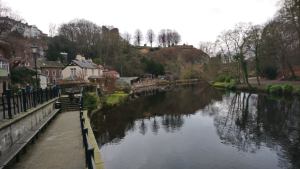
Having parked up, we ambled our way upstream along the very pretty River Nidd, passing beneath the ruined castle battlements and several bustling cafés. The climb up to the castle was a bit of a challenge, but we soon accomplished it with several stops to take in the views.
Over the centuries, the castle has served as both a royal residence and a prison for Richard II. It was largely destroyed during the Civil War, with only the King’s Tower and the courtroom surviving. Unfortunately, the tower and museum were closed for renovations, but the views over the river and the surrounding town were well worth the effort.
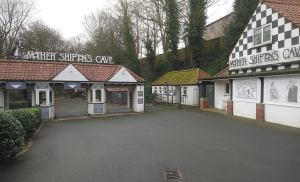
Descending once more to river level, we continued upstream towards arguably the town’s most famous attraction, Old Mother Shipton’s Cave. Old Mother Shipton, born Ursula Sontheil in 1488 during a violent thunderstorm, was the daughter of the 15-year-old Agatha Soothtale. She was said to be deformed and strikingly unattractive, with a pronounced hunchback and bulging eyes, attributes that, in the superstitious climate of the time, quickly gave rise to claims of witchcraft. In later years, she gained considerable renown for her prophecies, many of which were reputedly accurate.
Regrettably, the attraction was closed; at this time of year, it only opens at weekends, so a visit will have to wait for another occasion.
We returned to the car via the town centre, passing its charmingly preserved railway station along the way. We were greatly impressed by the visible layers of history and the rich architectural heritage of Knaresborough. A particular moment of amusement arose when we witnessed a rather dishevelled and evidently inebriated couple emerging from a Bentley, complete with an “HRH” registration plate, and staggering unsteadily across the town square. One might conclude that even the most exalted of personages are not immune to life’s indignities!
By 3 p.m., we had checked back into the Kestrel and elected to dine in the inn’s restaurant that evening.
29th January 2022
A comfortable night’s sleep was undisturbed by the storm that had raged outside, so it was with some surprise that, upon drawing back the bedroom curtains, we discovered the beer garden strewn with upturned furniture and collapsed trellises.
During breakfast, our waitress informed us that several of the roads leading into town were currently blocked by fallen trees. Further disappointment awaited: a quick check of the internet revealed that Richmond Castle, the highlight of our planned itinerary for the day, was closed due to extreme weather conditions. Hmmm…
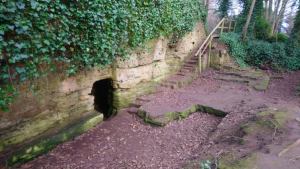
With one of today’s planned activities cancelled, we changed focus and, after breakfast, headed to nearby Plumpton Rocks, but alas, that too was closed! Battling a resurging wind, we returned to Knaresborough to visit Sir Robert’s Cave beside the River Nidd, a rare surviving example of a medieval hermit’s dwelling.
It is thought that King John, who frequently stayed at Knaresborough Castle, once visited Robert in his cave. Robert is believed to have lived there for thirty years. Although little remains apart from the cave itself, it was easy to imagine being transported back to the 12th century while exploring his modest abode. A fascinating site, and easily missed if you aren’t looking carefully.
Our journey northwards towards Richmond took us through increasingly blustery conditions, with leaves and small branches whipping dangerously across the road. Evidence of the previous night’s storm was everywhere: fallen trees had been chainsawed into neat piles at the roadside.
As is our custom, we first attempted to locate our accommodation for the night, the once-elegant Georgian coach house, the Black Lion Hotel, before setting off to explore. Thanks to the town’s one-way system and narrow cobbled streets, this was no easy task. After parking on the outskirts and walking into the centre, and following directions from a helpful barmaid, we eventually found the hotel’s car park.
Setting off to explore the bustling little town, we decided to circumnavigate the lively market square, which was full of Saturday stalls and locals hunting for bargains. We even managed to secure a few finds of our own in one of the many antique shops along the way.
After safely stowing our newly acquired treasures in the boot of the Mini, I fired up the GPS, and we set off on a trail that would take in the castle and Easby Abbey, one of the best-preserved monasteries of the Premonstratensian ‘White Canons’.
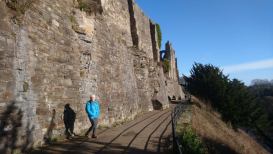
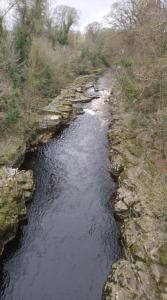
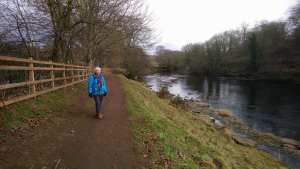
Leaving the base of the ramparts, we descended steeply through cobbled streets to river level, where we joined a well-trodden path alongside the watercourse. The River Swale at Richmond is wide, rocky, and fast-flowing, a formidable natural deterrent to any would-be aggressor. It also provides a delightful walk, with plenty to see, at least along the section we explored.
The trail was littered with fallen branches and twigs, and the howling wind above, rattling ominously through the treetops, made the walk at times feel distinctly unsettling.
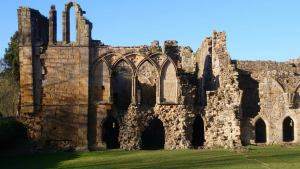
Reaching St Agatha’s Abbey (Easby), once painted by J.M.W. Turner, we spent some time exploring its extensive ruins before entering the still-active parish church within the grounds to admire its display of 13th-century wall paintings.
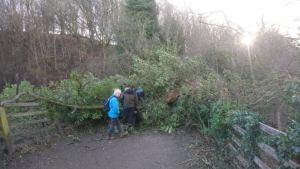
Continuing along the path, we soon encountered a large fallen tree, which blocked the route and necessitated some nimble clambering and crawling by runners, ramblers, and dog walkers alike. It added a little excitement to the day and served as a stark reminder of the power of the storm.
We crossed the river via an old railway bridge, following the line of the now-vanished track back towards Richmond. En route, we paused briefly at the old station, which had been tastefully and usefully converted into a restaurant and cinema complex. Checking the films on offer, we considered returning later in the evening for some entertainment.
After arriving back at the hotel, we enjoyed a very acceptable meal in its restaurant before heading once more to the old station to watch a 7.45 pm showing of Belfast, a story depicting a young boy and his working-class family experiencing the turmoil of late 1960s Belfast, based on the life of its director.
We came away feeling that the film missed a great opportunity to fully convey the grimness and tensions of life in Northern Ireland during that period and, as such, found it rather disappointing.
30th January 2022 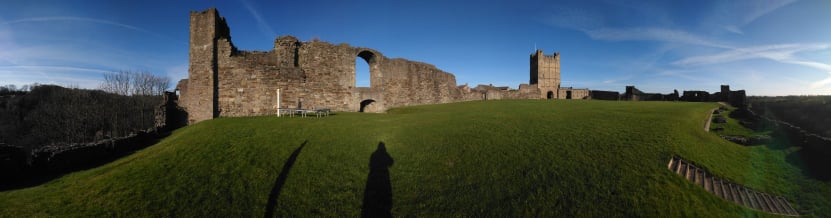
With Storm Malik having moved on overnight, we enjoyed breakfast at the Black Lion before walking the short distance to the castle, confident it would now be open, and indeed it was. We were first through the gate at 10 am, opting to visit the adjacent museum first. Although small, its displays and exhibits explained the castle’s history well and added greatly to our enjoyment and understanding during the subsequent tour of the various buildings.
Despite the sunshine, the breeze was bitterly cold, ensuring that we didn’t linger too long on the high ramparts. The castle was originally called Riche Mount, meaning ‘the strong hill’, and although today it stands as a shadow of its former self, the imposing 12th-century keep, symbolising the power and strength of its builder, Duke Conan of Brittany, still dominates the site. It was well worth our Malik-delayed visit.
Before moving on to our next planned venue, we took the opportunity to mooch around the Artisan Fair being held in the town centre.
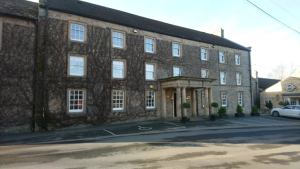
A half-hour drive then took us to The Morritt Hotel, situated in the pretty hamlet of Greta Bridge in the Teesdale countryside. A charming country house hotel, wedding venue, and spa, it was to be our accommodation for the night. The hamlet is famously associated with Charles Dickens, who stayed there and mentioned it in his novel Nicholas Nickleby.
Satisfied that we had located the hotel, we drove on to Barnard Castle.
As usual, we opted to take our evening meal in the hotel’s Dickens Bar and Bistro, and what a fine pie I had in such gorgeous surroundings. The walls were painted with amusing scenes by John William Gilroy (1868–1944), best known for his work with Guinness advertisements, and the roaring log fire added wonderfully to the atmosphere. The room exuded a cosy, old-world charm, providing the perfect backdrop for our last evening in Teesdale.
Content and pleasantly tired from the day’s exertions, we lingered over dessert and coffee, reluctant to bring an end to what had been an adventurous and memorable few days. With storms, fallen trees, medieval ruins, and historic towns, the trip had thrown everything at us, yet each twist and turn had only added to the experience.
The wind rattled the windows as we finally turned in, but cocooned in the warmth of the old hotel, we slept soundly, ready for whatever the next day’s journey might bring.
31st January 2022
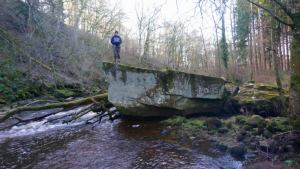 With another excellent breakfast consumed, we checked out of the hotel and, pulling on our walking boots, set off on a short ramble along the nearby River Greta to find the Scotchman’s Stone, the subject of a painting by John Sell Cotman and a poem by Mark Crowson.
Not a cloud marred the sky, but a residual, bitterly cold breeze from last night’s storm made for a shivery jaunt. Our path immediately took us through the remnants of an ancient Roman fortress, part of which must lie beneath The Morritt Hotel itself, though today it can only be detected through the gentle undulations and ditches in the adjacent field.
The stone is reached by a steep, treacherous side path that quickly descends through trees perched high above the watercourse. Deftly negotiating the descent, we found ourselves beside the subject of so much artistic musing. We guessed that this lump of limestone had originated from the cliffs far above the opposite riverbank millennia ago, tumbling its way down to its present resting place.
It was hard to see what made this particular rock so special, but it had provided us with an hour’s diversion, a burst of fresh air, and a little adventure, and for that, we were grateful.
This evening, we are staying at Walworth Castle, and that’s where we made our way next. After checking in and familiarising ourselves with the location, we moved on to our planned activity for the day: the nearby remains of a Roman bridge at Piercebridge.
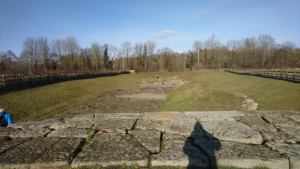
The site is easily reached from the car park via a short path that briefly follows the River Tees. Here, you can view the remnants of a substantial bridge that once carried Dere Street, the Roman road linking York with Corbridge near Hadrian’s Wall. Though time has certainly taken its toll, enough of the bridge remains to spark the imagination. Several informative boards help to explain what is visible and what has been lost to the ages. Very interesting indeed, and a fascinating glimpse into the engineering prowess of the Romans.
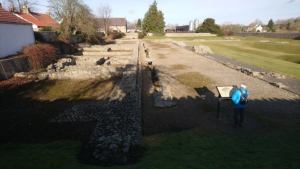
We moved on a short distance to the village of Piercebridge to explore the Roman fort and settlement that grew up around and protected the bridge. The fort, constructed around AD 260, likely replaced an earlier military facility on a different site, possibly known as Morbium, which is still visible today. The remains are excellently explained through a series of informative boards scattered around the site. It’s well worth a visit for anyone interested in Roman history.
Feeling the chill and in need of some warming exercise, we drove a short distance down the Tees to the small settlement of High Coniscliffe to begin a circular walk that followed part of the river. The river here is much calmer than the previous day’s experience, being shallower and wider, dotted with sandbanks perfect for wildfowl. The terrain was fairly flat, making for less interesting walking, and the wildlife, far wiser than ourselves, remained well hidden in their cosy hideaways. The highlight of this ramble, much to our amusement, was opening a tube of Pringles as we slowly chilled to the bone.
We were very relieved to check into the warmth of Walworth Castle and settle into Edwina’s bedroom, once occupied by Edwina Cynthia Annette Ashley, granddaughter of Sir Ernest Cassel and who married Lord Dickie Mountbatten in 1922.
That evening, we chose to eat in-house. The restaurant, situated in the old kitchen, retains much of its original character, with parts of the walls stripped back to reveal the castle’s original brickwork. The atmosphere, enhanced by subdued lighting and historical touches, made it easy to imagine the hustle and bustle of a 12th-century kitchen. When our order arrived, it turned out to be a feast! I’d planned to try the cheese board for dessert, but the sheer quantity of food on our plates meant there was no room left at the Inn. I now understand why they have 66 weddings booked for the coming year.
1st February 2022
Thankfully, breakfast wasn’t as hefty as last night’s meal, though still filling. After check-out, we headed south toward our next destination, Pontefract.
It was another blustery day, though not quite as intense as Malik and Corrie. The wind was strong enough to shift the car around on the A1 as we made our way. We arrived at our accommodation, the King’s Croft Hotel on the edge of the town, by 11 am to check its location before moving on to our first activity of the day: Pontefract Castle, which was built in 1070 AD by Ilbert de Lacy, who fought for William the Conqueror at the Battle of Hastings.
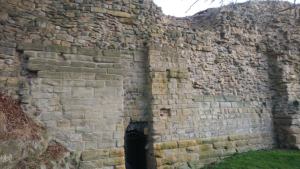
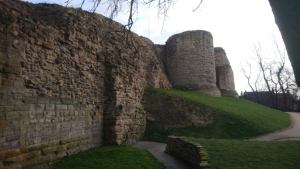
Thoughtfully, the entrance to the castle and car park is free, so even on such a windy day, there were quite a few visitors who were encouraged to brave the elements and take in a bit of history. As expected, the upper battlements were taped off (thanks to more Health and Safety regulations), and, annoyingly, the visitor centre wasn’t open on a Tuesday! However, we made the best of the situation by studying all the information boards and, for a bit of excitement, risking certain death by catching the views from on high. The wind whipped fiercely around us, making for an exhilarating, if slightly nerve-wracking, experience as we admired the sprawling views of the town and surrounding countryside.
Despite the chilly weather, the castle provided a great backdrop for a deeper dive into Pontefract’s rich history. Built after the Battle of Hastings by Ilbert de Lacy, Pontefract Castle once held considerable strategic and political importance, serving as a royal residence and military stronghold over the centuries. While we couldn’t climb to the top, the lower levels still offered a fascinating glimpse into the past.
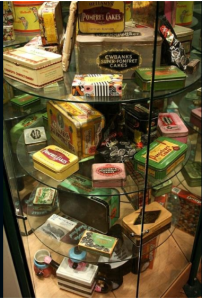
The town is well known for its production of the Pontefract Cake, and to discover more about this childhood sweet, we next went in search of the museum. After asking several locals, we eventually found our quarry in the town centre, and, wearing the obligatory masks, we explored this small but rewarding depository. A large display concerning the herb liquorice is the first thing you see upon entering. A side cabinet containing commercially produced jars, packets, and tins of this ‘wonder’ sweet took Sue and me back to the sixties and sparked a lengthy discussion about our favourite ‘Liquorice Allsorts’. Other displays included information about the castle (of course), holiday posters, and art-deco glasswork, all adding to the charm of the museum.
Moving on, we went in search of some ‘cake’ to buy and roamed the surrounding shopping area. We got distracted for quite some time by a large, multi-story antique establishment, which led us to delay our cake hunt. Resorting to Google, we located an establishment some 20 minutes walking time away and chose to return to the car and drive. Guided by our maps, we were disappointed to find that Google had misled us, taking us to a large food factory with no public outlet. Disappointed, we returned to our hotel and checked in, our cake search unsuccessful for the time being.
Lazily, we took our evening meal in the hotel’s restaurant. The wind had returned, encouraging us to stay in the warmth of the King’s Croft rather than risk hypothermia on a short walk into town in search of another place to eat.
2nd February 2022
We were among the last ones to have breakfast. A large wedding party from the previous day must have been early risers and keen to return home, as the carpark was quite empty, and many of the tables in the restaurant hadn’t been cleared, indicating a hurried departure.
Our journey home was SatNav-guided, and intriguingly, it decided that the ancient Great North Road was the route of choice. We were hoping to break our journey with a visit to one of the historical and natural attractions along the route, but upon checking each one as we approached using Google and our English Heritage handbook, we were disappointed to find that none were open this early in February. So, we continued on our way and were home by 11 am, wrapping up our adventure.


Leave a Reply