3rd June 2017
The alarm was set for 4:45 am, but like the rest of our group, we were awake by 3 am. Sleeping at altitude is not easy, breathing feels laboured, and the air is so dry that you find yourself needing regular drinks. We’ve partially acclimatised, as the headaches and random feelings of nausea have eased, but sleep continues to be a challenge.
We were second to breakfast at 5:05 am, and soon the others from our group joined us. Afterwards, we returned to our room to finish getting ready, took our suitcases down to reception, and waited for the transport. At 5:30 am sharp, we boarded the coach and made our way to the bus station in Puno, where we’d catch another bus to Cusco. This coach was modern, with toilets, WiFi, and a hot drinks facility, quite necessary, since we wouldn’t reach our destination until 5:30 pm that afternoon.
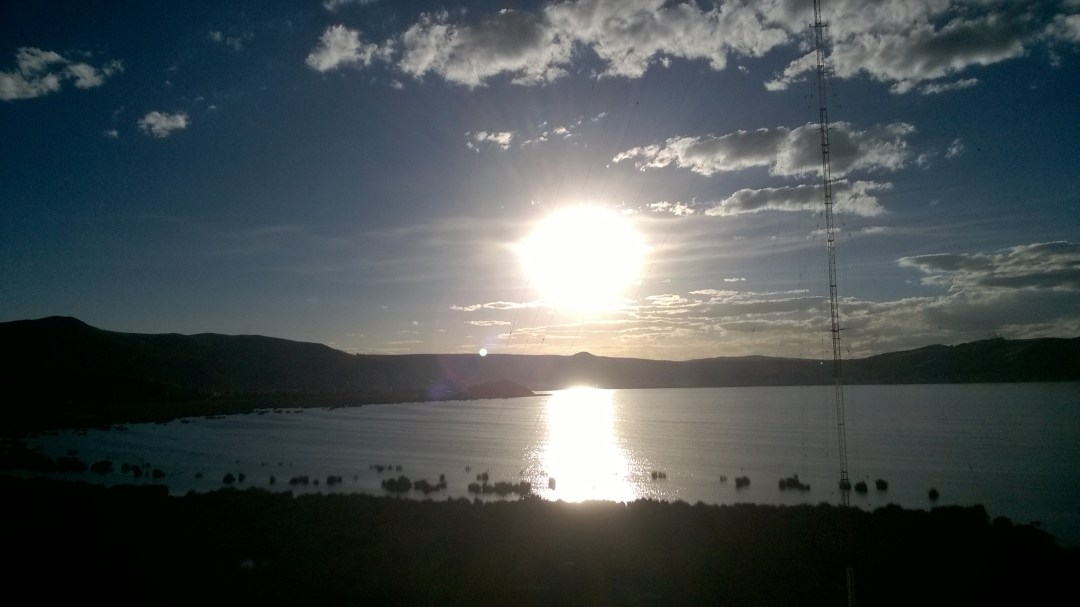
As we left Puno and Titicaca behind, the road wound high above the town, giving us a last look at the lake. Along the way, we would make five stops to visit various locations, one of which would include a restaurant for lunch.

The scenery we passed through was like something straight out of a David Attenborough natural history programme. It’s astonishing how the Peruvians manage to survive and thrive in such a challenging environment. Whether they notice the beauty and grandeur of their country as they go about their daily agricultural tasks is something I’d love to ask them. As a poorly-Spanish-speaking foreigner, I can only wonder.
The journey unfolded through all kinds of mountainous terrain, with blue skies and warm sunshine accompanying us. At the highest point of our route through Cusco’s South Valley, our guide pointed out that just ten years ago, this same route at this time of year would have been impassable due to snow. Now, the snow was confined to the very tops of the mountains on either side. The guide wistfully attributed the change to global warming. Ironically, on the very day of our journey, Donald Trump announced America’s withdrawal from initiatives to curb global warming. Well done, Donald, like your Disney namesake, you really are quackers!

Despite it being winter, Peruvian families could be seen working together in the fields, gathering corn, and tending to their flocks of sheep and alpacas. They work incredibly hard, and it’s clear they make the most of any available land. If a piece of land is flat, it doesn’t matter how precarious its location might be; they will put it into production. Reaching some of their fields at such high altitudes is truly mind-boggling. I can see why the Peruvian people are not a tall race; a low centre of gravity is certainly an advantage when navigating the steep, near-vertical tracks they use.
Our first stop was at an archaeological site to see an Inca step pyramid. We spent around 40 minutes there, learning about the Inca civilisation before climbing to the top of a tall building to photograph the site from a distance. I wasn’t overly satisfied with that, but what I found far more interesting was what was going on in the nearby village. They were holding a festival, and part of the celebration involved all the children (both boys and girls) having their hair done by an army of hairdressers, all lined up and working at the same time. It was such a novel and fascinating sight.

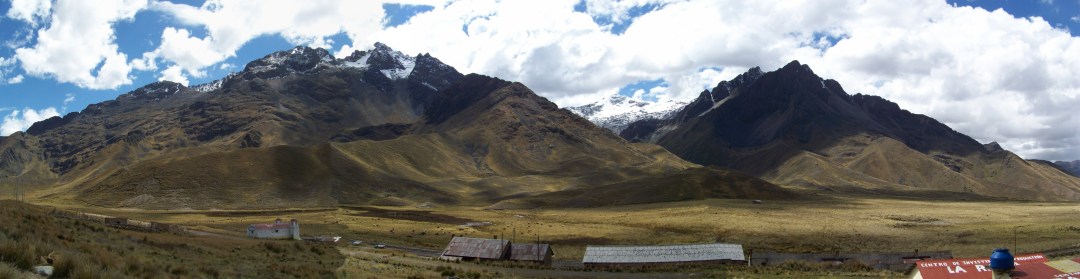
At La Raya, the highest point on our journey at 4500 meters, we made a brief stop for just 8 minutes to take photos. The air was so thin that, within minutes of stopping, headaches and nausea set in. The altitude was taking its toll on everyone, so the stop was kept short. Despite this, we managed to snap a few photos, and some of our group even purchased Alpaca trinkets from the stalls that had been set up for tourists at the top. It was a stunning location, but the altitude made it hard to fully enjoy the moment.
After the brief stop at La Raya, we made our way to a roadside restaurant next to a picturesque waterfall for lunch. The buffet was acceptable, but nothing too remarkable. Our guide predicted we’d sleep through the next part of the journey due to the altitude, but he was wrong. The scenery was far too captivating to sleep through. The stunning landscapes of Peru, with their vast, rugged beauty, kept us wide awake. I couldn’t help but wonder if the guide, being Peruvian, might take the grandeur of his homeland for granted, as the beauty seemed so intrinsic to the land itself.


Racchi’s archaeological site was truly fascinating. Known as the “Temple of God Wiracocha,” it was once a residence for Inca royalty, though it was destroyed by the Spanish. Despite the destruction, what remains is incredibly impressive, especially when we learned that the site was once covered in gold. The scale and architectural brilliance were awe-inspiring, and Sue and I both agreed that we could have easily spent an entire day exploring the site and taking in its history. It was a reminder of the grandeur and sophistication of the Inca civilisation before the Spanish conquest.


Andahuaylillas was our last stop, and it’s certainly a mouthful! The Catholic church there was magnificent, with an overwhelming amount of gold artefacts and icons. The artwork and murals were incredibly detailed and beautiful, but the church’s history carries a more troubling message. Built around 1500, it was used by the Spanish to convert the local population, with the narrative that Catholicism led to Heaven and staying with their indigenous beliefs would lead to Hell. While the church’s grandeur and artistry were awe-inspiring, the underlying message was uncomfortable. It’s a fascinating piece of history but one that reflects the darker side of colonialism.

We arrived in Cusco at 5:30 pm. We changed buses once more, this time to be taken to our hotel, the Jose Antonio, which is now firmly etched in our memory.
After checking in, Sue and I had coffee in our room and then packed in preparation for yet another early start. Tomorrow, we’re off to Machu Picchu, with a 4:30 am wake-up call.
 Palmer Family
Leave a comment