29th January 2017
We didn’t have to keep the heating on overnight. Down at this altitude, it was much warmer, and we slept well. I had to rise early for an appointment with a harness and cable, but Sue opted to stay snug in bed while I dressed and went down for breakfast. As I finished my curried potato pancakes, Sue arrived for hers, just as I departed with four of our group to walk to the meeting point for our morning activity.
After completing the obligatory disclaimer forms, we boarded a ramshackle minibus. We were joined by two young Chinese girls and a Nepalese from Kathmandu. As I’ve already mentioned, the roads here are atrocious, but this journey took it to another level. In fairness, the authorities are trying to improve the road, but working on the surface without stopping the traffic is downright dangerous, especially when any mistake could lead to a several-thousand-foot plunge to the valley floor. I suppose we tourists would have received high marks for style, but scored poorly on technique and execution!
Despite many near misses, and after passing the hotel we had stayed in Sarangkot (trekking up would have been safer), we eventually reached the top station of the Zip Flier.


It was a gorgeous day, no clouds and Annapurna across the valley looked as beautiful as could be against a blue backdrop. More photos were taken. We read from the information board, listened to the heavily accented Nepalese instructions, and prepared ourselves for the flight down.
We were to fly in pairs, and I was scheduled for the third flight. The two Chinese girls went first. After being strapped in and receiving last-minute instructions, the gate they were pushing against with their feet was opened, and they flew. Screams, I suppose, all the way down. I can’t be sure, as 1.8 km is a long way, and I lost sight of them very quickly as they disappeared into the landscape.

I was paired with the guy from Kathmandu. After the instructions, if you see a white flag, pull on the right-hand rope; if you stop, pull on the left-hand rope. Everything seemed straightforward. No problem there; I had no intention of pulling on any rope, and this Nepalese competitor was going to eat my dust!
As the gate opened, I figured I’d stolen a march by launching my body forward to gain momentum. That’s when the race was won. As he dwindled behind and I picked up speed, I felt the rush of wind increase, and the flesh on my face became increasingly contorted. Tears began to be forced from their ducts, but I couldn’t wipe them away, as I had to fight the straps to keep myself straight while simultaneously attempting to keep my legs straight and splayed out wide.
It then dawned on me that the instruction to keep my legs as wide as possible, which seemed counterproductive at the start, now made sense. Streamlining at this speed wasn’t needed; using my legs as air brakes was! I kept my legs out.


To be honest, everything is a blur. Trying to focus on your harness, while the scenery whizzes by with a howling tornado in your face, isn’t easy. I remember being told, ‘When you’re over the river, focus on the flag.’ Well, there was the river below, but where the bloody hell do I look for a flag? Oh, ‘s**t‘, there it is, too late, no point now. Goodbye, world!


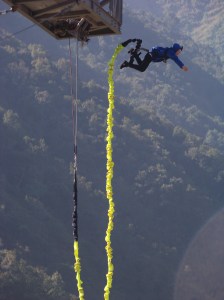
Oh, how did that happen? I stopped with hardly a judder. What was all that about at the top? If you don’t slow down enough, you’ll slam into the buffer, so you brake when you see the white flag. Perhaps miracles do happen.
After all of us had flown, we watched some Chinese tourists bungee jump from the platform in front of the restaurant. Most had to be pushed, and all screeched demonically on their way down. Asians seem to have a voice particularly suited to screeching.
The journey back to Pokhara was in a Land Rover and very uncomfortable, but thankfully shorter, as we had obligingly shed 1.8 km in height, which is the equivalent of several thousand bends in the road here.


I arrived back at the hotel to be greeted by Sue from the 3rd-floor balcony. We exchanged stories of our morning activities. She had been shopping and bought a jacket and a much-treasured Christmas bauble. After a coffee, we set off on a walk through the town and along the lake shore. We stopped at a restaurant and had a much larger lunch than planned.
We were joined at our table by a guy from Leigh-on-Sea, who I guessed craved some British company. He had just arrived from a 14-day trek around the high Annapurna and had only his sherpa for company. He showed us some of the photos on his camera, and we exchanged stories of past holidays. He was a postman who had saved up three weeks’ holiday, and this is what he did with it. Brilliant.
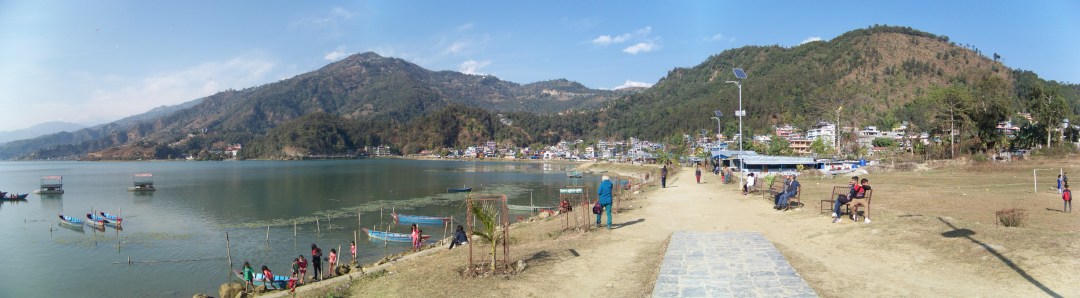
He finished his meal before us and moved on. We carried on with our low Annapurna trek around Lake Fewa, stopping at a bar when we came across a couple from our group. We had refreshments with them before returning to the hotel, Sue to watch BBC World News, and me to snooze.
Later that evening, we packed our cases in readiness for a very early drive to Chitwan and then took a walk into town to see and sample the Pokharan way of life for one last time. We stopped at a very comfortable bar, choosing pavement seats to watch life go by. I’ve been to some places, but this one is certainly different. Progress will change it, I’m sure; the Chinese will see to that, as they are certainly here in very large numbers. However, on an optimistic note, when we first started coming across the Chinese on our travels, we found them unique, different and odd, but over the years they have slowly become Westernised. I guess soon they’ll be no worse than your average stentorian American.
Returning to the hotel, we discovered most of the rest of our party still in the bar and much the worse for it. Glad we chose to say goodbye to Pokhara and headed off to bed, there was no alcoholic altitude headache coming our way!
 Palmer Family
Leave a comment