(20th March 2025)
Sue’s Christmas present from me was a couple of away days on the Suffolk coast, and it took until today for us to find the time to fit it in. Fortunately, we chose a run of forecasted warm, sunny days and set off from Willow Bank under blue skies at 10 am. The two-and-a-half-hour journey went smoothly, with the only hold-up being a half-hour delay crawling behind a wide load on the A14.
 On arriving at the Ivy House Country Hotel, we were pleased to find that we could check in immediately, as our room was ready. Instead of having a picnic on our planned ramble, we unpacked and scoffed salmon sandwiches and crisps in the room before pulling on our hiking boots, powering up my GPS, and setting off on a four-mile walk through the Carlton Marshes Nature Reserve. Our route followed the Wherry Lines Walk 7, which forms part of the Angles Way, a 93-mile trail that follows the Norfolk-Suffolk county boundary from Great Yarmouth to Thetford. The path was well-trodden and easy to follow as it meandered through the reedy marshland, a patchwork of grazing marsh, fens, peat pools, short fen meadow, tall fen (known as ‘tall litter fen’), dykes, pools, and scrub. Mostly man-made, these habitats have evolved over hundreds of years of traditional management.
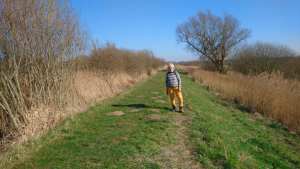 Within a quarter of a mile, we passed close by the Carlton Marshes Nature Reserve & Visitor Centre, elevated above the marshes, though on this occasion, we chose not to visit. Birdlife was abundant, with swans and mallards being the most prolific, though we also spotted a heron and some unusually bold coots. The sound of many hidden birds filled the air throughout our walk. This was a haven for nature lovers like us, and most of the people we passed were equipped with binoculars, many clad in camouflage clothing.
 The return leg of our walk followed the shore of the picturesque Oulton Broad, a man-made expanse of tidal water created from ancient peat diggings. Passing through the many static caravans of Tingdene Broadlands Park and Marina, we paused on a conveniently placed bench in Nicholas Everitt Park to enjoy the warmth of the spring solstice sun. A lone cormorant stood on a buoy, waiting patiently for some unfortunate fish to swim by. The park seemed an excellent amenity for both locals and tourists, with cafés, shops, and an abundance of water sports.
Moving on, we made our way along the road leading to Oulton Broad South Railway Station, where we rejoined the Angles Way. This took us back through the static caravan park before joining a narrow field path. We stopped briefly to chat with a couple of friendly horses, one of which amusingly stamped its front fetlock in an attempt to persuade us to feed it grass. A sign on the paddock fence politely requested people not to feed the horses, suggesting that, like us, many others had fallen for its antics in the past!
Back at the hotel, we relaxed in front of the TV until dinner at 6:30 pm in the restaurant, housed within a converted medieval barn. Though Sue wasn’t particularly fond of her dessert, I thoroughly enjoyed my meal and left feeling stuffed. We finished the evening watching TV in our room.
21.03.25
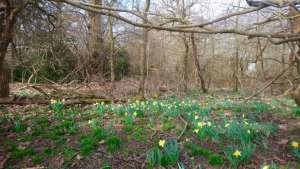 Forecast to be another bright and sunny day, we were at breakfast at 8 am. Sue enjoyed a full English, while I opted for Eggs Royale, accompanied by the usual cereal and yoghurt to provide those vital calories necessary to charge the leg muscles for another ramble. I had plotted a circular walk around Benacre Broad and its nature reserve, which includes the reedbeds and lagoons of Benacre, Covehithe, and Easton Broads, along with the woodlands and heathlands on the higher ground between them. It was just a fifteen-minute drive away, and we parked at the junction of two narrow country lanes near Holly Grove before pulling on our hiking boots. For most of the route, we followed the Suffolk Coastal Path, though a long section required us to tackle the beach below heavily eroded cliffs.

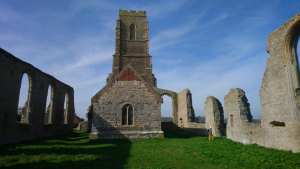 Passing alongside ancient woodland bedecked with daffodils, we came across the tiny hamlet of Covehithe and the ruined church of St Andrew’s. Once a glorious medieval church, St Andrew’s now lies in picturesque ruin by the sea, with only the lofty fourteenth-century tower (preserved as a sea mark) and a curtain of original walling surviving. It dwarfs a tiny 17th-century church, built against the tower within the shell of the larger structure, with an unusually thatched roof. We spent some time exploring inside the church and the ruins outside, along with its small adjacent cemetery.
Frustratingly, progress along our plotted OS trail was barred by signage indicating no access to the coast/beach across private land, directing us instead onto a path branching off from the edge of the hamlet. This added half a mile to our ramble, but the narrow path proved easy walking with pleasant views. Arriving at the beach, a fresh breeze prompted fleeces to be zipped and hands to be tucked into pockets. We slid down the low sandy cliff to sea level and set off up the coast, fruitlessly searching for shells at the water’s edge. Disappointed, we turned our attention to the base of the rising cliff face, where clear evidence of recent landslips suggested the potential for fossil hunting. While cuttlefish bones were in abundance, fossils remained elusive.

 A few dog walkers passed by, but after about a mile of beach tramping, we encountered a gentleman who warned us that the tide was turning. We had about half an hour to reach the point where we could leave the beach before being stranded. Picking up the pace, we abandoned our shell and fossil hunt and strode off purposefully. We successfully navigated around a small section of sandy bedrock that would soon have been awash with the incoming tide. After that, there was little danger of being cut off, as the cliff gradually reduced in height until it levelled out into a shingle and sandy strip between Benacre Broad and the English Channel. Here, we rested on a large driftwood tree trunk, recovering from our exertions while observing a great many swans gracefully sculling on the water. We were particularly fascinated by a lone, rare black swan just a few metres from the shore. A couple of skittish oystercatchers sifted along the water’s edge, only to fly off when we rose to continue our ramble.
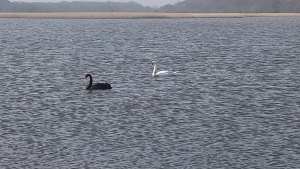 The Broad can only be viewed from this coastal strip, as access around its reedy banks is restricted by the Benacre Estate, with fencing and warning signage. After about 100 metres, the shingle bank gave way to a rising cliff, which our trail thankfully followed along the top. Evidence of recent coastal erosion was evident as we passed a WWII concrete bunker that had once stood atop the cliff but was now being washed by the waves some 50 metres out to sea.
Leaving the clifftop, we headed inland along what we both agreed was the least interesting leg of our walk: a concrete farm track through barren, early spring-ploughed fields. The final stretch back to the car was along a narrow, winding country lane. Sue’s legs gave out just half a mile short, so she took a rest by a field gate while I continued to fetch the car and pick her up before carrying on to the coastal village of Kessingland.
There has been a settlement in Kessingland since Palaeolithic times. Between the Hundred River and Latmer Dam was once a large estuary used by Vikings and Romans. At one time, the village paid a rent of 22,000 herrings to its Lords, making it more important than nearby Lowestoft. We parked at the Sailor’s Home pub next to the foreshore for refreshments before braving a chilly, stiffening breeze for a walk along the concreted seafront, admiring some of the expensive properties with magnificent sea views. A 100-metre expanse of littoral land, composed of sand, marram grass, and low gorse, lay between the sea defences and the shoreline, crisscrossed by several paths. On a less breezy day, we might have ventured across it to dip our toes in the sea, but today, we had no intention of joining the few hardy holidaymakers we could see through our binoculars.

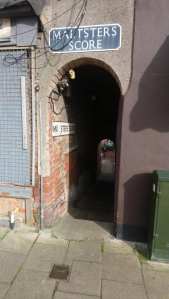 Satisfied we had seen enough and decided it was worth another visit on a warmer day with no easterly wind, we moved on up the coast to Lowestoft. We parked in the town centre, next to the main shopping precinct, with a ticket granting us two hours to explore. The pedestrianised area allowed us to browse the many retail outlets before crossing Artillery Way (A47) into the Old Town to investigate the ‘Scores’, ancient narrow pathways unique to Lowestoft that run from the top of the cliff down to the beach, allowing townspeople quick access.
Disappointingly, the area looked tired, with numerous vacant and dilapidated shops. However, the many plaques describing the history of buildings held our interest. One particularly amusing account detailed a dispute between a doctor and his patient, in which the patient rode his horse through the doctor’s front door. This historical part of town would benefit from pedestrianisation, encouraging more tourists and improving the facilities.
We returned to the Ivy Country Hotel after a brief stop by the Seagull Theatre, where we had booked tickets for that evening.
Dinner was at the Tramway Hotel, an eight-minute walk from the theatre. The food was excellent. The play was less so.
‘Rope’, the play that inspired Alfred Hitchcock, is a pitch-black comedy of murder and intrigue. The performance was in the round, and we were fortunate to have front-row seats within centimetres of the actors. I found the script clunky and difficult to relate to, and one of the principal actors was particularly poor, with little to no projection, making him hard to hear. Amusingly, Sue voted with her eyelids, dozing off during both halves. Only my judicious elbow prodding prevented her from slumping onto the stage. Fortunately, I think only one performer noticed. During the brisk walk back to the car, Sue remained alert and chatty. Despite missing much of the play, she agreed with my verdict: we have seen better plays and worse plays better acted.
22nd March 2025
We woke to a cloudy and chilly day. Breakfast wasn’t until 8:30 am, by which time we had packed for our return home and watched the early morning news. The restaurant was busy, with just two waitresses serving both dining rooms, yet they managed to keep on top of orders, and we were fed and watered without too much delay. We checked out early at 10 am, as Sue wanted to visit Carlton Marshes Nature Reserve Centre, which we had passed on our first day. It was only a five-minute walk, but we opted to drive since we would be leaving for home afterwards.
 Surprisingly, the car park was very busy, with the centre bustling with organised groups of all ages. Despite the cold, we spent about an hour following some of the well-maintained trails, visiting hides, and feeding toast (which Sue had surreptitiously saved from breakfast) to a pair of ducks. The journey home was uneventful, apart from a brief, heavy rainstorm that reduced visibility.
On reflection, we were fortunate to enjoy a couple of warm, sunny days and to have chosen such a conveniently located hotel. It was an ideal break to recharge the batteries.
RANT: No matter where you are, it has become nigh on impossible to ignore the idiotic, self-centred clown that the good people of the USA saw fit to elect as their representative. Like an unflushable turd, he has managed to spread his toxic presence into almost every corner of global affairs.
Whilst in Suffolk, seated upon ‘the throne’ and contemplating life’s great mysteries, my mind wandered to the acronym POTUS, the grand title bestowed upon the American president. It struck me that this particular occupant deserved something rather more fitting, something truly reflective of his character. And so, after due consideration (and a leisurely moment of inspiration), I present the revised definition:
Parasitic, Opinionated, Tyrannical, Unhinged Slob.
Perfect, don’t you think?
 Palmer Family
Leave a comment