17th December 2024
It was a partial sea day when we docked around 1 pm at San Juan port. The morning began leisurely for most passengers, with plenty of seating available in the buffet for breakfast, likely since the clocks had been put forward by one hour the previous night.
After breakfast, we attempted to book a time in the restaurant for our evening meal in the dining room, but all the slots had already been taken well before the cruise. Afterwards, Sue attended a question-and-answer session with the ship’s electrical and engineering team in one of the lounges, while I spent the time updating my past blogs.
One interesting fact that came up during the session was in response to a question about how the ship would deal with pirates. Although the boat didn’t carry any arms, there was a device located on the deck that could be pointed at any approaching pirate boat. This device would produce a loud and piercing sound that could potentially rupture the eardrums of the attackers.
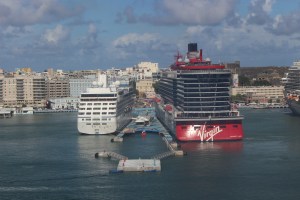
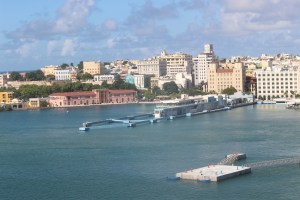 Straight after lunch, we disembarked from the ship. There were three other cruise ships in port, but thankfully ours was moored closest to the Old Town and Castillo San Cristóbal, a massive, 27-acre historic fortress that once protected the eastern gate of Old San Juan. It’s considered the largest Spanish fort ever built in the Americas. The temperature was a sweltering 30°C and promised to climb even higher.
We planned to start with a visit to the castle as part of a circular walk around the Old Town. We wound our way upwards through the city’s steep streets, eventually reaching the main gates, only to discover they were closed. Other disappointed tourists told us that the entrance was further along the castle wall to the right. Following their advice, we trudged 500 metres uphill in the blistering heat, only to find there was no entrance there either. Frustrated, we returned to the closed main gate, where I managed to catch the attention of a staff member through the railings. They informed me that the actual entrance was further to the left and up the hill.

 After another heated slog, we arrived at a large square with the entrance at the top of a ramp. The area was bustling with tourists taking photos, chatting in groups, and seeking shade wherever they could find it. The oppressive heat and humidity were relentless. At the ticket office, Sue decided against entering the fortress, so we agreed she would wait in the square while I went in alone. However, when I tried to buy the $10 ticket, I was told it was card-only. As I had only brought cash (as advised by the ship), I was unable to enter. Disappointed, I returned to the square, only to find Sue was nowhere to be seen.
 I scoured every shady spot, descended the battlements to check if she was sheltering below, searched the nearby shops, and even walked down the hill to a market, all to no avail. Thinking the worst, I returned to the square and rechecked the shaded corners. As a last resort, I climbed back up the ramp to the ticket office, and to my surprise and relief, I spotted her walking inside the castle! It turned out she had been offered a spot to wait inside and had accepted. Despite being drenched in sweat from my frantic and lengthy search, I had no trouble letting her know my feelings about not waiting where we had agreed.
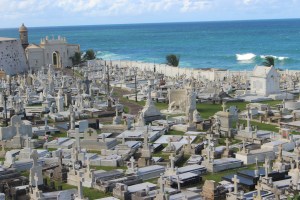 Next, we planned to visit Castillo San Felipe del Morro, commonly known as El Morro. This large fortress and citadel, built by the Spanish in 1539, served as a key defence for the city and was located a short distance from Castillo San Cristóbal. On the way, I stopped to photograph the ornate cemetery between the two fortresses, but ultimately decided to skip El Morro, suspecting they would also only accept card payments.
We followed the castle walls around the promontory, encountering numerous cats for which the town is famous. The views of the sea from the high vantage point were stunning, but would have been far more enjoyable on a cooler day. In search of relief from the heat, we ventured into the town along its unique blue cobbled streets, made from the slag of old ironworks. Eventually, we  stumbled upon the Catedral Basílica Menor de San Juan Bautista. Its understated charm, devoid of excessive gold ornamentation or grandeur, made it feel like a functional and welcoming place of worship.
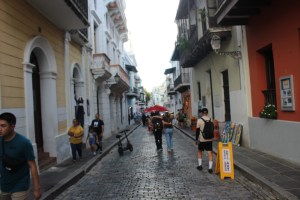 Continuing along the cobbles, we discovered the ancient entrance gate to the town and, shortly after, a small linear park where pigeons were enthusiastically fed by tourists. Hundreds of the birds strutted about, eagerly scavenging for dropped crumbs.
Gradually, we made our way downhill back to the port. By then, the clear blue skies had been replaced with patchy clouds, and the temperature had mercifully dropped. The lengthy queue to pass through security and reboard the ship was a final trial, but we were relieved to return to our cabin and a much-needed cooling shower.
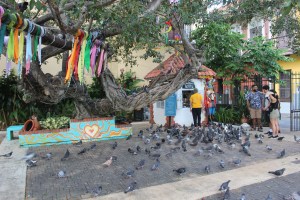 After our day in San Juan, we both agreed that we liked the place. The Old Town is picturesque, full of history, and has a lovely atmosphere.
That evening, we dined with our Canadian tablemates. To Sue’s surprise, the husband had worked at the same nuclear power station in Deep River, Ontario, as her uncle in the 1960s. Unfortunately, he couldn’t recall whether they had ever met. After dinner, we attended the 7:30 pm performance by Kuba, the multi-instrumentalist we’d seen the previous week. Disappointingly, it was the same show. Afterwards, we moved between bars, enjoying the various live bands before heading to the top deck to watch the ship depart.
To our surprise, the deck was wet; it must have rained while we were safely inside. We watched another cruise ship leave, but for some reason, the Nieuw Statendam’s departure was delayed. Eventually, tired from the day’s exertions, we descended to Deck 4 and retired to bed.
 Palmer Family
Leave a comment