12th December 2024
Sea days are the epitome of laziness, and this one was no exception. The ship offered a packed schedule of activities, but the most demanding task we undertook was a leisurely stroll around the upper deck after breakfast to gauge the day’s temperature.
Sue, ever the intellectual, attended a couple of talks on topics that piqued her interest, while I stationed myself in the atrium with my laptop, fiddling with photos and updating the blog. My morning exertion amounted to a coffee run and a brief pause to watch seabirds dramatically dive for fish near the ship’s bow, nature’s action film.
After lunch, Sue elevated relaxation to an art form, basking in the sun on the top deck while we temporarily swapped roles. I ventured into the world of shipboard lectures, sitting in on a surprisingly fascinating talk by the Cruise Director about Guglielmo Marconi, the Italian electrical engineer, inventor and physicist best known for developing the practical wireless telegraph system that would earn him credit as the inventor of radio.
We reconvened at a bar for a presentation on Nassau, our next port of call. Sue dutifully took notes in readiness for the following day, then decamped to another bar to read and enjoy the ship’s saxophonist’s swan song. He was disembarking to join another vessel, presumably one where the passengers also appreciated a jazzy farewell.
Intending to join Sue after a quick detour to the cabin to catch up on world news, I made the fatal error of lying down. One minute I was frowning at global headlines; the next, I was sound asleep. By the time I resurfaced, our musical rendezvous had become a solo outing.
Holland America Line has a couple of quirky traditions we haven’t encountered on other cruises. One evening is dedicated to the colour orange, in honour of their Dutch heritage, with guests encouraged to wear something orange to dinner. Fortunately, I had a silk shirt (from Vietnam) in the right hue. Sue, on the other hand, could only manage a pink patterned dress, close enough, we felt.
Today, the buffet on Deck 9 hosted “Cake Day”. The queue at the dessert station stretched the full length of the restaurant and into the lift atrium. I’ve never had much of a sweet tooth and fail to see the allure of calorie-laden patisserie, so I was quite content to find no queue at the salad and cheese counters. Sue does enjoy cake, but the sheer length of the line put her off, and she opted for other dishes instead.
It was noticeable, though, that the portions being served were far too large for most people to finish, and much of it ended up in the bin.
13th December 2024
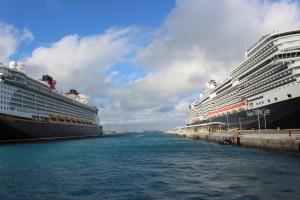
When we checked the ship’s cameras on our cabin TV before heading to breakfast, we could see that we were still at sea, though Nassau, the capital of the Bahamas, was already visible on the horizon. By the time we’d finished our morning meal, we had smoothly docked alongside a Disney cruise ship.
We disembarked just before 9 a.m. into a blustery wind, which made the walk along the pier rather bracing. Squalls whipped across the harbour, sending spume skittering through the air and making it feel more like the Cornish coast than the Caribbean.
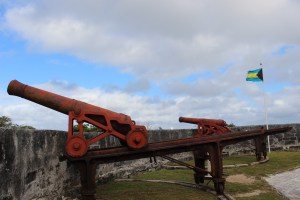
With Google Maps for Providence Island already downloaded to my phone, we set off for Fort Fincastle. Dating back to the 1700s, it’s one of the island’s oldest surviving structures. Built by Lord Dunmore to protect Nassau from pirates and rival European powers, the fort’s cannons were, rather anticlimactically, never fired in anger.
Perched atop Bennet Hill, Providence Island’s highest point, the fort demanded an uphill walk from the port. Thankfully, the wind kept the temperature down to a very manageable 23°C, making the climb an easy affair.
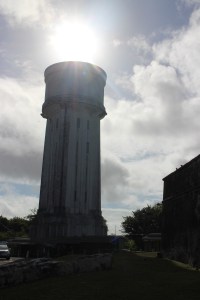

The town’s water tower shares the same hilltop as the fort and comes into view well before the battlements themselves. A small cluster of tourist stalls surrounded the fort’s walls and was just beginning to open as we arrived.
Entry to the fort cost $3, and access was via a short, narrow tunnel cut through the outer wall. As defensive structures go, it’s the smallest we’ve ever visited, and aside from the panoramic views from the top, there’s very little to see inside. A short video presentation plays in the rather gloomy powder room, and the information boards are tired and faded, with graphics that are barely legible.
After our brief tour, Sue browsed the market stalls and purchased a small trinket before we moved on.
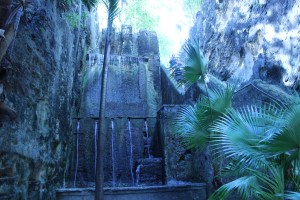
Next to the fort is the Queen’s Staircase, a 66-step flight hewn from solid limestone by hundreds of enslaved people. Intended as an emergency route to the fort, it was later named in honour of Queen Victoria. Sheltered from the wind, we strolled along the shaded ‘cut’ to the base of the steps, enjoying the cool microclimate. We paused to take photos of the artificial waterfall cascading beside the stairs before continuing to Bay Street, Nassau’s busiest thoroughfare, winding its way through the heart of downtown.
En route, we stumbled upon the Bahamas Historical Museum. After paying the $5 entrance fee, we were guided for an hour by the volunteer curator on duty. The exhibits, all donated by local residents, may not have been the most polished or visually captivating we’ve encountered, but the curator’s stories, deep knowledge, and personal insights made the visit thoroughly engaging. He even offered us tea, coffee, and biscuits, and in return, we bought a couple of books from his modest little shop.
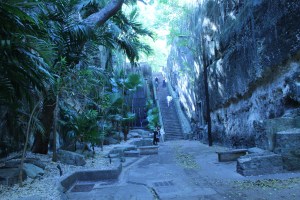
Continuing along Bay Street, we joined the throng of tourists, passing the Pirate Museum and the Straw Market before making our way onto West Bay Street. From there, we took Mount Bethel Way towards Fort Charlotte. Located west of downtown Nassau, it is the largest of the three remaining forts and commands a commanding position atop a hill overlooking the entrance to Nassau Harbour. Fort Charlotte is a complex made up of three parts: the main eastern fortification (Fort Charlotte), a middle bastion (Fort Stanley), and a western outpost (Fort D’Arcy).
After paying the entrance fee, we were shown around by a young student who delivered a rehearsed script at each point of interest. This fort is significantly larger than Fort Fincastle, although its cannons, like those at the smaller fort, were never fired in anger. The exhibits within the walls were better maintained, and the signage was much easier to read, though our knowledgeable guide made them largely unnecessary.
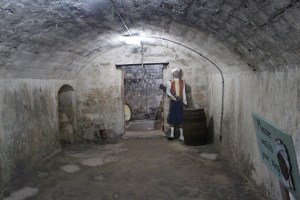
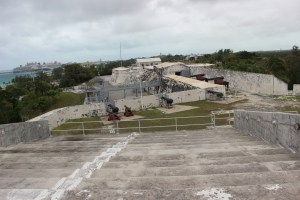
Leaving the fort, we made our way back into town along a route that took us past the beach and through the shopping district. We paused to listen to a beach party and make use of the facilities before returning to the ship for lunch.
That evening’s meal was the last dinner of the cruise for many on board, as we would be docking in Fort Lauderdale the following morning for disembarkation and their journey home. We were seated at a table with three men, but the conversation was strained, the meal was filled with awkward silences and stilted small talk. It was a relief when they left to pack, allowing us to enjoy our coffee in peace. Our five-hour walk earlier in the day had tired Sue out, so we decided to forgo the evening shows and relax in the cabin until sleep gently crept over us.
 Palmer Family
Leave a comment