7th June 2024
Despite staying in a lovely hotel and a sumptuously furnished room, we slept poorly. The constant travel, time zone changes, and a general lack of sleep from so many early starts meant my mind refused to settle into anything resembling a REM pattern. A disagreement over which (if any) optional tours to book in the Galápagos, along with an intermittent noise from our room’s refrigerator that closely mimicked a lawn mower starting up, didn’t help matters. By 5:30 a.m., I gave up, showered, and joined Sue in the restaurant for an early breakfast.
To my surprise, several other members of our group were already there. No doubt the relentless pace of the itinerary, and perhaps deliberations over how best to spend the unexpected extra day we’d been gifted on the islands, had also kept them from sleeping soundly.
Our bus to the airport departed punctually at 7:15 a.m., taking around 45 minutes through fairly busy morning traffic. It was interesting to observe the various districts we passed through, buildings clinging to the sides of deep, dry ravines that cut through the sprawling city like slashes from a giant’s axe. The ravine walls were clearly unstable in places, some being sprayed with concrete, others reinforced with matting and planted with cacti and other hardy herbaceous plants. The topography dictated a winding route along the canyon edges, repeatedly looping across bridges in sharp U-bends before continuing in the opposite direction.
Quito is evolving into a modern city without resorting to the kind of towering skyscrapers that would, sadly, obscure the magnificent backdrop of mountains and volcanoes. One hopes the city planners ensure it stays this way. The more affluent areas featured well-designed, low-rise housing estates and modern commercial buildings with colourful façades and innovative architecture, while poorer districts were characterised by unpainted concrete structures with tin roofs.
It was shaping up to be a beautiful day in Quito, but our flight was scheduled for 10:45 a.m., first to Guayaquil, and then onward across the Pacific Ocean to the Galápagos Islands. After having our luggage scanned, our guide organised the first of two required tourist permits to enter the islands, which cost $20 each. We then proceeded through Passport Control and a further baggage screening before entering Departures. Much like in any other capital city, though on a smaller scale, we passed through a corridor of gift shops and eateries with an Ecuadorian twist. Sue and I were the first to navigate the terminal and find a suitable place to sit and wait. Before long, the rest of the group joined us and resumed the conversations that had begun on the bus.
The flight was full and departed half an hour late. With just a 30-minute flying time to Guayaquil, we soon descended and watched as about a third of the passengers disembarked, to be replaced by new travellers joining us for the second leg. On the first stretch of the journey, we were offered a tiny bag of nuts and a cardboard cup of water. On the second, the nuts made a return appearance, this time accompanied by a choice of soft drinks or coffee.
We landed at San Cristóbal’s small airport soon after passing over a neighbouring island that, from the air, appeared uninhabited. San Cristóbal Island, also known as Chatham Island, is the easternmost and geologically one of the oldest islands in the Galápagos archipelago. On arrival, Passport Control relieved us of $100 each for the privilege of visiting. Our luggage was then laid out on the tarmac while a very enthusiastic sniffer dog bounced excitedly between the cases, checking each for drugs. Two bags were pulled aside by the handler before we were invited to collect our belongings and continue on our way.
The group met our new guide just outside the terminal building, and we were soon aboard a bus, wide-eyed and taking in the scenery during the short ten-minute drive to our accommodation, the Galápagos Planet Hotel. Our room was neat and tidy, with an air-conditioning unit that proved highly efficient. We were given twenty minutes to change into shorts and T-shirts before regrouping for a briefing and a walk into the town and along the beach.
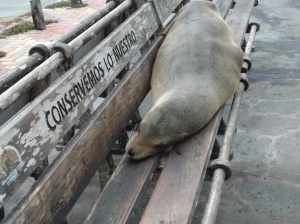
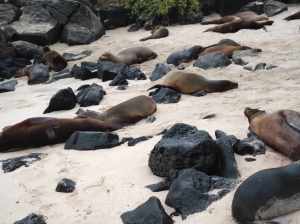
First impressions of San Cristóbal were very favourable. The town of Puerto Baquerizo Moreno is a smart and well-kept settlement, a little rough around the edges in places, but that’s easily forgiven given its remoteness. It was the beach and harbour that truly stole the show. Within seconds, we were greeted by the unmistakable sounds of sea lions: some were bellowing in territorial disputes, others, younger ones, crying for their mothers and milk, and a few voicing general displeasure at those around them. Most, however, were sleeping, many stretched out comfortably on the sand, some sprawled across the boulders that form the breakwater, a few lounging on benches and tables clearly intended for their human neighbours, and the rest flopped lazily across the pavements, forcing pedestrians to weave carefully around them.

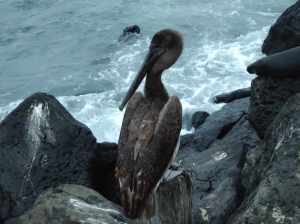
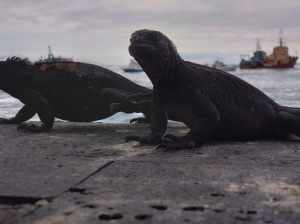
Though these contented, flippered mammals had initially captured our attention, it was soon diverted to the many iguanas, standing motionless like statues along the seawall and among the sea-washed rocks. Then we spotted pelicans, looking regal with their long beaks, and frigate birds wheeling overhead. A little further out to sea, Boobies could be seen diving for their lunch. Marvellous! It’s no wonder this place fired Darwin’s imagination.
As a group, we ambled towards Playa Mann beach, picking our way past slumbering sea lions, cameras snapping at every opportunity. Upon reaching our destination, we naturally drifted apart, each heading off to explore at our own pace. Sue and I opted to sit at one of the beachside restaurants for a much-needed meal of prawn ceviche and battered shrimp, before venturing onto the sand amongst the sea lions. The sun was beginning to set as we moved through them, listening to their cries and watching the youngsters playing in the surf, their behaviour at times strikingly human.
It was dark by the time we made our way back into town, which, in true Spanish style, was just starting to come alive. Music and dancing filled the harbour front, and the bars and restaurants were beginning to buzz. At one point, unsure if we’d lost our way, we asked a young Galapagueña for directions. To her and our amusement, we were barely 20 metres from the hotel.
With a significant sleep deficit to address, we called it an early night.
8th June 2024
We slept well and late. Breakfast was served in the open on the top floor of the hotel and consisted of fresh fruit, cheeses, and scrambled or fried eggs. The morning was warm, and the meal perfectly suited the climate. We sat with the British-American couple and, as usual, found ourselves chatting about past holidays.
As nothing had been planned for the day, we decided to visit Playa Punta Carola, a little further along the coast than we had walked the previous day. We wandered leisurely through the town, browsing some of the tourist shops and taking yet more photos of the animal life on the beach and rocks. It’s endlessly inspiring how utterly unbothered they are by us, these supposedly dangerous humans. They refuse to move out of our way, seemingly indifferent to our presence.
Even when people attempt to mimic the calls they make to one another, as I’ve heard other tourists do (and have admittedly tried myself), the animals barely flick an ear. You get the distinct impression that they’ve heard it all before, and it’s neither amusing nor worth a glance.
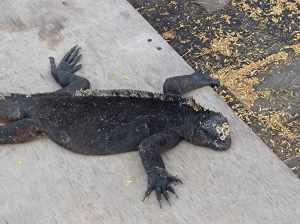
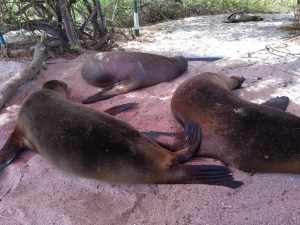
By the time we passed Playa Mann, the temperature had climbed into the mid-twenties. We continued along a dusty track that first led to a small concrete pier, deserted except for a few idle seals, hundreds of crabs, and several marine iguanas. After a few more photos, we moved on, following a narrow, volcanic, rock-strewn path that wove through a dense tangle of shrubs adorned with pretty yellow flowers. The path ended beside a large bush, beneath which a pair of hefty sea lions were dozing in the shade, nestled among the gnarled ground roots.
The sandy beach beyond sloped steeply down to a barrier of scattered rocks, over which the waves rhythmically frothed before creeping a little way up the shore, then easing back into the calm, blue Pacific. Naturally, sea lions were everywhere, most of them dozing at the water’s edge, but a noisier few were cavorting in the surf beyond the rocks. A handful of humans had also sought refuge from the sun beneath the low bushes that bordered the top of the beach.
Sue chose to do likewise, while I set off to explore the far side of the little bay. I paddled and photographed my way to a small lighthouse, then followed a sandy trail that ended at a dead end, where I took a picture of a large, rather impressive boat anchored just offshore, no doubt the toy of some billionaire.
Backtracking, I found another route which eventually led, via a concrete path, to a signposted Tsunami Evacuation Route. Taking a break in the shade on a bench, I chatted to a couple of lost Americans and pointed them in the right direction back to civilisation.

Returning to Sue, we retraced our steps to the bar where we’d had lunch yesterday and quenched our thirst before visiting a small supermarket to buy a packet of banana crisps and some nuts to snack on back at the hotel.
It had been a hot and sweaty morning, so as soon as we got back to the Galapagos Planet Hotel, we showered, nibbled our booty, and fell peacefully into a deep sleep.
A couple of hours later, feeling refreshed, we headed back into town. The sea lions, crabs, iguanas, and birdlife here are endlessly fascinating; you really don’t need any other form of entertainment. We stood for ages watching their antics. We were so close that we could easily have broken the number one Galapagos rule: DO NOT TOUCH THE WILDLIFE! We’d been warned within minutes of landing that failure to comply would result in a swift flight off the island and a hefty fine.
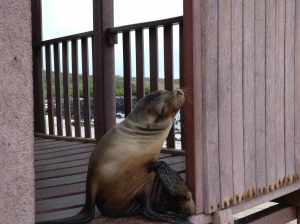
Tickets please to the beach!
Between bouts of wildlife-watching, we indulged in the rather more costly tourist pastime of shopping. Around 7 p.m., we returned to the restaurant we’d chosen earlier in the day and enjoyed another superb seafood meal. Later, back at the hotel, Sue treated herself to an ice cream while I found a T-shirt I liked (though do I really need any more?).
9th June 2024
Sue woke early at 6:30 a.m. and went up for breakfast at 7. I slept on for a while longer, but joined her around half an hour later. She was the only one in the breakfast room, though a waiter was already busy preparing for the expected onslaught of hungry patrons. Even half an hour later, we were still alone, almost finished with our breakfast, when the first of our group finally appeared, followed by others trickling in one by one.
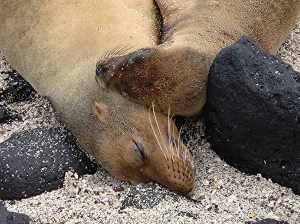
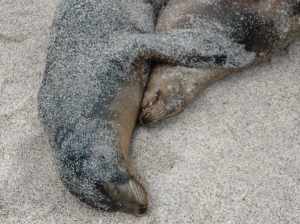
Motherly love
 Back in our room, we got ready for the morning’s excursion to Playa Lobería. We were due to meet the rest of the group at 9:30 a.m., and were duly seated in the lobby with three other group members. A hotel staff member asked what we were waiting for and pointed out that it was only just after 8:00 am. Confusion ensued, our mobile phones were still on Ecuadorian mainland time, and we hadn’t realised that Galápagos time is one hour behind.
Sue stayed in the lobby and chatted to pass the time, while I took the opportunity to return to our room and grab a short nap.
The group left by bus at the correct time, and within a few minutes, we had arrived at our destination. Playa Lobería is a picturesque mix of sand and rock, accessed from a small car park via a 300-metre-long path. The sheltered bay is popular for snorkelling and is the only beach on the island suitable for surfing. As expected, there were the usual sea lions and marine iguanas, along with a good variety of birdlife.
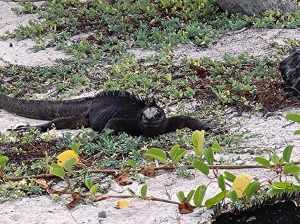

Some members of the group took to the water and later reported seeing parrotfish and manta rays. Sue chose to sit on a log and soak in the surroundings, while I decided to explore the bay and beyond. Crossing the bay, I photographed a few iguanas, marvelling at how, despite their considerable size, they blend so well with the volcanic rocks. Since they tend not to move, there’s a constant risk of stepping on one. I continued to the headland, though I didn’t see much more of note, so I retraced my steps to rejoin the group, who were beginning to gather after their chosen activities. On the way back, I paused to photograph a lone, brave surfer, risking life and limb by attempting to board at low tide, when the rocky seabed lay exposed.
We were back at the hotel by 11:30 a.m. (Galapagos time!). I opted for a cold shower to refresh myself after my coastal ramble in the heat, while Sue caught up with her emails, comfortably stretched out on the bed.
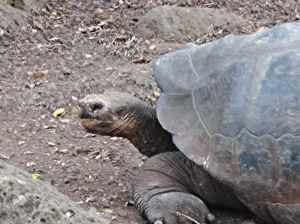
At 2 p.m., we rejoined the group for a 45-minute drive to the Centro Crianza de Tortugas Terrestres (Giant Tortoise Sanctuary). This breeding centre is dedicated to the conservation of the giant tortoises native to San Cristóbal Island (Chelonoidis chathamensis). Around 50 adult tortoises and their young live here. The sanctuary is located in the fertile highlands, and although the upper slopes were shrouded in mist today, the centre itself was thankfully clear.
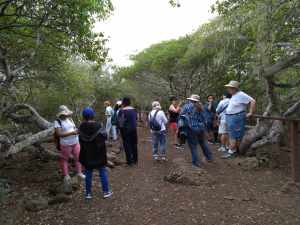
An 800-metre circular path winds through its two hectares, passing by two of the feeding stations where the tortoises are given food three times a week. We were accompanied by a knowledgeable guide from the centre, who fielded all our group’s questions with enthusiasm. It took nearly two hours to complete the circuit, spotting the tortoises among rocks and the twisted trunks of trees, finishing at the compound where the very youngest tortoises are kept.

Next, we boarded the bus for a ten-minute journey towards the coast, stopping at the start of a downward path leading to a beautiful sandy beach. We spent about half an hour among the sea lions and fellow tourists, snapping photos and climbing the small hill on one side of the bay. The sea here wasn’t suitable for snorkelling, so our stay was brief.
We returned to the hotel in time to freshen up and change before Sue, and I walked into town for our evening meal. We had planned to dine at the restaurant from our first day, but after a long walk, we found it closed, as were many other places we passed. It was Sunday, after all! So we retraced our steps and returned to the restaurant where we’d eaten the previous night, enjoying another excellent meal. On the way back to the hotel and bed, Sue treated herself to an ice cream.
10th June 2024
This morning dawned with a clear blue sky and hot sunshine! We weren’t the first down for breakfast, having adjusted our phones to Galapagos time, back in sync with the Galapagueños!
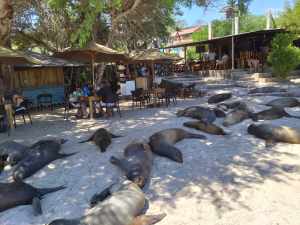
 Leaving the hotel, we headed into town along the seafront, eager to watch and listen to the antics of the resident sea lions. They are endlessly fascinating, especially the playful youngsters who seem to spend all their time playing and suckling. The females mostly sought shady spots for a snooze, while the large males tried to bully one another and chase off any young challengers. The birdlife was fearless; having them so close, completely indifferent to our presence, was both sweet and strangely unsettling. The lizards and iguanas were like statues, utterly unflinching, no matter how close you came. The larger ones stood their ground, while the smaller ones grudgingly scurried a few feet away. All this unfolded right on the promenade, amid shops, restaurants, and passing traffic, the animals clearly knowing they are untouchable here.
We returned to the Centro de Interpretación on Playa Mann as our starting point for a trek to Cerro Tijeretas, a hill rising to around 200 metres just north of Puerto Baquerizo Moreno. From the viewpoint at the top, you can enjoy sweeping views of Puerto Baquerizo Moreno, Lobos Island, and León Dormido. The hill is home to many frigate birds, locally nicknamed “Earwigs” because of the distinctive shape of their tails, and we were keen to photograph them up close.


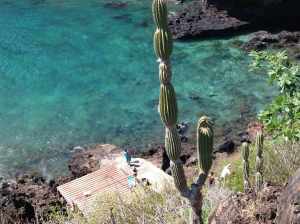
The path from the Interpretation Centre winds its way through the volcanic landscape and is a real pleasure to follow. The walking is mostly easy, although the latter section becomes quite steep. Along the way, the shrubs and cacti make for lovely scenery, but you have to tread carefully to avoid their needle-sharp spines. Just below the summit, there’s a viewing platform, from which we enjoyed splendid views over the town and seascape, and managed to capture some excellent photos of frigate birds in flight. From the summit itself, we spotted a statue of Charles Darwin standing atop a smaller hill to the left of a rocky bay nestled beneath our viewpoint. That was our next destination.

Thankfully, there was plenty of shade provided by the larger bushes, cacti, and trees, as well as regular benches to rest on. The heat was building, and the sweat was pouring. We took our photos of the great man before descending to the rocky shoreline and platform to meet the local sea lions. Climbing back up to the statue, we followed the path to another viewpoint overlooking the sea and spent some time watching a pelican swimming among the rocks, hoping to catch a fish unawares. A little further on, we came across an old cannon, placed there in the 1970s by the Ecuadorian navy, before returning to the centre.
On the way back to the hotel, we first stopped for cold drinks at a bar on Playa Mann and watched the sea lions chilling out all around us, then paused again in town for large cones of ice cream to cool down further. We spent the heat of the afternoon in the comfort of the hotel and its shower facilities.
For our evening meal, we once again walked to Playa Mann and dined at a restaurant there, watching the sun go down. It was quite magical, with the sound of sea lions forming a chorus. On the way back through town, we bought a painting of two blue-footed boobies that we had spotted a couple of days earlier.
Back at the hotel, we finished the evening playing pool in the games room. A fitting way to end our trip to the Galápagos, I think.

 Palmer Family
Leave a comment