17th April 2024: Saranda – Mesopotam – Blue Eye – Gjirokaster
This morning, we continued our journey to Gjirokaster, also known as the Stone City. Overnight, the weather had taken a dramatic turn; the temperature dropped considerably, and there had been rain.
Setting off after breakfast under a cloudy, gloomy sky, we left the beautiful resort of Saranda behind and once again climbed into the mountains. En route, we stopped at the hilltop settlement of Finiq. Originally established in the 5th century BC by the Chaones, part of the Pelasgian Kingdom in ancient Epirus, it wasn’t inhabited again until the Byzantine era. Its 12-foot-thick stone walls were built to protect the ancient residents against Illyrian attacks. Today, the ruins include a small church, a theatre, remains of houses, and Roman cisterns.
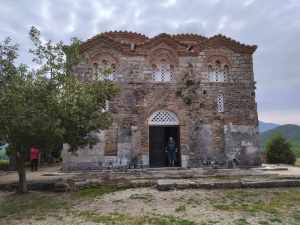
Thankfully, the weather improved by the time we arrived at the site; it was warmer and less threatening, with the sun making a few tentative appearances as we explored the temple. Much of the complex remains unexcavated and overgrown with thick brush and grass. The church is the only intact building, though it is in need of some renovation. Inside, the walls were originally painted a striking blue, but now, falling plasterwork and areas repainted in white detract from its early splendour. Iconic religious paintings still hang on the walls, and a few relics sit in small recesses. Today, the church is no longer used for worship, serving instead as a place for tourists to visit.
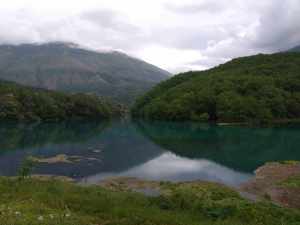
Descending from the mountain range, we drove along the edge of a wide valley. On one side, numerous villages clung to the rocky, tree-covered slopes, while on the other, a swathe of rich, cultivated farmland stretched out towards the opposite rugged mountain faces.
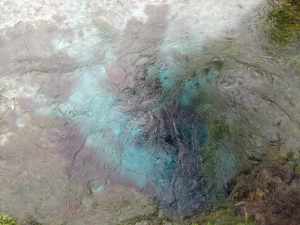
After about an hour, we arrived at Blue Eye National Park, home to a remarkable natural phenomenon, the “Blue Eye” spring. Located near the village of Muzinë, this spring reveals crystal-clear blue water visible from depths exceeding fifty metres. Divers have ventured down to that depth, but the true extent of the karst hole remains a mystery. The spring itself is some distance from the car and bus park, but a quaint little train, pulling three carriages, regularly ferries tourists along a steep, wooded ravine to the site.
Our group mingled with others as we walked the short path from the train’s drop-off point to the viewing platform above the Blue Eye. We took photos and marvelled at the astonishing clarity and vivid colour of the water as it surged forth from deep within the earth. The thought of a diver descending into the karst against the strong upward rush of water was truly mind-boggling and undeniably perilous. A few of us then followed a forest path a little further downstream to capture more photographs of the river before returning to catch the train back.
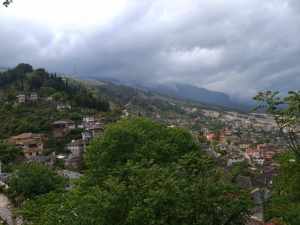
Continuing our drive along the valley, we eventually arrived at our destination, the UNESCO-listed town of Gjirokaster. Renowned for its extensive use of stone in building houses that resemble small fortresses, and its quaint cobblestone streets all converging on the bustling Bazaar, it has rightly earned the title of ‘Albania’s best kept secret.’
Our coach had to stop a short distance from our accommodation, the Hotel Cajupi, a stark, functional building erected in 1964 during the communist era. We carried our cases to the reception and left them there until check-in later. As a group, we then set off on foot, wandering up into the cobbled streets of the old town to find lunch. Following our guide’s recommendation, we chose a local restaurant, which proved to be an excellent choice.
Unfortunately, the forecast rain made its appearance towards the end of our meal, forcing us to hasten indoors to finish before the downpour intensified.

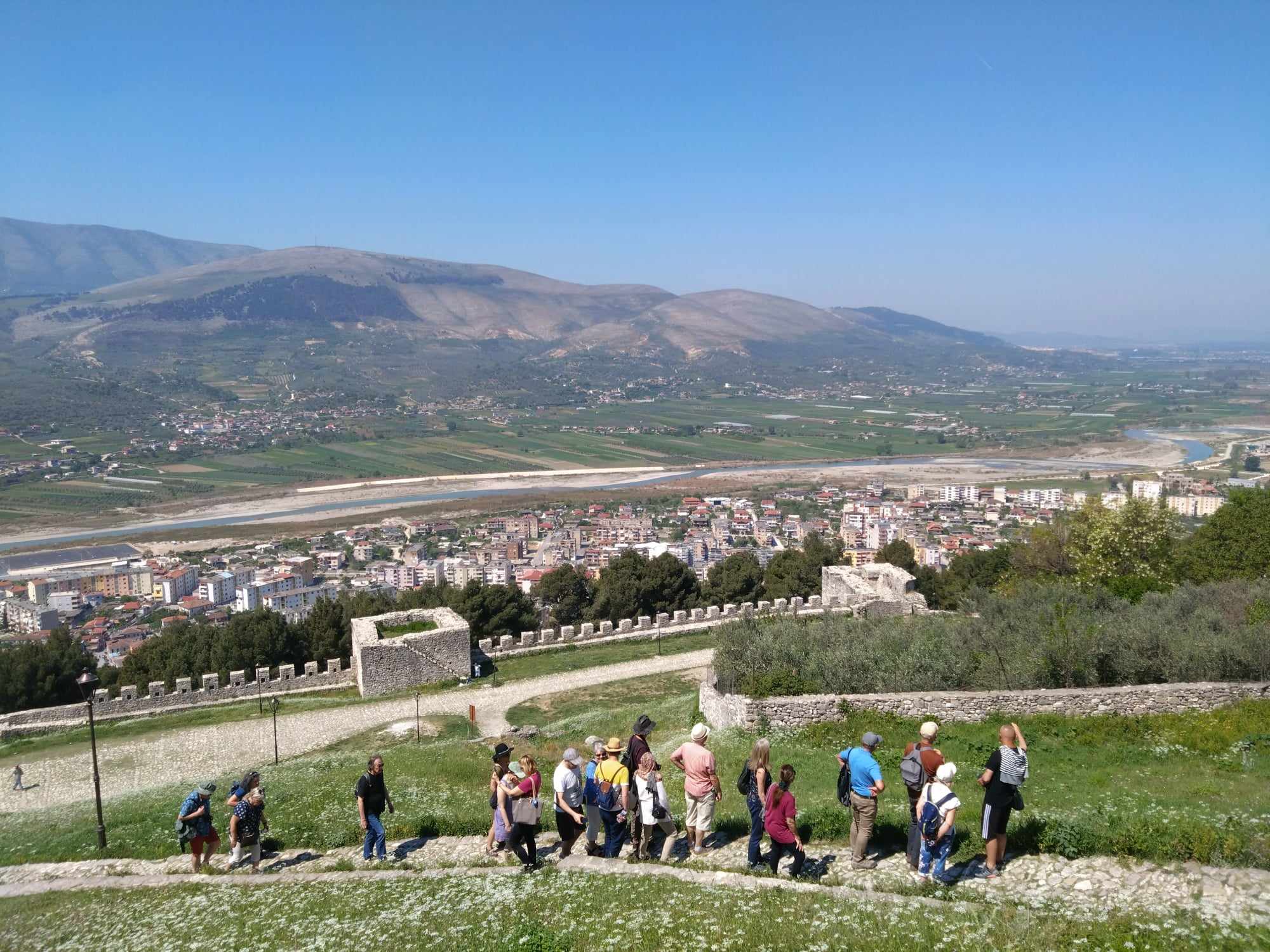
At 3 p.m., the entire group reconvened in the heart of the town to begin the climb up the mountain to Gjirokaster Castle. The fortress loomed imposingly above the town, strategically positioned to command the vital river valley route below. Inside the castle grounds, we explored a military museum housing an array of captured artillery and memorabilia from the Communist resistance against German occupation. A particularly striking exhibit was a captured United States Air Force plane, symbolising the regime’s defiant stance against Western powers.
The castle itself has a long history, existing in various forms since before the 12th century. Its current appearance was heavily influenced by extensive renovations and a westward expansion undertaken by Ali Pasha of Tepelene after 1812. Later, in 1932, the government of King Zog expanded the prison facilities within the fortress.
Fortunately, the rain had stopped as we began our tour, allowing for a dry exploration of the lower sections. However, by the time we reached the upper battlements, the weather turned once again, the wind whipped fiercely, and rain returned, accompanied by thunder that echoed ominously through the valley below. Despite the worsening conditions, our guide led us through all the highlights of this fascinating castle. Some members of the party emerged noticeably more bedraggled than others, but everyone agreed it had been well worth the effort.
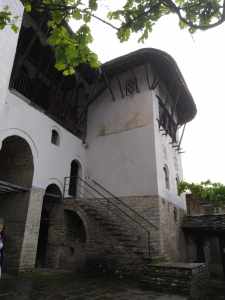
The climb up to the castle from the town had been long, 345 steps in total, but descending proved far trickier on the wet, slippery surface. It took quite some time before everyone in our group managed to gather safely at the base. Fortunately, the rain had stopped during our descent, raising hopes that the weather might clear and we could finally dry out.
Our next stop was to view a typical pre-communist era Gjirokaster house. We took some photos of the exterior, but with time pressing, we regrettably had to move on before exploring inside. While standing outside the home of Albania’s once-paranoid ruler, Enver Hoxha (born October 16, 1908, in Gjirokastër; died April 11, 1985, in Tiranë), the rain returned. Sue and I chose to retreat to the warmth and dryness of our hotel, while some of the hardier members of the group pressed on with the guide.
Later, after the rain ceased, we wandered back through the cobbled streets for our evening meal at a small side-street restaurant. Just as we finished eating, the entire town was plunged into darkness by a power cut. We learned that such outages are common here, and the locals simply light candles and carry on with their lives. Finding our way back to the hotel proved tricky, relying solely on the light from my mobile phone as we carefully navigated past sleeping dogs and other befuddled, wandering tourists like ourselves. As we reached the Hotel Cajupi, the rain began again.
18th April 2024: Gjirokaster to Tepelena, Voskopoja, and Korca
Breakfast revealed a pleasant surprise: the dark grey clouds of yesterday had given way to blue skies dotted with puffy white wisps drifting over the mountain tops. Annoyingly, just as we were getting dressed, another power cut plunged us into gloom, making packing a challenge, especially since our room had only a small shaded window.

This morning, we continued our journey to Voskopoja, winding through the scenic Vjosa River valley to take in the spectacular views of the surrounding landscape. Voskopoja was once a major centre of economic, cultural, and artistic development, reputed to be one of the largest commerce and trade hubs not only in Albania but throughout the Balkans.
The drive was stunning, with breathtaking mountain vistas unfolding at every turn. The narrow roads twisted and turned sharply as we ascended and descended through the rugged terrain. I was pleasantly surprised to see quite a few cyclists tackling the challenging route, some long-distance adventurers hauling heavily laden bikes, while others enjoyed the boost of electric assistance to power through the lung-busting climbs.

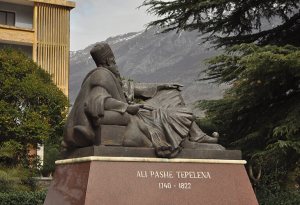
Our first stop was to explore the ruins of Tepelena Castle, named after Ali Pasha of Tepelenë, who made it his residence until 1820. The fortress, as it stands today, was rebuilt in 1819 with the addition of three imposing towers. It was here, in 1809, that Lord Byron famously met Ali Pasha, immortalising him in Western Europe through his poem Childe Harold’s Pilgrimage. The views from the castle were breathtaking, sweeping over the valley and river below, but our attention was soon captured by a rather bold donkey grazing perilously close to the cliff’s edge, much to the amusement (and concern) of the group, and the subject of many of our photos as it nibbled on dangerously precarious foliage.
Each leg of today’s journey was long, but the spectacular scenery kept us alert, banishing any temptation to nod off. The roads were far from built for luxury coaches, sharp hairpin bends demanded cautious negotiation, and oncoming vehicles often forced both drivers to pause and carefully judge the best way to pass. Progress was slow, yet endlessly fascinating. Frequent roadside shrines served as sober reminders of the dangers of these mountain passes, a testament to what might happen if one misjudged a bend at such dizzying heights.
At 1 p.m., we finally paused for lunch in one of the many valleys we had crossed during our mountain-hurdling drive. The meal was hearty and satisfying, although the couple we dined with warned us they were always the last to be served, and, true to form, they were right!
The post-lunch leg proved to be the most challenging so far. Roadworks meant that for two long stretches we had to abandon the tarmac and navigate freshly bulldozed earth. Our driver frequently halted to assess the terrain, carefully calculating whether we could proceed. After some tense moments and a few nerve-wracking scrapes and jolts, he managed to steer us safely through the rough patches.
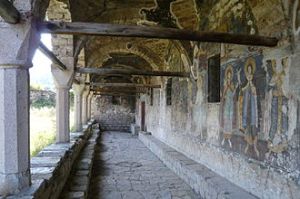
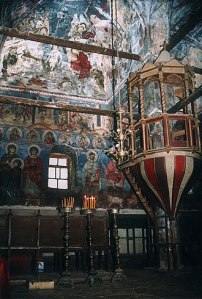
As the sky grew heavy with clouds, we arrived at St. Athanasius Church, an Orthodox Christian sanctuary that remarkably escaped the widespread destruction inflicted by the communist regime. Nestled in the village of Voskopoja, the church and its accompanying 16th-century monastery stand as resilient testaments to a once-thriving cultural and commercial hub of the Aromanians during the 18th century. At its zenith, Voskopoja was home to the first printing press in the Ottoman Balkans outside Constantinople.
As we stepped inside the church, rain began to fall, and we were grateful to find the priest had switched on the heating; the cold bit sharply, intensified by a freshening breeze. The interior was breathtaking; every inch of wall and ceiling was covered in vivid, intricate artwork. Astonishingly, these frescoes survived the communist era, especially when many exterior paintings bear the scars of defacement and graffiti.
By the time the rain ceased and daylight started to fade, we made our way to Korca, a historic city celebrated for its rich cultural traditions and notable Ottoman-era architecture, including one of Albania’s most important mosques.
We checked into the Hotel Kocibelli, conveniently located in the city centre. While some in our group chose to visit a local brewery to sample the beers, Sue and I preferred to stroll the lively streets nearby, soaking up Korca’s nightlife before retiring for the night. Albanian lagers, however, are not exactly my favourite drink.
19th April 2024: Korca to Pogradec, Lin, Elbasan, and Tirana
After a hearty breakfast accompanied by the best coffee we’d had since arriving in Albania, we set off on a guided walking tour of Korca’s Old Bazaar. We meandered through cobblestone streets lined with charming shops and inviting restaurants. Along the way, we paused to photograph a bakery just opening for the day and a blacksmith proudly showcasing his finely crafted agricultural tools. On our return to the coach parked outside the hotel, we passed both the central city mosque and an Orthodox church, briefly stopping at a museum dedicated to the Albanian language, once a school where Albanian was first taught in the 17th century.

On a cloudy, chilly morning, we set off toward Pogradec, a city nestled on a narrow plain between two mountain ranges along the southwestern shore of Lake Ohrid. This ancient and deep lake forms a natural border between southwestern North Macedonia and eastern Albania. Upon arrival, we paused by the lake’s edge to stretch our legs while our guide shared the rich history of the region.
From the 8th to the 14th century, Pogradec changed hands among various powers, including the Bulgarian, Byzantine, and Serbian Empires. In the mid-15th century, it became part of Skanderbeg’s state, a proud era that ended with his death in 1468. Soon after, the Ottomans invaded, maintaining control until Albania declared its independence in 1912.
A strengthening wind whipped the lake’s surface into restless waves, making any thoughts of paddling in the cold, grey water quickly vanish. Several in our group sought refuge in a cosy beachside café, savouring the warmth of hot coffee. Meanwhile, Sue and I zipped up our coats and strode along the promenade, pausing to study statues of city dignitaries unknown to us, and to gaze across the choppy waters toward the distant shore of North Macedonia, shrouded beneath a heavy, drab sky.

Continuing our journey in the warmth of the coach, we climbed to the top of a hill overlooking Pogradec to visit the ancient Illyrian fortress of Encheleana. This fortress, scarred by centuries of wars and invasions, now stands as a preserved cultural monument. Reconstructed during the Middle Ages, it was renamed by the Bulgarians during their occupation of southeastern Albania, a name that endures to this day. Perched, exposed and high above the valley, the bitter cold wind bit through us, so after taking a few photographs, we reluctantly moved on.
Our next destination was Elbasan, a city steeped in history since Illyrian times, known for the fascinating overlap of Roman and Ottoman ruins. We made a brief stop at Elbasan Castle, which dates back to the 4th century BC. Unfortunately, as rain began to fall, our plans to explore the castle were cut short, and we missed the chance to fully appreciate what promised to be an impressive fortification.
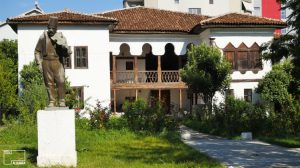
We then moved on to the heart of Elbasan to visit the Ethnographic Museum. Thankfully, the rain had ceased, and being indoors was a welcome relief for cold and weary tourists who had been exploring historic sites for several days. Housed in a traditional two-story 18th-century house, the museum offered a fascinating glimpse into the culture, folklore, and daily life of this medieval city. The artefacts were captivating, and the curator’s insightful guidance made for a refreshing and enlightening diversion.
Our journey to Tirana included a stop for lunch at a charming roadside and riverside restaurant nestled within a ravine. Here, we encountered Albanian self-service for the first time, a somewhat daunting experience given the unfamiliar dishes and limited explanations from the staff. Despite the mystery of the offerings, I found my selections delicious and remarkably affordable.
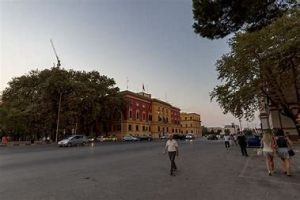
As a final farewell to the rich culture and history of Albania, our last stop was in the heart of Tirana near its University, located at the end of a long, wide boulevard constructed by the Italians during their occupation. Our guide shared with us his perspective on the city’s development, contrasting his memories of a quieter youth with the rapidly expanding capital of today, though he expressed some reservations about its future under a cloud of political corruption.
We said our goodbyes to the guide and driver outside the Hotel Doro City, where we had first stayed at the start of our journey. That evening, with three other couples from our group, we dined at a nearby restaurant. Being our last night, we indulged in a few extra drinks and retired late, content and happy.
20th April 2024: Tirana to Luton
We woke to a bright, sunny morning and were the first down for breakfast at 7 a.m. By 8:30, we were packed and seated on the coach with the remainder of our group. Some had left the night before, others very early that morning. Despite it being a Saturday, the notorious Tirana traffic was light, and we made good time to the airport.
Check-in and security were swift, leaving us with three hours to spare before our flight. With 1000 Lek remaining, we opted to buy two enormous sausage rolls for the journey, priced at 500 Lek each. I passed the time watching a film on my laptop, while Sue browsed the internet on her phone.
To our surprise, our seats were together in a pair by the wing emergency exit rather than the usual trio, making for an unusually comfortable flight. We landed at the farthest possible gate, meaning a trek through to arrivals before catching a bus to the off-site Airparks car park, where Sue’s Mini awaited.
The journey home was uneventful, accompanied by the Tigers versus Saints rugby match streaming on my phone. We arrived in time for me to catch the second half on TV, though hopes of a victory raised in the first half were dashed as they were ultimately thrashed.
Thoughts on Albania: Our whistle-stop visit to Albania was thoroughly enjoyable, offering an eye-opening glimpse into the history and culture of a people about whom we had known little beyond Western media portrayals of organised crime and illicit activities.
Our guide expressed deep scepticism about the politicians running the country, describing them as corrupt. Yet he also acknowledged that Albanians are still learning how to manage their newfound freedom, making mistakes along the way, a legacy of centuries under Ottoman and communist domination that left little room for self-determination or free will.
Everywhere in this stunningly beautiful country, new construction is underway: houses, hotels, factories. The rush to build is fueled by a belief that tourism will drive progress. However, the infrastructure, particularly the roads, lags behind and will take years to improve. The fall of communism left behind crumbling towns and abandoned factories unable to compete with Western technology, and the ordinary people bore the brunt of this upheaval. One can only hope the country gets it right and the economic bubble doesn’t burst.
The people we met were kind and welcoming to strangers. The food was delicious, and while drink prices were lower than in the UK, the difference was not dramatic. Hotels were comfortable, restaurants plentiful, and the scenery spectacular, brimming with castles, churches, mosques, seaside resorts, and lovely beaches with great facilities for children. What’s not to like?
 Palmer Family
Leave a comment