14th April 2024
Tirana – Berat: It was an early start on a cloudless morning, shortly after breakfast. The coach departed at 8.30 a.m., and as it was a Sunday, the streets of Tirana were, for once, eerily quiet, entirely free from the traffic jams that had characterised the previous days.
Our destination was Berat, renowned for its white Ottoman houses. En route, we passed through Elbasan, Albania’s fourth most populous city, and continued to Lake Belsh, part of the Dumrea group of caustic lakes in central Albania, often called “Little Toscana”.
Berat is over 2,400 years old, making it one of the oldest continuously inhabited regions in Albania. It holds UNESCO World Heritage status and lies approximately 100 kilometres away.
Leaving Tirana, we passed through an old communist-era suburb that was once reserved exclusively for high-ranking party officials. It was once off-limits to the general public and heavily guarded by the army. Today, it remains one of the most desirable areas in the capital, with many of the original buildings replaced by ultra-modern homes and apartment blocks. Some of the architecture is stunning, and new developments are still underway. It is now the most expensive area in Tirana in which to own property.
Once beyond the city, we joined a smooth, fast, and recently built motorway, heading towards the mountains. Before long, we were winding through a dramatic landscape of craggy peaks, dotted with large, opulent villas that clearly spoke of considerable wealth. The scenery was breathtaking, and I would rank this road among my top five for its spectacular panoramas, which seemed to unfold at every bend.
We passed swiftly by Elbasan, where the legacy of communism was painfully evident. Under Soviet influence, this area had been earmarked for steel production, using outdated Chinese methods. The town now appeared bleak and neglected, in dire need of colour and renewal. The derelict furnaces and associated factories stood grey and forlorn beneath a vibrant azure sky, a poignant sight.
Further on, we descended into a lush valley. Under communism, this area had been used exclusively for growing tobacco. Today, however, olive groves and a variety of food crops have taken their place. As we travelled further still, the fields began to show signs of a different legacy, ‘nodding donkeys’, remnants of a once-active oil industry. Most of the machines we saw from the speeding coach were rusting and still, but a few were moving in their characteristic seesaw motion, pumping the controversial resource from deep underground. Our guide mentioned that the Albanian government is considering reviving this oilfield. I hope they do not.

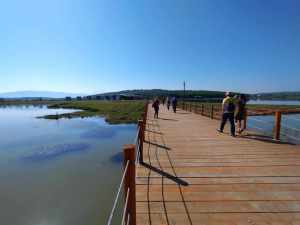
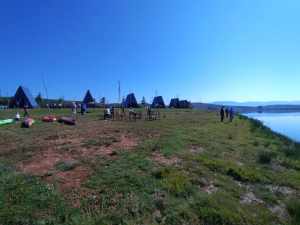
Upon arriving at Lake Belsh, we had forty minutes to explore this stunning location, now the centre of a growing tourist industry with weekend cabins, lakeside restaurants, and a range of leisure activities. As it was still early in the season, preparations were underway to ready the facilities for the busier months ahead. We strolled along the shore, enjoying the chance to stretch our legs and chat amongst ourselves, delighted to do so in such a beautiful setting.
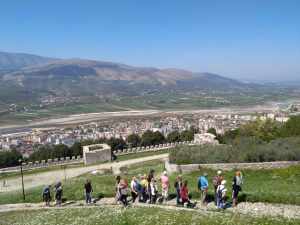
On reaching Berat, our coach did the hard work, carrying us up the mountainside to the base of the castle walls. There we disembarked and once again braved the treacherously steep and slippery surfaces that so often characterise these ancient sites. We spent three hours walking the ramparts and exploring the castle’s interior. Among its highlights are a couple of remarkable churches, well worth a visit, and the ruins of the Red Mosque, a derelict structure of historic interest. The views over the city and the river valley below were truly spectacular.
Sue and I discovered a small restaurant tucked away within the castle community, and, joined by a few others from our group, enjoyed a very pleasant lunch.
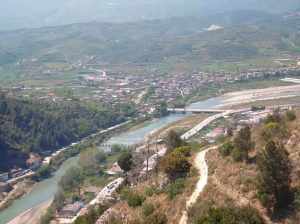
Later, the coach took us back down into the town, where we visited the Berat Mosque and the Old Bridge of Gorica. The river rushing through the town had a fierce current, definitely not something you’d want to fall into. As a group, we crossed the river twice, walking from one bridge to the other. From the riverbank, we took photographs of the castle perched high above us, and of the iconic white-washed houses stacked haphazardly up the mountainside beneath the fortress.
In the distance, the snow-capped peaks of the surrounding mountains were still visible, a sign that winter was clinging on by its fingernails. Down here, however, the temperature had climbed once more to a balmy 29°C, tempting many of us to sample a variety of local ice cream flavours from a cheerful vendor on the main street.
After checking into the very modern Republika Hotel, we had an hour to settle in before the day’s final planned activity: a wine-tasting experience. Sue chose not to join the rest of the group, preferring instead to shower and relax in our well-proportioned room.
The visit to the Çobo Vineyard was a half-hour drive away. On arrival, we were given a tour of the fermentation and bottling rooms before sitting down to sample two whites and two reds from their extensive cellars. Olives, cheese, and bread were served alongside the wine. The vintages, part of their award-winning collection, were pleasant enough and provided the perfect backdrop for a relaxed evening of convivial conversation.
On returning to the hotel, Sue and I strolled into town and enjoyed an evening meal of moussaka and spring rolls at a bustling riverside restaurant, before heading back for a well-earned sleep. It had been a long and active day.
15th April 2024: Berat – Ardenica Monastery – Apollonia – Vlora
After breakfast, we set off at 8.30 a.m. for Ardenica Monastery, built in 1282 by the Byzantine Emperor Andronikos II Palaiologos to commemorate his victory over the Kingdom of Sicily. This 13th-century Byzantine complex is best known locally as the site where Albania’s national hero, Skanderbeg, was married.
It was another glorious day beneath a cloudless blue sky, with temperatures expected to reach the low 30s °C. Our route took us along a wide valley that had once been wetlands. Before the rise of communism, it was a marshy expanse, later drained using Dutch engineering expertise under Soviet oversight. Today, the land is fertile and productive, though ownership remains fragmented, divided into inefficient blocks held by individual families.
As we reached the foothills, the coach began to struggle slightly with the narrow, twisting road that climbed steeply towards the monastery. Several stops had to be made to allow oncoming traffic to pass in tight squeezes.
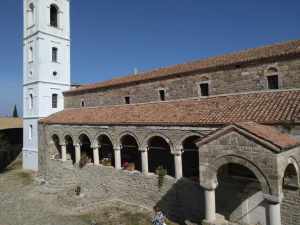
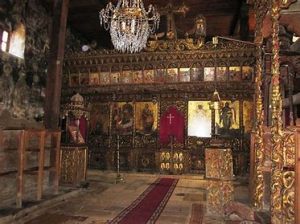
As expected, the views from the monastery walls across the valley to the distant sea were staggering, especially on such an exceptionally clear day. It was a shame I hadn’t brought my binoculars on this trip. However, our main purpose here was to explore this historically significant religious site, so we soon stepped inside its cool, dark interior.
Originally, a pagan temple dedicated to the goddess Artemis once stood where the monastery now sits, which explains the origin of the name Ardenica. The current structure was built in 1282, commissioned by the Byzantine Emperor Andronikos II Palaiologos.
Perhaps the most notable historical event associated with Ardenica is the wedding of Skanderbeg to his lifelong wife, Donika, which took place in April 1451. The ceremony was held in the Chapel of St. Trinity, the monastery’s earliest church, originally built in the 10th century.
The interior of the monastery is adorned with beautiful, gold-accented frescoes illustrating various biblical stories. Of particular note is the lofty, ornately carved, goblet-shaped pulpit, strikingly similar to those we’ve seen in several other churches during this trip.
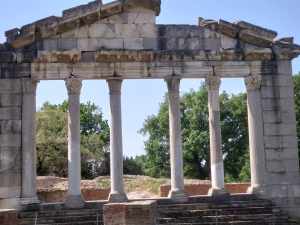

From here, we continued to the ruins of Apollonia, an evocative collection of Roman remains perched on a remote hillside. Once an important city in the region, Apollonia retains an atmosphere of faded grandeur.
We then departed for the coastal city of Vlora, nestled at the foot of the Ceraunian Mountains and flanked by both the Adriatic and Ionian Seas. A popular tourist destination, the site was busy on our arrival, with several school groups and another English tour bus in attendance. Thankfully, they soon departed, leaving us to enjoy the peaceful setting at our leisure.
Much of the ancient city remains hidden beneath the undergrowth, but what is visible suggests a vast site, with considerable potential for further discovery. The midday heat had become quite oppressive, and, along with a few others in our group, I paused our explorations for some much-needed refreshment at a small on-site restaurant.
Within the ruins is an excellent museum, housing a remarkable collection of statues, many with astonishing detail, as well as a wide array of artefacts from both Roman and Greek civilisations, each of which, at different times, had occupied the region and left their mark.
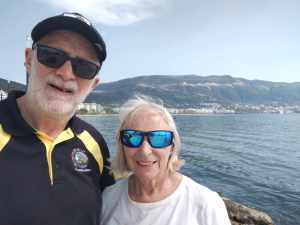
Next came a long drive along the coast to Vlora, the city where Albanian independence from the Ottoman Empire was proclaimed on 28th November 1912. On arrival, we broke for lunch. Sue and I chose a seafront restaurant, while others in the group opted to explore the local area.
After regrouping, we embarked on a short city walk to view several of Vlora’s statues and landmarks. We also visited a mosque, though unfortunately (or perhaps fortunately, depending on your viewpoint), we were unable to enter as the call to prayer was imminent.
Following this brief tour, we boarded the coach for a short journey to our accommodation, the Kraal Hotel, conveniently located just a few steps from Vjetër Beach.
After checking into our spacious room, we had an hour and a half to relax before reconvening in the lobby for our next activity: a visit to the Independence Museum. This historic building was where Ismail Qemali, Albania’s first Prime Minister, served between 1912 and 1914 and where the country’s first democratically elected government was debated and formed.
Although the museum is not usually open on Mondays, the curator kindly opened it especially for us. She did not speak English, but our guide provided translation as we moved from room to room. The building holds great significance, as it was within these walls that the modern Albanian state was officially declared. Inside, we viewed both original and replica documents relating to this historic event.
We returned to the hotel on foot and later rounded off the evening with dinner at a nearby restaurant, accompanied by another couple from our group.
16th April 2024: Vlora – Himare – Saranda – Butrint
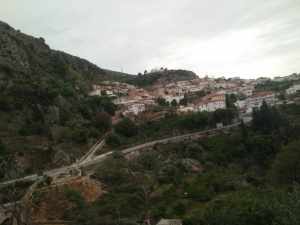

As forecast, it was cloudy when we departed the hotel at 8.30 a.m. Breakfast had been something of a manic affair, with three coachloads of tourists all leaving at the same time. It was a bit of a scramble to grab a plate and secure your preferred items before they vanished.
We set off on time to continue our journey south through Albania. We had been forewarned that this would be a long day of travel, following narrow mountain roads that twisted and wound sharply through numerous steep ascents and descents.
After a couple of hours on the road, we paused briefly to stretch our legs and soak up the breathtaking scenery at Llogara National Park. The views were truly spectacular, vast alpine meadows, towering rock faces, sheer drops, and dense forests framed by the surrounding mountains, all tumbling down towards the distant shimmer of the Albanian Riviera.
Feeling refreshed, we pressed on through a series of picturesque seaside villages, stopping again for coffee and a much-needed toilet break at a charming roadside restaurant. Most remarkable was its location: a series of waterfalls cascaded past seating platforms, the water gurgling beneath diners’ feet before surging through the building itself and plunging several hundred metres down to the sea below.
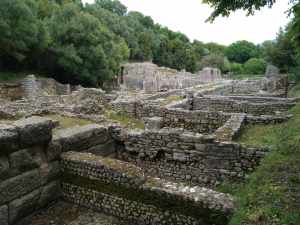

Continuing along the coast, we arrived in Saranda, a resort town on the Albanian Riviera nestled between the Ionian Sea and hills lined with olive groves. We paused here for lunch before pressing on to the ruins of Butrint.
This is Albania’s most significant archaeological site and a designated UNESCO World Heritage location. Dating back to the 7th century BC, Butrint later became a Roman colony before falling under Venetian and then Ottoman control.
We had a couple of hours to explore its many historically important structures, including the Acropolis, Basilica, and the palace. The setting itself is striking, lush with trees and surrounded by water. It’s a large and atmospheric site, and we needed the full two hours to explore it properly. It was well worth the visit. A delightful surprise was spotting turtles swimming through the flooded ruins, an unexpected bonus.
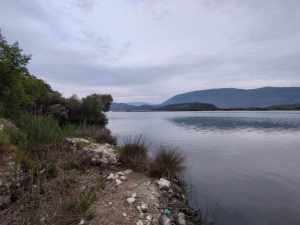
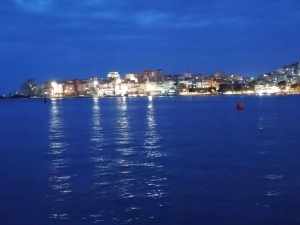
We continued down the coast to Saranda, the location of our accommodation for the night. Our first stop was at a spot on the outskirts of the city that is rapidly gaining a reputation for its deep blue sea and has even been dubbed the “Maldives of the Mediterranean.” Indeed, I could see some similarities to those endangered Indian Ocean islands, small islets set in crystal-clear waters, and from our vantage point, the beach appeared white, seemingly made of coral sand. However, on closer inspection, the sand was artificial, composed of finely ground limestone, and the foliage on the islands was far from tropical. Nevertheless, it’s good marketing, and I’m sure many visitors are fooled by the illusion. It is an extraordinarily scenic resort.
When we finally reached our accommodation, the Havana Hotel, we discovered that some in our party would be staying at another hotel just a few metres away, but not us. After checking into our very comfortable and modern room, we took a fairly lengthy stroll along the road to have our evening meal at a beachside restaurant. First impressions of Saranda are very favourable; we shall see if that holds true tomorrow.
 Palmer Family
Leave a comment