11th April 2024
Departure: Our Wizzair flight from Luton wasn’t until the afternoon, so there was no need to thrash our way down a motorway at some ungodly hour, as has become the norm in recent years. However, despite having been packed, checked, added to, and checked again the day before, we still woke before 7 a.m. and were dressed and breakfasted by 8 am.
Charlotte called in briefly on her way to work for a quick coffee, to wish us a safe journey, and to collect some clothes Jamie had grown tired of, to see if they might fit Lucas or Ellis before donating them to a charity shop.
We had originally planned to leave Willow Bank at 11 a.m. and drive to the airport. However, a major fire in the multi-storey car park at Luton six months ago had destroyed the facility, and the aftermath was still causing delays. A text from the airport the previous evening warned us of potential disruption, so we decided to leave at 10 a.m. instead. As it turned out, there were no delays, and we parked without issue, catching the shuttle bus to departures and arriving by 11:30, giving us over four hours to kill.
We picked up a Meal Deal from Boots for lunch. I watched the Netflix film Scoop on my laptop while Sue browsed the internet on her mobile. Later, we bought another Meal Deal to eat on the plane.
The flight was delayed by half an hour, conveniently placing us in the air around our usual tea time. The plane wasn’t full, and we each had a row of three seats to ourselves, which allowed us to stretch out and catch a short nap during the 2-hour 45-minute journey.
It was already dark when we landed in Tirana. Thankfully, immigration was quick and painless, and we managed to change some euros into Albanian lek before meeting up with our guide and the other members of our group. Once all eleven of us were assembled, we boarded a modern coach for a 30-minute drive through the city to our four-star accommodation: the Hotel Dora City. We were soon checked in and fast asleep in our room. It had been a long and tiresome day.
12th April 2024: Tirana – Lezhë – Shkodër – Tirana
We had set the air conditioning in our room far too low the night before and spent most of it freezing, each of us thinking the other was asleep and not wanting to disturb the peace by switching it off. In ignorance, we endured.
We were down for breakfast just after 7 a.m., enjoying a selection of cold meats and cheeses, with a hot option of omelette and sausage; I had both.
It was a leisurely start to the day, leaving the hotel at 9 a.m. for our journey to the city of Lezhë, known in ancient times as Lissus. Tirana’s traffic is effectively one long rush hour. Over the past five years, the number of cars on the road has exploded in line with the country’s growing wealth, and the road network simply can’t cope. The authorities are upgrading the current system and building new roads, but these improvements are only adding to the chaos and will likely continue to do so for some years yet.
We made little real progress until we finally escaped the city limits and joined a newly built motorway that followed a valley between two mountain ranges. Coincidentally, this also formed the flight path for aircraft landing in Tirana.
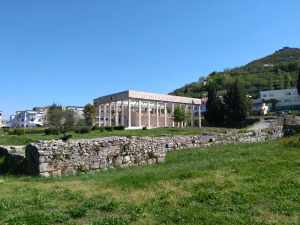
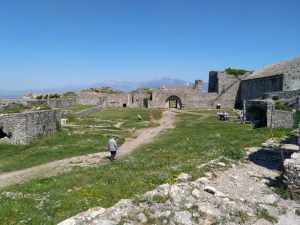
Our first stop, after an hour and a half, was in Lezhë to visit the City Castle, originally built during the Illyrian era, later rebuilt by the Venetians in the 1440s, and then by the Ottomans in 1522. We also visited the Mausoleum of Skanderbeg, an Albanian feudal lord and military commander who led a rebellion against the Ottoman Empire and is celebrated as a national hero.
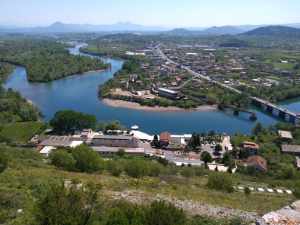
We continued to the 4,000-year-old Rozafa Castle, dramatically situated between two rivers, offering panoramic views over the city of Shkodër, the surrounding mountains, and Lake Skadar. The road up to the castle is far too narrow and winding for a full-sized coach, so at the foot of the small mountain upon which it stands, we transferred to a minibus and placed our trust in the driver to navigate the tight hairpin bends safely.
The final stretch had to be done on foot. Centuries of footfall had polished the cobblestones to a glassy sheen, making progress tricky, and, I suspect, treacherous in wet weather. At the summit, our guide gave us a fascinating account of the castle’s long and turbulent history, and we took photos of the breathtaking views over the city, rivers, and lake. Thankfully, a small café at the top allowed us to quench our thirst, and by now the temperature had risen to 29°C, although a welcome breeze at the top helped to keep us cool.
We descended once again by mini-bus and rejoined our far more comfortable coach for the short journey to nearby Shkodër, a city and municipality in north-western Albania, renowned for its striking scenery. We began with a brief city tour, ending at the Cathedral, where we spent a few minutes exploring the impressive building before heading into the centre to visit the Old Bazaar and find some lunch.
We chose a small restaurant near the mosque and invited fellow tourist, Paul, to join us. He’s travelling alone and seemed grateful for the company.
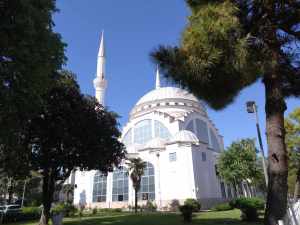
With lunch finished, we met up with the rest of our group outside the mosque and went in to have a look around. We were fortunate that our visit coincided with a wedding; it was fascinating to observe the ceremony and note the similarities with a British Christian wedding.
The return journey to our hotel, Dora City, took just over two hours, with the final stretch again hampered by heavy traffic. Most of our party slept through the drive.
That evening, Sue and I strolled into a bustling, lively city centre. We happened upon Paul in one of the restaurants and decided to join him for dinner. It turns out his partner isn’t fond of travelling and prefers to stay at home while he heads off on his various foreign adventures.
13th April 2024: Tirana – Krujë – Durrës – Tirana
After breakfast, we had a slightly earlier start at 8.30 a.m. Another hot and sunny day was forecast, with the temperature once again creeping up to 29°C.
Traffic as we left Tirana was still busy, though not quite as bad as the previous day, allowing us to make decent time on our journey to Krujë, one of Albania’s most historically significant towns, known for its resistance against the Ottomans and for being the birthplace of Albania’s national hero, Skanderbeg.

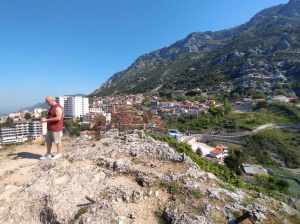
Most of the journey followed the same valley route we had travelled the day before, but this time we turned left and headed towards the distant mountain range. The road to Krujë was surprisingly poor for such a historically significant site; one might expect better infrastructure given its importance in Albanian history and its appeal to visitors.
Our coach parked near the entrance to Krujë Castle, which has proudly stood atop a rocky cliff high above the city for the past fifteen centuries. It has borne witness to the region’s long and turbulent past, once serving as the centre of Arbëria (the ancient name for Albania), during a time when the Ottoman Empire held sway over much of Europe, including Constantinople and the Balkans.
Remarkably, the castle held out against Ottoman forces for thirty-five years, a testament to the leadership of Gjergj Kastriot Skanderbeg, Albania’s legendary national hero, who defended its walls with unwavering resolve until his death.


To enter the castle required another steep and precarious climb over polished cobblestones that threatened to twist an ankle, or worse, but the effort was well worth it. The views from the top were magnificent, particularly on such a clear and glorious morning.
After a short exploratory ramble, during which many photos were taken, our group made its way into the Skanderbeg Museum, dedicated to Albania’s national hero, Skanderbeg, the son of John Kastrioti, Prince of Emathia.
A Christian leader, Skanderbeg, united the Albanian princes in 1444 and was appointed commander-in-chief of the League of Lezhë. Between 1444 and 1466, he repelled thirteen Turkish invasions, and his successful defence against the forces of Murad II in 1450 earned him renown throughout the Western world. Pope Calixtus III named him Captain General of the Holy See, and in 1463, Skanderbeg secured an alliance with Venice, enabling a renewed offensive against the Ottomans.
Until his death, he continued to resist Turkish domination. However, within a few years of his passing, his citadel at Krujë fell in 1478, and Albania came under Ottoman rule.
The museum, dedicated to his life and legacy, was well worth visiting. It housed a fascinating collection of unique artefacts and exhibits that both informed and entertained.
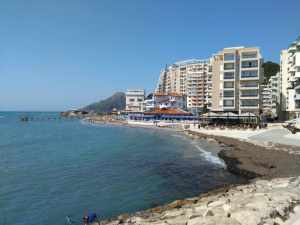

From the castle, we descended into the Old Bazaar, set among the heavily cobbled streets surrounding the castle walls. Mindful of the uneven surface I would have had to navigate in order to browse the myriad trinket shops, I opted instead to take refreshments in a nearby bar and let Sue tackle the cobbles and explore the tourist offerings.
Our next stop was the port city of Durrës. Known in medieval times as the most important ancient central Mediterranean metropolis, it remained so until the 15th century, when it was occupied by the Ottomans. It stayed under their rule until 1912, when Albania proclaimed its independence, and Durrës became the capital, a status it held until 1920. The city is home to the largest Roman amphitheatre in the Balkan region, dating back to the early 2nd century.
We began our visit with a pleasant lunch at a beachside restaurant. Afterwards, Sue and I enjoyed a stroll along the beach, mingling with locals and soaking up the sun, sea, and sand until it was time to regroup. As with much of what we have seen so far in Albania, Durrës is growing at a phenomenal pace. New buildings are springing up everywhere: factories, shopping malls, hotels, apartment blocks, and there are thousands upon thousands of new cars, either in motion or lined up in vast lots waiting to be sold.


With our guide, we followed the Ancient City Castle Wall, taking in the Roman Amphitheatre and Roman Public Baths. Much of Albania’s ancient architecture has yet to be fully excavated, and many remnants have been built over. However, there are now plans to introduce more stringent building controls to prevent further deterioration.
We both liked Durrës. It has the feel of a place striving to catch up with the modern world, eager to throw off the shackles of its oppressive communist past as quickly as possible.
Our return journey to Tirana was surprisingly swift; it seems a late Saturday afternoon is a good time to travel! That evening, we dined at a restaurant just 30 metres down the road from our hotel, sharing a table with another couple from our group. Before heading to bed, we packed our cases once again. Tomorrow, we move on.
 Palmer Family
Leave a comment