
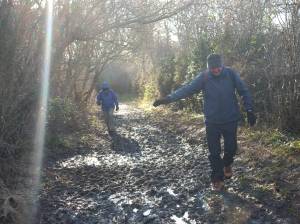
As the month progressed, the rain gradually disappeared from our daily BBC weather maps, replaced by temperatures hovering around a chilly 0°C. A high-pressure system had settled stubbornly over the UK, bringing overnight frosts and the occasional snow flurry to the east of the country. It was on one such day, the 9th, that Jim, Sean, and I ventured out to Ravensthorpe Reservoir for a ramble. Despite the clear blue sky, a brisk northerly breeze ensured hats and gloves were firmly in place.
As on my Boxing Day visit with the family, the wildfowl were plentiful and highly vocal. This time, however, there were some new arrivals: several cormorants could be seen bobbing and diving beneath the rippling surface. They remained hidden for over a minute at a time before surfacing unexpectedly some distance away.
The mud we’d encountered during our festive family walk was still very much in evidence along long stretches of the path. I was wearing wellies and so didn’t need to watch my footing too carefully, but my two companions, both in boots, had to tread more cautiously. They were only too aware that any unfortunate slip would result in weeks of relentless teasing.
Having returned safely to the car, we decided to head to The George in Brixworth for lunch. However, a set of roadworks on a narrow country lane, with no diversion signposted, put a stop to that. TomTom suggested we double back to Ravensthorpe and head north instead. Passing through the village, we noticed The Chequers was open and decided on a whim to see if they were serving food, and they were.
After an excellent lunch, we were back in Harborough by 2 p.m., pleased with ourselves after a thoroughly enjoyable and active morning.
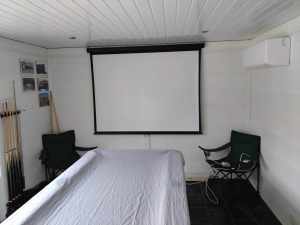
Old Screen
The following day, Sue and I visited the Kibworth Antique Centre and spent an enjoyable couple of hours browsing relics of the past. We even managed to purchase a couple of items that had caught our eye. On the way home, we received a call from Viv with some good news: they had exchanged contracts with their buyers. She was eager to know if we wanted the last few bits of house paraphernalia before they took them to the tip.
After lunch, Sue headed off to join her U3A rambling group, while I set about preparing to swap the projector screens in the Garden Room. I had just begun when Ian arrived, keen to offload the final contents from the house. I spent the next half hour transferring more miscellaneous items into the garage to be sorted through at a later date.
Before leaving, Ian kindly helped me mark out the drill holes for the much larger automatic screen, formerly in the lounge, which was now to be relocated to the Garden Room.
The remainder of the afternoon was spent mounting the screen and wiring it to its sensor. A very weary Sue returned just as I was finishing up for the day, and the light was beginning to fade.

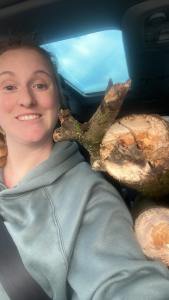

Over the following (very chilly) weekend, Jamie went paintballing to celebrate his friend Tommy’s birthday. Sarah and Lee spent an energetic day in Bagworth Woods cutting down trees. It seems the National Forest is trialling a rather novel initiative, ‘Community Woodfuel Days’, aimed at maintaining local woodlands, where volunteers are encouraged to fell rogue trees, with the added bonus of taking the firewood home. They provide the necessary tools and training, though sadly not chainsaws, so participants have to work hard for their reward. A great initiative and a win-win for all involved.
Charlotte and Suraj spent the weekend completing the refurbishment of Lucas’s bedroom, mounting a headboard made from reclaimed scaffolding planks and painting the newly fitted wardrobes. Sue joined a U3A nature ramble on Sunday, while I entertained a few rugby chums in the Garden Room, watching Leicester Tigers turn in a very poor performance in France against La Rochelle, losing 45–12.
Over the weekend, we received worrying news that Sue’s sister had been taken to the hospital with breathing difficulties. She had taken to her bed several days earlier, feeling quite unwell.

On Monday (15th), while the northern parts of the UK were blanketed in snow, Sue and I drove south under clear blue skies to Wiltshire. As one of my Christmas presents to Sue, I had arranged a three-day getaway to explore some of the prehistoric history of the county. Our itinerary included visits to the Neolithic henge monument surrounding the village of Avebury, as well as the more famous henge at Stonehenge.
The three-and-a-half-hour journey saw us arrive in the village of Avebury around midday, so we opted to sit on a conveniently fallen tree trunk in a field next to the car park and enjoy a picnic lunch. The village of Avebury lies partly within the monument itself, a vast circular bank and ditch enclosing an inner ring of massive standing stones, covering more than 28 acres.
After lunch, we chose to visit the Alexander Keiller Museum, located just outside the circular earthworks. The museum houses one of the most significant prehistoric archaeological collections in Britain and provides a fascinating insight into the lives of those who built and used the henge thousands of years ago.
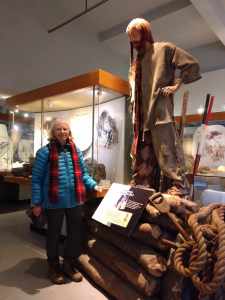
Alexander Keiller was a Scottish archaeologist, aerial photographer, businessman, and philanthropist. He worked extensively on the Avebury site and played a crucial role in its preservation. As expected, the artefacts and displays focused mainly on finds from the stone circle and its various excavations. However, given that the surrounding area is rich in Neolithic structures, including nearby Silbury Hill and West Kennet Long Barrow. The museum did an admirable job of placing the stones in a wider historical and cultural context.
Many of the exhibits were interactive and engaging, easily holding our interest, but we had come primarily to see the stones themselves, and that was where we headed next.
Just a short step across the road brought us into the vast circular monument, which is now quartered by roads running through the site. The depth of the surrounding ditch is striking even today, but armed with information from the museum, we could better imagine just how much deeper it would have been when first constructed, before centuries of natural deposition softened its edges.
The stones themselves are truly awe-inspiring. Avebury is not only home to the largest stone circle in Europe but also the oldest known stone ring in the world, predating even Stonehenge. Archaeologists believe that the inner circles were created around 2600 BC, with the outer circle and ditch added approximately a century later in 2500 BC. Each stone weighs up to 40 tons and stands over six metres tall.
It took quite some time to make our way around the entire circle, as each stone demanded to be admired, speculated over, and discussed anew, how they were moved, why they were placed where they were, and what purpose they might have served.

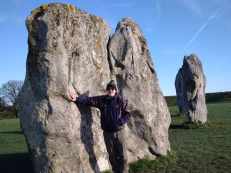
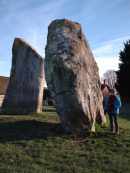

Returning to the car park and consulting the map provided by the museum, we set off along a muddy path leading to the nearby monument of Silbury Hill. The route followed the edge of fields and skirted low hedgerows; the winter landscape lay bare under a pale blue sky. Despite the lingering cold, the walking soon warmed us, and we made steady progress, slipping only occasionally on the sodden ground.
Silbury Hill soon loomed into view, an unmistakable man-made mound rising impressively from the surrounding flatlands. At over 30 metres high, it is the largest prehistoric mound in Europe, its scale quite arresting when seen in person. Dating from around 2400 BC, it remains something of an enigma; no burials have been found within, and its original purpose is still the subject of speculation. Religious significance? A marker of power? An astronomical feature? The theories abound, but none are conclusive. In approaching the hill, we had to cross a small field bridge which arched precariously over a full and fast-flowing River Kennet by way of a partially flooded field in which the monument stood. Originally, the ancient builders had dug a ditch surrounding its slopes, which was now full and spilt onto the surrounding grassy pasture.


Returning to the car, we chose to drive the short distance back to the hill and its small car park located on its southern side to view it one last time before sunset. With the light now turning golden and shadows lengthening across the fields, Silbury took on an almost otherworldly presence, its grassy flanks glowing softly in the fading sun. A pair of crows wheeled overhead in the stillness, their cries the only sounds to disturb the hush.
We stood quietly for a while, watching the sky deepen, and the last rays slip behind the mound. There was something deeply timeless about the scene, man-made yet ancient, familiar yet unknowable. It seemed fitting to leave it in silence, letting the moment speak for itself.
As the chill returned and the last of the light drained from the sky, we climbed back into the car and made our way to our accommodation, grateful for a warm room, a hot shower, and the prospect of a good meal. The day had given us much to reflect on, and we looked forward to what Stonehenge would bring the next morning.


That night, we stayed at a Travelodge on the outskirts of Devizes. After checking in, we drove into the town centre to enjoy a very pleasant meal at The Bear Hotel. With a history stretching back to the early 1600s, the inn has welcomed a remarkable array of guests over the centuries, from the Archduke of Austria in 1786 to George III and Queen Charlotte in 1789, and again the Queen alone in 1817. The Duchess of Kent and Princess Victoria stopped here in 1830, and Edward VII, then Prince of Wales, visited in 1893. Inside, little seemed to have changed since the early 1800s. Though the menu has certainly evolved, it was easy to imagine the grand scenes that had once played out in these rooms, far more illustrious than our quiet dinner.
The following morning, peculiarly enough, we breakfasted on foot-long sausage, bacon, and cheese subs from the Subway outlet next to our hotel. Surprisingly tasty and very filling, they fueled us well for the day ahead. Yesterday we had planned to visit West Kennet Long Barrow but had failed to fit it in, so today it was our first destination.
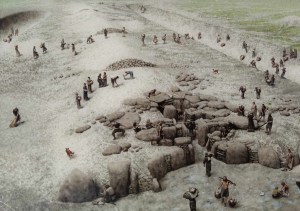
The West Kennet Long Barrow lies just half a mile from Silbury Hill. It took us about half an hour to drive there and park in a small layby beside a path leading directly to the monument, which stood visible on the ridge across the valley.
The River Kennet ran through the valley below. Although the small field bridge crossing the river was dry, the adjacent riverbank remained flooded from recent rains. Sue, wearing wellies, crossed the patch with ease, but I had to cling to the wire fence beside the path to avoid getting my boots wet as I carefully made my way across.
After a steady climb up the ridge, we reached the chambered long barrow, likely built around the thirty-seventh century BC during Britain’s Early Neolithic period. Today, it stands in a partially reconstructed state, offering a fascinating glimpse into ancient burial practices and the sheer effort involved in its creation.

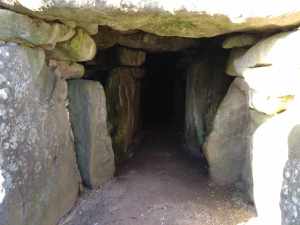
The monument was entirely ours to explore, stretching along much of the hilltop and standing prominently visible across the surrounding landscape. Constructed from earth, local sarsen stones, and limestone brought all the way from the Cotswolds, the long barrow is essentially a large rectangular tumulus outlined by kerb stones.
Inside, human bones were placed within the chambers, dated between 3670 and 3635 BC, and represent a mix of men, women, children, and adults. We ventured into the first chamber, tucked behind enormous stones that formed the entrance. Peering into the dim interior, our minds drifted back nearly five and a half millennia, imagining the lives and rituals of those long gone.
After reading the information boards, we wandered the entire length of the barrow, tracing the locations of the burial chambers as dips and depressions marked their spots beneath the earth. A bitterly cold wind whipped across the exposed site, ensuring we didn’t linger too long despite the haunting beauty around us. With boots squelching, we retraced our steps and splashed across the Kennet once more on our way back to the car.
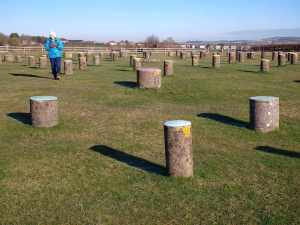

The 35-minute drive to Woodhenge was truly memorable, one of the most picturesque routes I’ve ever taken, only rivalled by the Pendle Witch Trail Sue and I explored years ago through the Trough of Bowland.
Woodhenge itself is an ancient Neolithic site dating back to around 2500 BC, located just 2 miles north of Stonehenge near Amesbury. It was first discovered in 1926 thanks to aerial photography, revealing 168 postholes arranged in six concentric rings. At its centre lies the grave of a child, believed to have been a sacrifice, as the skull showed signs of being split.
The original wooden posts, once towering several meters high, have long vanished, and today are marked by concrete replacements set in the postholes. The site feels quite stark now, with little physical structure remaining, but the detailed information boards and graphics help bring its story to life.
As we wandered among the markers, we were surprised to find a tooth and a name tag left on the central mound, right above the child’s grave. It was a poignant and curious gesture, and it made us wonder: why leave such a personal tribute here? Was it a sign of modern reverence, a connection to ancient rituals, or simply a visitor’s quiet homage to a life so long ago lost?
Curiosity sparked, we ventured deeper into the site, gently disturbing a small flock of sheep lounging by the Cuckoo Stone, a large, squat sarsen stone lying on its side. This is the same type of stone as the largest ones used at Stonehenge. We thought we could make out a face shape etched into the upper surface of the rock, somewhat reminiscent of the famous statues on Easter Island. But knowing how unlikely that was, we didn’t linger long and followed the sheep back toward the henge.
Next, we stopped to read an information board by the car park about the Durrington Walls, a Neolithic feature marking the site of a large settlement that may have housed as many as 4,000 people. Today, little remains visible, but in the distance, a faint ditch and bank system could still be seen tracing the outlines of this once-thriving community.
Just a short 15-minute drive away, we reached our final destination for the day: the iconic Stonehenge on Salisbury Plain. Built over several phases beginning around 2950 BC, the monument consists of a circle of massive sarsen stones encircled by a bank and ditch, enclosing an inner circle of smaller bluestones. At its core lies a horseshoe arrangement of five trilithons, aligned with the midsummer sunrise, likely for ritualistic or ceremonial purposes.
Today, visitors must park about one and a quarter miles away at the visitor centre and take frequent shuttle buses to the site. As English Heritage members, Sue and I enjoyed free parking and entrance to the museum, which gave us an excellent introduction to the monument’s history before seeing it in person.
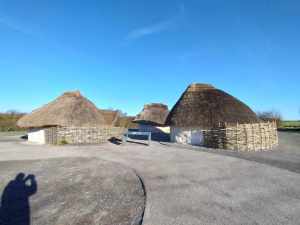

Even on a bitterly cold Tuesday afternoon in mid-January, the museum and site were buzzing with tourists from around the globe. Before stepping out to see the monument itself, we spent a good hour exploring the museum’s rich displays and artefacts. The highlight was the circular video wall, a captivating presentation that vividly traced Stonehenge’s history and significance. It’s definitely not to be missed.
Afterwards, we wandered through the recreated Neolithic village, where life-sized huts give a glimpse into how people might have lived in the area thousands of years ago. We also admired a replica of a massive sarsen stone mounted on a sled, showcasing the incredible effort required to move these giants.
Then, we caught one of the comfortable shuttle buses that ferry visitors the mile or so to the stone circle itself.
Sue, recalling her childhood, fondly remembered sitting on one of the large fallen blue stones inside the circle. Today, however, there was no chance for that nostalgic photo; the circle was now cordoned off by ropes to protect the stones, preventing visitors from approaching too closely. Still, a well-trodden path tracing the perimeter of the monument offers a full 360-degree view of the awe-inspiring megaliths, allowing us to marvel at their size and setting from every angle.
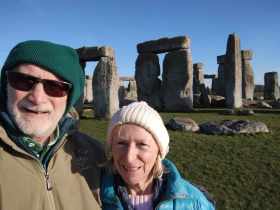

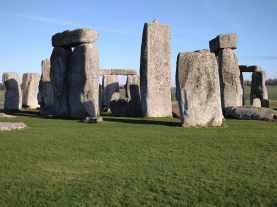
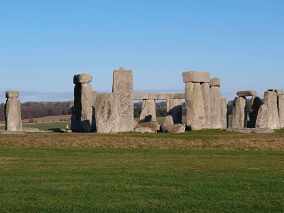


It was while we were circumnavigating the monument that I received a call from the Travelodge we had left earlier that morning, apparently, I’d left my spare mobile phone behind in the room. The hotel staff kindly assured me they’d keep it safe until I could return the next day to collect it.
After that, we spent another hour leisurely walking around the henge, soaking in the atmosphere from every angle. Then, we made our way back to the Visitor Centre, where we browsed the museum shop for souvenirs and books before setting off to Durrington for the night.
Our accommodation was something quite special, one of the Stonehenge Inn’s Shepherd Huts, tucked away in the pub’s courtyard. These huts are beautifully crafted to be both authentic and comfortable, with all the modern amenities you could want: an ensuite bathroom, insulation for year-round comfort, hot water, and even a TV. It was the perfect cosy retreat for a short stay, with the bonus of having a great pub just a few steps away.


The Shepherd Hut, named ‘Chapel’, was perfectly snug, warmed quickly by the electric heater we switched on as soon as we arrived. Leaving it on while we popped back to the car to explore Durrington made sure we returned to a welcoming, warm space.
As for Durrington itself, well, it’s not exactly a picturesque village, just a scattering of shops, a couple of churches, a pub or two, and rows of pretty typical housing. Any real interest lies beyond the village borders in the prehistoric sites we had come to see.
Back at our hut, we passed the early evening watching TV until around 7 p.m., then headed to the pub bar for dinner. To our surprise, the pub was hosting about 80 soldiers from a nearby base, apparently having a Christmas celebration. Expecting noise and chaos, we were instead met with polite, well-behaved young soldiers, a stark contrast to the rowdiness you might find with a crowd of rugby or football fans.
For dinner, both of us opted for the pub’s speciality dish, ‘Chicken Stonehenge.’ It was a hearty and delicious meal, definitely one I’d recommend if you find yourself there.

The next morning, since our Shepherd Hut didn’t offer breakfast, we found ourselves back at Subway, this time after picking up my forgotten mobile from the Travelodge reception. With our appetites satisfied, we drove into Devizes and parked near the town green, where a frozen pond was the centrepiece. Using the crusts saved from our Monday picnic, we fed the ducks, swans, and seagulls gathered on the small patch of ice-free water near the bank.
Wandering into town, we visited the Wiltshire Museum, which is housed in a beautiful Grade II-listed Georgian and Victorian building. Since 1874, the museum has been a treasure trove, notably boasting the largest collection of Early Bronze Age gold ever displayed in England. We spent a good hour admiring roughly 500 Stonehenge-era objects, leaving the more modern exhibits for another day.
Finishing our visit, we wandered at random through some of Devizes’ narrow medieval streets, soaking in the town’s character before making our way back to the car. With the Satnav set for home, and the aircon turned to warm, we began the journey northward.
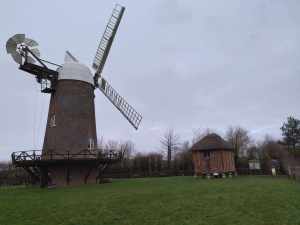
Before leaving Wiltshire, we noticed a sign pointing to a historic windmill nearby and decided to take a detour. After winding along narrow, often wooded lanes for about five miles, we arrived at Wilton Windmill, a striking five-floor brick tower mill perched on a chalk ridge between Wilton and Great Bedwyn in the Vale of Pewsey. Built in 1821, the mill stands behind a solitary, elegant house atop a rather chilly hill.
Thanks to the dedication of volunteers, the mill has been restored and, on select days, still grinds grain into flour. Though the sharp breeze kept us from lingering too long, the visit was a refreshing and pleasant pause in our journey.
The remainder of our trip home passed smoothly and without incident, bringing to a close another memorable chapter of our Neolithic adventure.
 Palmer Family
Leave a comment