30th September 2023
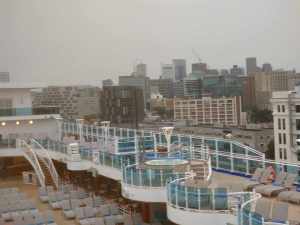
Port days are always tinged with uncertainty; there are usually forms to fill in, schedules to keep, and the perennial question of what to wear. I steadfastly refused to wear name badges or identification tags throughout my working life. Yet, aboard ship, I’m more than happy to have a sticker stuck to my jacket or rucksack, anything that lightens the burden of ensuring I disembark at the right time and in the correct group.
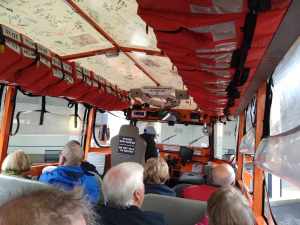
It was a dry, overcast day in Boston, with a slight chill in the breeze, ideal weather for exploring a city. Disembarking 3,400 passengers takes time, especially since US Customs and Immigration require each guest to complete a two-page form and attend a face-to-face interview. Fortunately, we had booked a morning tour and were placed in the first group to be processed. By 9:30 a.m., we were dockside and boarding our transport, a WWII-era vehicle affectionately known as a ‘Duck’, capable of travelling on both land and water.
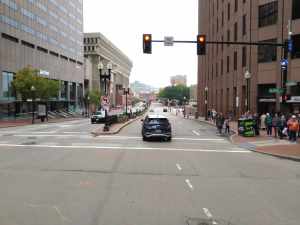
Along with 32 other guests, we spent about an hour touring the city, taking in the sights as our guide, amusingly dressed as a Viking, provided a lively commentary at each location. Viewing a modern city interspersed with historically significant older buildings, all dwarfed by towering glass and concrete structures, wasn’t quite what we had hoped to experience. The real draw of the tour was taking to the water in a road vehicle and observing the city from this unique vantage point.
There are 28 of these amphibious vehicles, known as ‘Ducks’, operating in various colours across the tourist trade; ours was bright orange.
We entered the water via a gently sloping ramp, comically governed by a set of traffic lights. After a brief wait to allow a black ‘Duck’ to exit the river, we glided effortlessly down into the Charles River. What followed was a leisurely half-hour sail, turning around after passing beneath the arches of Longfellow Bridge. We cruised past the Boston sailing and rowing club, momentarily disturbing two eights preparing to race. All too soon, we exited the river at the very point we had entered, just as smoothly as we had arrived.
Another half-hour of land-based touring through the city’s increasingly congested streets followed, and all too soon we were back at the port, tipping our guide and wondering what to do next.
Following a stream of passengers spilling from the bowels of the Sky Princess, we joined a queue at a nearby bus stop, half a block away, and asked where the bus was headed. Most, like us, hadn’t a clue, but a couple nearby interjected, saying it was going to the South End, which they believed was in the city centre. Expecting to pay upon boarding, we were pleasantly surprised to find it was free. Fifteen minutes later, we disembarked at the city’s main train and bus terminus.

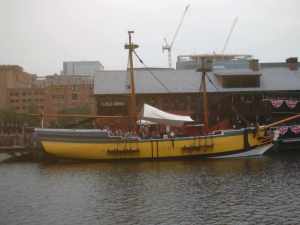 On the pavement, we consulted Sue’s notes from the onboard city presentation, studied the map, and decided to visit the Boston Tea Party Ships and Museum. A short walk guided by Google Maps brought us to its entrance.
The museum re-enacts the pivotal event that sparked the American War of Independence, using costumed historical interpreters, interactive exhibits, full-scale replicas of 18th-century sailing ships, and a wealth of historic artefacts. At $37 per person, it wasn’t cheap, but it was well worth the cost, particularly if, like us, your knowledge of the Boston Tea Party and its context is somewhat patchy.
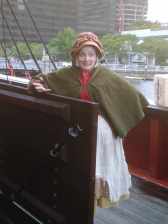
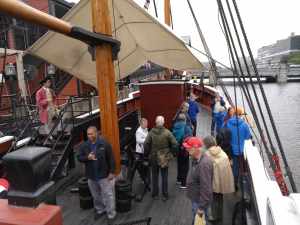
On entry, each of us was assigned a character who took part in the original event. I was Francis Akeley (1731–1775), a self-employed wheelwright and one of those who famously threw the chests of tea overboard on the night of 16 December 1773. Sue became John Sawtelle (1743–1811), a lawyer who had ridden 60 miles on horseback to be there for the momentous protest. We re-enacted the town meeting that led to the decision to defy British taxation on tea, then boarded and explored a replica of one of the three ships. Some guests, including Sue, took the opportunity to hurl a crate of tea into the harbour.

Inside the museum, a combination of clever technology, striking visuals, and engaging performances by our guides brought the unfolding events and the path to revolution to life. The presentation was superb. As an ardent British citizen, I have to admit that the colonists had a point and presented a very persuasive argument. It’s just a shame they couldn’t have paid the tax, remained within the British Empire, learned how to spell properly, mastered the use of a knife and fork, and voted sensibly.
Afterwards, we took a short stroll along the river before returning to South End station to catch a bus back to the Sky Princess, just in time for a very late lunch.
That evening’s performance in the theatre featured an excellent folk band called The Trawler Men. Billed as an Americana group from London, Dara, Justin, and Ben are three friends with varied musical backgrounds, united by a shared passion for folk music from the British Isles. Performing as a vocal trio with guitar, double bass, and violin, they delivered a very enjoyable and accomplished show.

 Palmer Family
Leave a comment