18th September 2023
“I grow dauntless as I grow old, I believe anyone that plods on in any one way, especially if that one way will bring him bread & cheese, will grow the same.”
Thomas Gainsborough

The 28th of August was a Bank Holiday and, although it started well, it didn’t end too well for me. An early morning bike ride through the fields around Lubenham took me across the vast new estate being built on the old airfield and onto the outskirts of the town, where I discovered that one of the roads was named after a Palmer. Curious, I asked Bard, the conversational generative AI chatbot developed by Google, and it informed me that the street was named after a nineteenth-century local landowner named William Palmer.
Hoping to find out more about this gentleman, I did some further digging on Google and came across several articles about a William Palmer, known as the Rugeley Poisoner or the Prince of Poisoners, an English doctor found guilty of murder in one of the most notorious cases of the 19th century. Obviously, this was not the local landowner and an unlikely candidate. So, digging deeper, I discovered a Horace William Palmer, once landlord of the Talbot Inn in the town, who died in the First World War. A much more plausible candidate, as was his brother, P. R. Palmer, who was also killed in the Great War after being shot down on 25th May 1917 during the Battle of Arras. His aircraft became the 20th victim of the German ace Karl Allmenroder, one of Manfred von Richthofen’s Flying Circus.
I suspect Bard confused the titled landowner with a landlord, which led me down the fascinating path of uncovering the lives of these three Palmers!
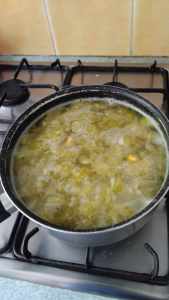
Soup
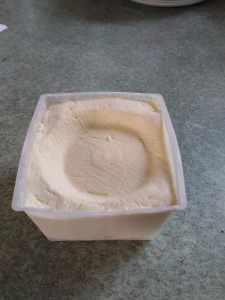
Creamy Cheshire cheese
After arriving home and having a shower, I set about using some of the ripe tomatillos I had grown this year. I found a recipe for Tomatillo and White Bean Soup and set about making what eventually turned out to be a delicious bowl of grub. While preparing the ingredients, a toothache developed in my lower left mandible and grew increasingly painful as the day went on.
That afternoon, I began making a creamy Cheshire cheese, a process that lasted until 9 pm before the cheese was carefully placed in the fridge to chill. An early tasting promised delights in the days to come.
Despite taking paracetamol, the troublesome tooth allowed little sleep that night. The following morning, as soon as the dentist opened, I booked an appointment. Unwilling to accept a slot in late October, I settled for one six days away. However, after another day and night of pain, a further call successfully brought the appointment forward to just two days later, 1st September.

Over the Bank Holiday, Charlotte and her family chose to travel to Wells-next-the-Sea, a town once renowned as an important commercial seaport and manufacturing centre, but now a popular seaside destination and still a working fishing port, to spend some time on the beach enjoying the late summer sun.
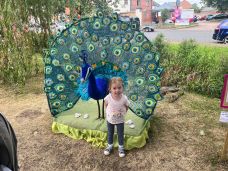
On the same day, Sarah and her family preferred to stay local and visit the sixth annual Desford Scarecrow Festival. They followed this with a trip to Cosby Yarn Bomb to admire the incredible creations of some very talented villagers.
 Jamie and Ruth chose to come to Harborough for a BBQ with friends. Later, they dropped Nala off with us for a few hours while they went ten-pin bowling in Kettering. The dog enjoyed munching peanuts with us while we watched a film on Amazon Prime. We have come to the conclusion that the quality of films available on this platform is rather poor and limited in genre; it’s great if you want to watch war films, but most of the ones we sat through appeared to have been made on very tight budgets.
On Tuesday, Sue took Doreen to Hoby, near Melton Mowbray, for coffee and cake and to have a look around her son’s garden centre. Sean and I made use of our free bus passes to catch a late morning bus to Lutterworth. After a substantial carvery lunch at The Elms pub, we meandered through the town following the Town Trail, then enjoyed coffee in the Wycliffe Rooms before catching the 3.30 pm bus back to Harborough. A pleasant way to spend a coolish day.

Though the end of August fizzled out with indifferent weather, September began with much more promise. Temperatures rapidly climbed into the 20s (°C) with the sun making a welcome return. With no live rugby to watch on screen on Saturday the 2nd, I met up with Jim C, Jim H, and Roy at Harborough Rugby Club to watch the 1st team lose to Nuneaton in a highly entertaining game. The conditions drew a large crowd, providing a great opportunity for humorous banter with old friends. One such conversation was with a fellow referee who had taken charge of the 3rd team match. At 77 years of age, I was astonished by his fitness and ability to keep up with play. Past injuries had curtailed my refereeing duties at the age of 60!
On Sunday, Sue and I visited the Rothwells to celebrate Charlotte and Suraj’s wedding anniversary. It was an appropriately glorious, hot day, and we spent the time sitting in the garden, chatting and sipping cool drinks. Later, I took a hot and lethargic Harry for a walk into the centre of Rothwell, then we drove home.
Throughout the following very hot week, Sue kept busy with her petanque, rambling, and architectural U3A groups, managing to fit in coffee and biscuits with friends Lynne and Bridget. I, on the other hand, became solely occupied with a toothache. My first dental appointment (on 1st September) resulted in shaving off part of a previous filling (on the second lower left molar). This provided some relief for a few hours, but the pain soon returned. As it was a Friday, I had to wait until Monday to contact the dentist again. However, on Sunday afternoon, after eating lunch, the pain soared into the stratosphere of agony. Nothing would relieve it; I curled up into a ball in my study and groaned for over an hour before I could bear to pop two codeine tablets into a very reluctant mouth.
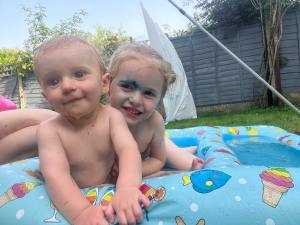
Archie and Alice chillin’.
Monday arrived, and dosed up with painkillers, Sue took me for an early appointment for a now regular eye injection in Leicester. Returning to Harborough by 10 am, she dropped me off at the squash club where she was to play petanque, and I walked the short distance to my dentist. I was pleasantly surprised and grateful that, after explaining the situation to the receptionist, the dentist saw me straight away.
After examining the tooth, he proclaimed that the lower jaw tooth needed removing, as did one on the upper jaw. He could remove the upper one but not the lower, as it was too tricky, and suggested I consider a private clinic in Leicester for that procedure. I agreed to proceed with that plan, and he made an appointment to extract the upper tooth the following Friday. I would have to wait for the private clinic to contact me regarding the lower tooth.
After another painful night, on Tuesday morning, I contacted the dentist to check if the referral had been made. I was informed that I had been referred for the removal of a wisdom tooth. This came as a surprise, although it had caused me pain on several previous occasions. The receptionist suggested I contact the clinic directly, which I did.
When I called, the clinic’s team were discussing my case. The receptionist took some further details and said they would get back to me. Half an hour later, she rang to ask if I could attend the clinic within an hour for a short examination to determine the best course of action. I hurried to the Carisbrooke Dental Clinic in Leicester and made the appointment.
After a couple of X-rays, numerous photographs, much prodding with jets of air, and some tapping of teeth, it was explained that the wisdom tooth had a small crack. The options presented were: (a) removal of the tooth at £300; (b) root canal and filling at £800; or (c) root canal and crown at £2000. The dentist also said, “Please, Mr Palmer, do not have the upper tooth extracted; I can see nothing wrong with it.” I chose the first option, and the extraction was scheduled for the following afternoon. I paid £175 for the consultation and headed home.
Wednesday was another very hot day, and ironically, Jamie dropped his car off in our driveway on his way to spend a few days in Tenerife with his friend Tommy; the temperature in Harborough was actually 4 degrees hotter than his destination. Later that afternoon, I set off with some trepidation for the scheduled tooth extraction at 2 p.m.
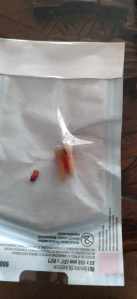
I needn’t have worried. After several injections of anaesthetic and a lot of tugging and wiggling, the tooth thankfully popped out without pain. The resulting hole was sutured and padded to soak up the blood and prevent further leakage. In less than 40 minutes, I was on my way home, the offending tooth safely in a plastic bag and my bank account £300 lighter. Considering the excruciating pain of the past week, the cost of permanent relief was well worth it. I have the utmost sympathy for those in the past who somehow had to endure such agony or undergo extraction without anaesthetic.

The following morning, I cancelled the extraction of the ‘good’ tooth and received a refund.
That afternoon, I visited the doctor to have a small mole on my back checked. Sue had noticed six weeks earlier that it seemed to have grown in size. The doctor thoroughly examined the mole, as well as the rest of my back, front, and head for anything concerning; fortunately, there was nothing to worry about. It was the shortest GP visit I have ever had. On returning home, I received a text from the surgery asking me to check my blood pressure and send the reading in. I did so, and it was normal.
 Sue and I have become dedicated surrogate conservationists for the wildlife around our property. Each evening, we put out apple and pear windfalls, fat balls, dog biscuits, and any leftovers from our meals during the day. Throughout the night, we are entertained by visits from badgers, foxes, deer, and muntjac. It is rare for any food to be left by morning.
Recently, I’ve been placing out dishes of red grape juice from last year’s crop, which, frustratingly, failed to ferment into wine. The badgers, however, are quite fond of it. Before breakfast, we scatter seeds and peanuts, along with any leftover bread, for the wide variety of birds to gorge themselves, as well as several squirrels. Often, we also receive a visit from an early, lone deer or muntjac, as well as a little sweet-faced water vole.


However, our once-growing clan of pigeons, which seemed to queue up every morning for their breakfast, is being decimated by a sparrowhawk and a peregrine falcon. This week alone, we have lost three of our feathered friends to these voracious raptors. Of course, it is nature’s way, and we accept that, but unlike those pigeons that seem to commit suicide by flying into the house windows, these birds of prey meticulously pull out their victim’s feathers before consuming their frail bodies, annoyingly leaving the debris scattered by the breeze all over the garden.
The other day, Sue and Bridget were sitting by the garden room, enjoying drinks and biscuits, when they watched bemused as a brazen sparrowhawk caught and dismembered its victim just a few metres away, creating yet another mess of feathers. Since then, it has been noticeable that the pigeons, though wisely hiding in the surrounding trees, have been absent from the breakfast table.
It’s the start of a new school year, and the main news over the past few days has been the closure of many school buildings due to the discovery that RAAC concrete deteriorates with age and is present in numerous establishments. However, that did not stop two members of the clan from beginning a new era of learning. Alice had her first day at pre-school, and Lucas started his first day in the Sixth Form. Ellis and Joey had already begun their second year at secondary school. Exciting times for them all.

Alice looking smart

Off to pre-school
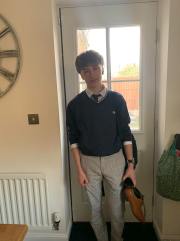
Lucas looking smart
Off to school
Life has a habit of throwing the occasional curveball and proving you wrong. The 11th of September was one such day. Eager to watch the England football team thrash Ukraine in Poland in a late afternoon kick-off, I was left frustrated by a lacklustre performance. England seemed content to pass the ball around the field without much purpose. With 69% possession and 695 passes compared to Ukraine’s 321, and Ukraine managing just two shots with only one on target, how on earth did the match end in a 1–1 draw?

Then things got worse. Convinced that, having lost three of their last four games, the England rugby team would be dismantled by a huge Argentinian pack in their opening World Cup group stage fixture in France at 8.15 pm, I wasn’t surprised when Tom Curry was sent off in the first few minutes. It’s just been that kind of a couple of seasons. It didn’t matter that the offence probably only deserved a yellow card, certainly not a red, yet the officials, who urgently need to sort these things out, seemed incapable of doing so. My mood wasn’t helped by the fact that George Ford was playing fly-half, in my opinion, the least talented no. 10 in world rugby, whose only real skills seem to be kicking the ball high and occasionally delivering a bullet pass. The post-match stats confirmed my view, with Ford passing the ball only twice and kicking everything else.
So, how on earth did we win 27-10? I suppose there’s a time and a place for everything, and the Stade de Marseille was it for George and the England side. Three drop goals and six penalties from the day’s hero, coupled with a ferocious team defence, sealed one of the unlikeliest victories ever. No, I haven’t changed my opinion on Ford; every dog has its day, and this was his. Argentina were poor, failing to grasp that against 14 men, you keep the ball in hand and run the opposition off the park. Instead, they tried to outkick a player who knows little else and were rightly humiliated.
Dare I hope? If, by some miracle, England wins this World Cup, I might just rethink my views on the Lancastrian Ford.
RANT: At this month’s G20 summit in Delhi, all references to Russia, Russian aggression, and Russia’s withdrawal and condemnation of the war in Ukraine, which featured in last year’s joint statement at the G20 summit in Bali, were removed from the official declaration. Instead, the statement merely emphasised that states must “refrain from the threat or use of force to seek territorial acquisition” and that “the use or threat of use of nuclear weapons is inadmissible.” Shame on India for lacking the courage to stand up to those with vested interests and to continue naming names. The war against Ukraine isn’t the only conflict raging worldwide at present. It’s understandable that many countries see the struggles they face directly as more pressing than trouble elsewhere. But this was an opportunity to call out those aggressors too, not to produce ineffectual statements that let perpetrators hide behind a smokescreen of anonymity, weakening the barriers that preserve humanity.

Sunday, the 10th, was another hot and sultry day. As usual, Sue rose early and went off to scour the local car boot sale for bargains, returning just after 9.30 a.m., red-faced and exhausted. Sarah had rung earlier to say the family were heading to the Lubenham Scarecrow Festival, and Charlotte and her family had decided to join them. Sue couldn’t face more time in the sun, so we opted not to go.
Around midday, both families arrived for drinks and snacks in the garden. I played a couple of games of pool with Ellis in the garden room while the rest of them lazed in the sun. With thunderstorms forecast for the afternoon, they left for home after about an hour.
Sue and I had booked a couple of nights at the Mill Hotel in Sudbury, Suffolk, so bright and early the following morning, we set off to visit one of the greatest houses in England, Audley End House and Gardens, a spectacular early 17th-century mansion set in beautifully landscaped parkland. After a leisurely drive of one hour and fifteen minutes, we parked alongside a dozen or so other cars in a field once used as a cricket pitch by the younger members of the Braybrooke family and walked the short distance to the main house.

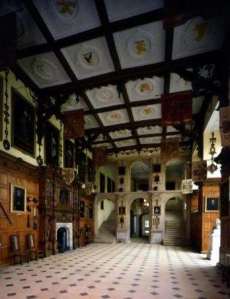
It was a lovely sunny morning and promised to remain so all day, so we chose to explore the impressive Jacobean mansion first. Though now only a third of its original size, it was built on the site of Walden Abbey, a Benedictine monastery dissolved and granted to the Lord Chancellor Sir Thomas Audley in 1538 by Henry VIII. The abbey was converted into a domestic house for him and was originally known as Audley Inn.
We spent a couple of hours wandering through this very palatial building, admiring its opulence, reading as many of the information boards as we could, and immersing ourselves in the stories and lives of those, both rich and poor, who had inhabited or frequented the many rooms and outbuildings. The house has a fascinating history and was well worth the slight detour from the more direct route to our accommodation in Sudbury.
Later, we retired to the shade of one of the many large oaks within the park to rest our tired feet and have a picnic before setting off on a trail to explore the park and gardens. A highlight of our wanderings was discovering the 120 varieties of apple trees contained within the walled gardens.
After completing our visit with a quick trot through the stable yard, we continued our journey to the Mill Hotel late in the afternoon.
Our route took us through the delightful narrow lanes of the Suffolk countryside, passing through chocolate-box villages of thatched cottages, little changed since Medieval times. Sue commented on each as we motored by, providing a running commentary that I could appreciate but not fully take in, my eyes glued to the road ahead to avoid the many potholes and the occasional vehicle suddenly appearing around tight, hedged bends.
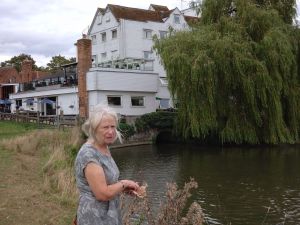
Pulling into the Mill’s car park, we checked in to discover that our room was across the road from the main hotel, in a group of buildings called the ‘Cottages’.
Having spent just over an hour driving to reach our destination, we chose to stretch our legs by feeding the many ducks on the associated millpond, with food helpfully provided by reception. We followed this with a short walk through part of the town before returning to change for dinner, which we enjoyed in the hotel restaurant.
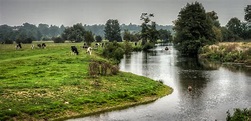
After breakfast, we pulled on our walking boots and set off along the River Stour, following part of the Gainsborough Trail before heading out into the Suffolk fields, returning five miles later to the hotel. It was a lovely day for a walk, passing through the water meadows where Thomas Gainsborough, the famous portrait and landscape painter who was born and educated in Sudbury, would set up his easel and paint. We could imagine the scene on a day when cattle lazed comfortably on lush grass beneath a cloudy blue sky, nonchalantly chewing the cud, unperturbed by the many walkers passing close by.
Having built up a great thirst during the increasingly humid morning, we stopped for quenching drinks in the hotel bar before driving to England’s best-preserved medieval town, Lavenham. The town prospered greatly from the wool trade in the 15th and 16th centuries, with blue broadcloth being a speciality. By the late 15th century, Lavenham was among the richest towns in the British Isles, paying more in taxation than considerably larger centres such as York and Lincoln.

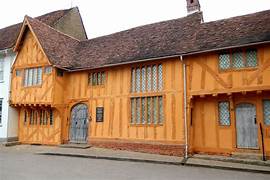
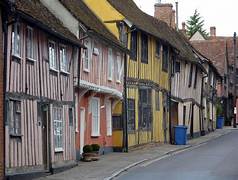
We spent time meandering through its pretty streets, reading the many plaques and information boards, and discussing each quirky building as we passed by. In the late 18th century, the village was home to the poet Jane Taylor, who may have written the poem The Star while living on Shilling Street, the source of the lyrics for the nursery rhyme Twinkle Twinkle Little Star. Returning to the market square where our car was parked, under a threatening sky, we paid our admission to the nearby Guildhall of the Catholic Guild of Corpus Christi. Built in 1529, it is now an excellent museum outlining the history of the town. We spent a pleasant hour or so immersing ourselves in the past lives of its inhabitants, while outside, a torrential storm raged, instantly flooding the square and sending fellow tourists scurrying into the surrounding coffee houses and pubs.
It was still raining when we hurried to the car, and any thoughts of visiting the large church of St Peter and St Paul, located on the outskirts of the town, were dashed by the weather.
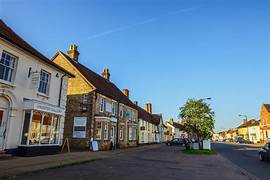
As we drove the few miles to Long Melford, the rain stopped. A former medieval wool town, Long Melford’s wide, tree-lined village street is the country’s longest. It is lined with fine buildings housing antique shops, art galleries and designer boutiques. We parked opposite one of its many antique establishments and spent half an hour perusing its curios before walking the length of this linear settlement. By then, the hour had passed 5 p.m., so most shops were closed for the day, thwarting any further indoor ventures. It is a pretty little place, worthy of a longer visit, but not today!
That evening, we chose to walk the half-mile or so down the road from our accommodation into Sudbury to enjoy a splendid Turkish restaurant for our evening meal.
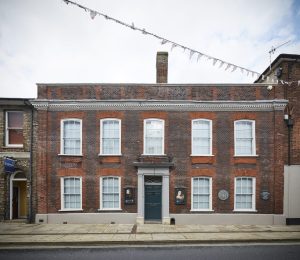
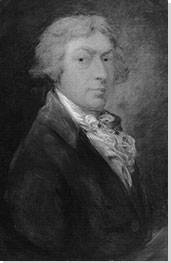 On any visit to Sudbury, one cannot fail to notice how proud its inhabitants are of their past, and in particular of Thomas Gainsborough, who achieved fame as the best-known English artist of the 18th century for his outstanding innovations and techniques in both landscape and portraiture. Beyond pubs, houses, streets, and trails bearing his name, there is, as you might expect, a museum dedicated to his life and art, appropriately housed in the very building where he was born. It was here that we spent the final morning of our trip to Suffolk.
The museum is situated close to Sudbury’s main square and comprises a mixture of buildings, with extensions dating back to around 1520. Thomas Gainsborough’s parents, John and Mary Gainsborough, likely moved here in 1722, five years before the artist’s birth. Promptly at 10 a.m., we were the first visitors of the day and set about exploring the building and its collection. Among the many paintings and drawings displayed in the rooms, many, as one would expect, were by Gainsborough himself. By comparing them with works by other artists, it is plain to see he was truly ‘a cut above’. A linked gallery in the new and very modern-looking extension housed a collection of works by Maggi Hambling, a contemporary artist whose style and techniques are as far removed as possible from Gainsborough.

The day was another glorious late summer affair, so we chose to move on to the Heritage Centre in the Town Hall, with its entrance just a short distance away in Gaol Lane. Most of the exhibits were located on the ground floor near the entrance; they were well displayed and proved to be fascinating, keeping us engrossed for nearly an hour.
Returning to the hotel car park, we began an uneventful journey back to Harborough, arriving in good time to cycle to and join the queue at the Medical Centre for our winter flu and Covid vaccinations.
The following week was spent preparing ourselves, the house, and the gardens for a month-long trip to New England and Canada. Before our visit to Sudbury, I had received a message from my step-brother, David Nixon, asking me to accompany him to his property in Bulgaria around mid-November. He and Genya, due to Covid and moving house in the UK, had not visited the property for over four years. The plan was to assess its condition and carry out any necessary work. Having previously spent several enjoyable months working on the house, helping him bring it up to European standards, I agreed to join him. It was then a matter of quickly arranging trains, hotels, flights, and car hire before Sue and I set sail for the Americas.

On the 16th, Radio Two came to Leicester with their ‘In The Park’ roadshow. After returning from Tenerife, Jamie and four of his friends attended the all-day event in Victoria Park, and luckily, the weather was fantastic for an outdoor music gathering. At 34 years old, I suppose he’s now past the age of appreciating Radio One songs and feels more comfortable with less modern tunes. Sadly, Susan and I find ourselves firmly in the Radio Four audience, where very little music is played!
The second round of Rugby World Cup matches saw Australia lose to Fiji, and England unconvincingly beat Japan 34–12, with two of their tries comically gifted by the opposition. It wasn’t at all clear what tactics England was employing, other than kicking the ball to the opposition, running after it, and seeing what happened. It’s not a strategy that will take them to World Cup glory. I shall miss their next two group-stage matches against Chile and Samoa, as well as the quarter-finals (unless they’re shown on the ship), which England should now comfortably qualify for. However, Sue and I will be back in the UK for the semis and the final, giving me something to look forward to and easing the disappointment of not being on holiday!
 Palmer Family
Leave a comment