26th April 2023
Today began at a leisurely pace as we prepared to catch our flight from Bahir Dar to Arba Minch via Addis Ababa. Breakfast was finished by 8 a.m., and I spent the remaining time updating the blog before we boarded our minibus to the airport at 10:30.
The twenty-minute drive marked the beginning of what turned out to be a rather stressful journey. Security at Ethiopian airports is strict and repetitive; there’s no room for error. Unfortunately, I had an illegal set of binoculars tucked away in my suitcase, carefully surrounded by a cluster of metal and electrical items in the hope they might be disguised. Would it be enough to conceal the offending contraband?
To my relief, both my suitcase and rucksack passed through the two sets of scanners without issue, and we proceeded to check in. However, a new concern quickly arose when the check-in agent, inexplicably, chose to tag all our luggage under our guide’s passport. We watched as the cases disappeared onto the conveyor belt, only for Sue’s and mine to reappear moments later, making a second circuit.
Puzzled, I watched as our bags continued to revolve aimlessly on their own for the next fifteen minutes. Meanwhile, we once again had to disrobe and send our belongings through security screening. As we made the long walk out to the aircraft, I kept an eye out for a luggage trolley carrying our cases, but saw none. A niggling sense of unease lingered as we boarded, unsure whether our bags would make it to Arba Minch with us.

We took off on time and, fifty minutes later, landed in Addis Ababa. Yet more disrobing and scanning awaited us before we were allowed into the terminal building. We made our way to the baggage carousel to await our cases, and, by some miracle, they appeared!
With cases in tow, we raced through transit, only to be stopped by an official who insisted on scanning our luggage again. Will this never end? I thought. But then, quite suddenly, he changed his mind and waved us towards the diplomatic check-in to expedite our journey through security. With the cases once more disappearing along the conveyor belt, we headed to the gate, boarding passes in hand. The flight departed on time, and we touched down in Arba Minch an hour later.
Reunited with our cases, we boarded the small coach that was to be our transport for the day. Our destination was a visit to the Dorze people, who live high in the Gughe Mountains. Once feared warriors, the Dorze are now better known for their skill in cotton weaving and the production of brightly coloured clothing. Their tall, beehive-like houses, constructed from bamboo and other local materials, are an iconic feature of the landscape.

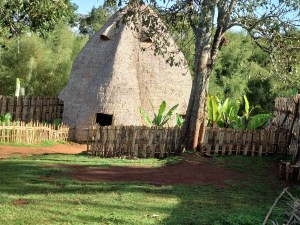
The road, more accurately, a rough and rutted track, wound steeply up the mountainside, utterly unfit for anything
other than a purpose-built off-road vehicle. Yet, somehow, buses, minibuses, and motorbikes all bounced, lurched, and weaved their way along its unforgiving surface. As we passed clusters of the Dorze’s distinctive homes, curious structures that felt oddly familiar, children dashed into the road to greet us, dancing with wiggly bottoms and irrepressible energy. They seemed genuinely thrilled to see us, and we waved and smiled in return, caught up in the warmth of their welcome.
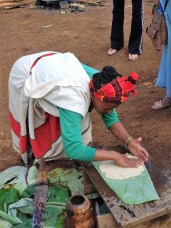
Upon arriving at the main village, we were greeted by the headman, who first led us into one of the towering, woven houses, giving us a chance to satisfy our curiosity about their remarkable construction. From there, we were taken to a small compound, where three women gave a demonstration of how they prepare a traditional bread unique to this region, made using the enset, or ‘false banana’ tree.
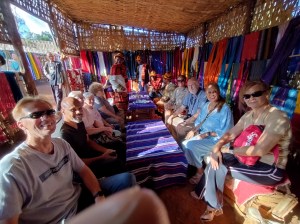
We continued and passed a large hut where a group of students from Addis Ababa had gathered, like us, they had come to learn about the Dorze. Dressed in brightly coloured garments they’d clearly purchased in the village, they were exuberant, lively, and very noisy. The air was filled with laughter as they knocked back shots of a locally brewed spirit, and they cheerfully invited us to join them.
We accepted. Seated along a long wooden table draped in cloth, we were handed full glasses of a clear liquid, allegedly made from garlic, honey, and herbs. It tasted utterly vile. However, after learning the local chant and response that accompanied the ritual of drinking, we joined in and downed our glasses, only for them to be refilled almost immediately. With a mixture of reluctance and good humour, we swallowed the second round too.
The students then challenged our group to lead a chant of our own. To my dismay, my fellow travellers promptly nominated me. Years of playing rugby had prepared me for such moments, but did it have to be with such an unpalatable drink? For my amusement, and to the confusion and delight of everyone present, I launched into the familiar call: “Ogi! Ogi! Ogi!” The crowd responded enthusiastically with the expected “Oi! Oi! Oi!” and, somehow, the dreadful liquid tasted just a little better for the change in tune.

With time pressing on, we made our way into a large hut where a group of colourfully dressed village women were chanting and dancing with infectious energy. Some of our group joined in the dancing, while others added to the rhythm with enthusiastic clapping. It was a brilliant experience, and the women seemed genuinely delighted by our willingness to get involved.
All too soon, it was time to leave. Our coach was parked near several racks displaying woven village garments, and we took the opportunity to support the local economy by purchasing some of the more colourful items on offer.
The journey back down the mountain was every bit as entertaining as the ascent. Children still dashed out to wiggle and dance for us, then attempted, often alarmingly, to race the coach as it shuddered and slid its way downhill. The views, however, were spectacular. As we descended, we looked out across the lush green landscape and the sparkling lake beyond, a vivid contrast to the drab browns and greys of the arid north. Surrounded by fields teeming with thriving crops, I thought to myself: I shall have a salad tonight.
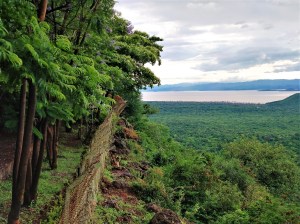
We checked into the Mora Heights Hotel at 6.30 pm and discovered that we had been allocated a chalet overlooking farmland, with the lake visible in the near distance. After a brief delay due to an incorrect room allocation, we were swiftly reassigned and had just enough time to freshen up and change before heading down for the evening meal.
The area is known for malaria, so we were relieved to find our bed fully netted. Even so, we spent some time hunting down as many mosquitoes as we could find and dispatching them with satisfying efficiency before finally crawling into bed, liberally scented with mosquito repellent.
 Palmer Family
Leave a comment