23rd April 2023

 Today did not start well for me. It should have been a day spent visiting the northwestern cluster of rock-hewn churches, beginning with an early, impromptu return to yesterday’s church to be blessed by its sacred golden cross. However, I woke feeling unwell and decided to sleep it off at the hotel. I suspected mild food poisoning from the fish I had for dinner the night before, and this later proved to be the case. Sue left me resting and joined the group for the day’s excursions.
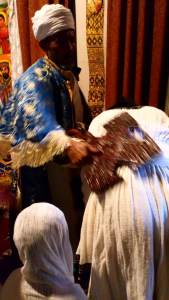
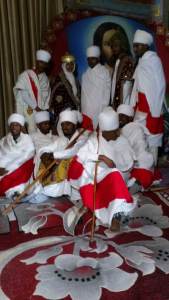
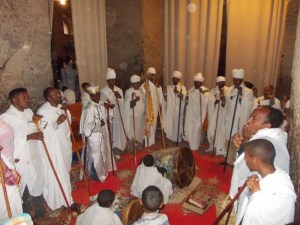
As it was Sunday, the church was bustling with activity; services, a christening, and a wedding were all taking place simultaneously in different parts of the building. Ironically, the couple getting married had been on the same flight from Heathrow as we. The priest brought out the Holy Cross to bless those in the congregation and members of our group who wished to receive the blessing. In a moving ceremony, the cross was passed over each part of the body, much like the wand used in airport security checks.

The group returned to the hotel for lunch, and Sue popped into our room to check on me. I was feeling better but not well enough to endure the bumpy minibus journey to the southeastern cluster of churches, so I remained in bed.
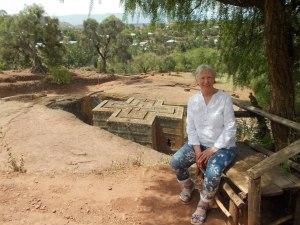
The group visited the churches of Biete Gabriel-Rafael, Biete Merkorios, Biete Amanuel, Biete Abba Libanos, and the most famous of all, Biete Giyorgis, a huge monolith shaped like a cross. Some of the churches were accessed via a series of long, dark tunnels. Sue reported it had been a very thought-provoking day.
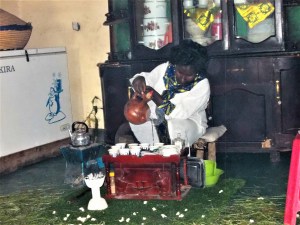
They finished the day’s activities with a traditional Ethiopian Coffee Ceremony hosted by a local family in one of the town’s coffee houses. The ceremony involved three cups of coffee: the first for pleasure, the second to provoke contemplation, and the third as a blessing to all who drink.
When they returned, I was feeling much better but chose to miss the evening meal and remain in bed.
24th April 2023
We were awake before 6 am, and Sue was in the breakfast room by 6:15. I opted to skip breakfast but had a coffee and collected some plain bread from the hotel kitchen to eat later at lunchtime. We were on the road by 7:20 am, bouncing along a road that was mostly in reasonable condition. However, where it wasn’t, a single misstep by the driver could have broken an axle. Our main concern was the random groups of unaccompanied goats and donkeys who seemed determined to get somewhere and stubbornly preferred the pot-holed road to the safer countryside surrounding it.
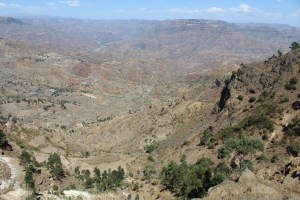
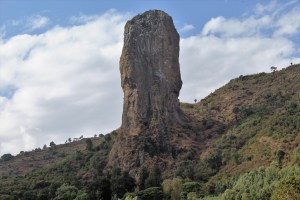
Every kilometre of the journey was fascinating and full of variety, offering a remarkable insight into the lives of the local people. We saw children dressed in blue or green uniforms heading off to school, and hundreds of stacks of eucalyptus poles—used for building houses—lined the roadside, tended by vendors. Villages dotted the landscape, their simple mud-walled houses topped with corrugated tin roofs. Along the way, we spotted people dressed in their finery, walking to church, and, notably, a large number of soldiers. This area had recently been a war zone, and we passed several checkpoints. So far, we had only slowed down and been waved through, but what was more unsettling was the number of locals openly carrying rifles, the kind used in combat rather than for hunting.

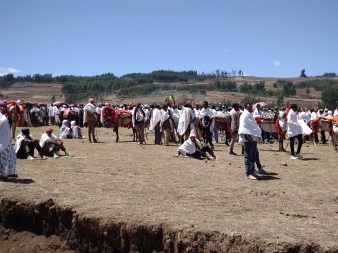
One unforgettable memory came as we descended into a valley, where we encountered a large gathering of people, mostly dressed in white, circling and marching, with some on horseback. Guns were fired intermittently into the air, and one rider shouted slogans that the crowd echoed back in response. We stopped, and our guide sought permission for us to approach and take photographs. It was a funeral procession for two young soldiers from the area who had been killed in the recent conflict with rebels in the north. A platoon of soldiers marched briskly alongside those on horseback and the mourners on foot, creating a powerful and moving scene.
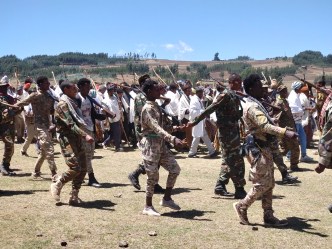
Despite the intensity of the chanting and the regular crescendos of gunfire, the atmosphere was surprisingly warm; people smiled and even ushered us forward to the very front for a better view. Our small group quickly became more of a curiosity than the ceremony itself, as locals crowded around, eager to see the foreigners.
During one lap of the procession, I caught the eye of the platoon leader. Rifle in hand, he marched directly up to me and began shouting in Ethiopian. Then, breaking into halting English, it became clear he was asking for my help. I nodded, though I wished I could respond in a way that might be useful, but I had no idea what he needed.
Later, on the walk back to the bus, we stopped to talk to a young soldier, barely 18, who had joined at 16. Surrounded once again by a crowd of curious locals, our guide finally explained the situation.
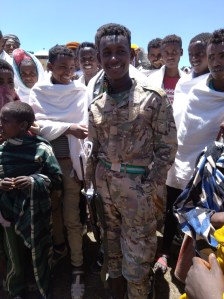
When the entire country was at war with the rebels, these young soldiers were sent to fight and die for their homeland. Now that the rebels have been pushed back to small areas in the north, the government views these (surplus) soldiers as a potential threat and wants to disarm them. The government’s secret, and tragic, solution is to covertly support the rebels and send these surplus soldiers back to fight and die.
The platoon leader was pleading with us to make this known and to help stop it. I truly felt for this emotional and desperate man. From what we witnessed in just a few days, yes, there are far too many guns in the country, but this approach is both insane and inhumane.
As is typical on such journeys, we made regular stops for drinks, lunch, and photographs from spectacular viewpoints. Finally, by early evening, we arrived at our hotel, AG Gondar, in the noisy centre of Gondar. It had been a long, fascinating, but tiring day. After dinner, it was straight to bed.
25th April 2023
Sue slept well, but I did not. Somewhere in the streets below, a party or nightclub blasted rhythmic Ethiopian music until 2:55 am, shaking our room in a way that even earplugs couldn’t block out. Then at 4:45 am, the neighbours next door turned on their TV, which, thanks to paper-thin walls, became an external speaker.
How Sue managed to sleep through this was a mystery to me. Talking to another couple from our group who had the same experience, we concluded it must be a gender thing: the husbands got no sleep while their wives remained blissfully oblivious to the noise.
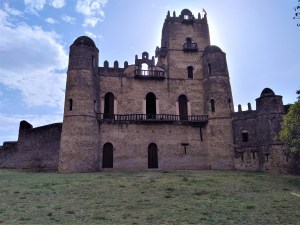
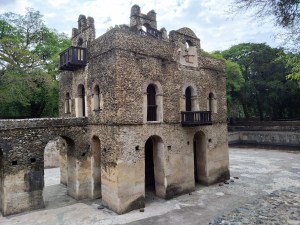
After breakfast, the group travelled a short distance to Gondar Castle. Often called the “Camelot of Africa,” Gondar was the capital for many centuries and exudes a medieval charm unlike anywhere else in the region. We were led by a highly knowledgeable guide who took us through the various palaces and rooms within the castle’s walls.
The castle had seen many uses over the years, later serving as a military base for the Italians during their occupation. Parts of it were destroyed by British forces under General Napier during their campaign against the Italians, leaving scars that remain visible today.
As I wandered through the battlements and grand halls, I couldn’t help but wonder if J.R.R. Tolkien had ever visited this place. The city of Gondar, with its fortress-like palaces and imposing walls, bears an uncanny resemblance to the castles depicted in The Lord of the Rings trilogy.

The rest of the day began with a fairly long drive through the now-familiar rural villages, offering further insight into the culture and agricultural practices of the Amhara region. Along the roadside, the square, pole-built houses with their corrugated tin roofs often stood alongside the more traditional small, circular huts topped with thatched roofs, structures that appeared to serve as sleeping quarters or storage. Everywhere, goats, oxen, donkeys, and horses moved quietly about their business, seemingly content and docile, whether working or simply grazing. I found myself fascinated by these solitary animals, some ambling off burdened with sacks, others standing patiently, awaiting their next task. These creatures did not seem mistreated but rather resigned and at peace with their lot.
More unsettling was the growing presence of soldiers and checkpoints. Until now, we had encountered only the Amhara militia, who greeted us warmly and waved us through. Now, however, the Federal soldiers appeared as well, less friendly, heavily armed with more sophisticated weapons. It soon became clear that the two forces harboured deep mistrust and animosity toward each other, adding a tense undercurrent to the journey.
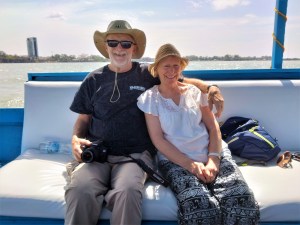
As we neared our destination, we crossed the mighty River Nile and spotted a large group of hippos wallowing in the muddy brown waters near the bank. Around 1 pm, we arrived in the modern city of Bahir Dar and enjoyed the best lunch of the trip so far at our hotel, the Jacaranda. Afterwards, we took a brief drive to Lake Tana, where we boarded a boat for a 40-minute sail to visit the ancient island monasteries scattered across the lake.
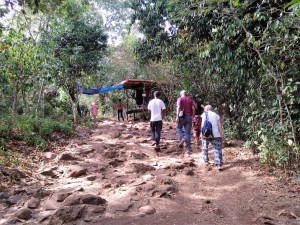
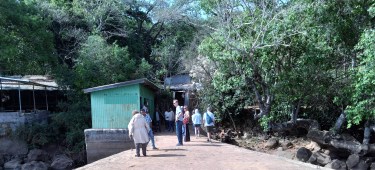
Upon disembarking at a small concrete pier, we made our way through a dense forest along a stone-strewn path toward the Ura Kidane Mihret and Kibran Gabriel monasteries. These sites are renowned for their spectacular paintings depicting vivid religious scenes. Our guide took time to explain the significance of each image, enriching our understanding of its profound spiritual meaning.
On the return journey to the boat, we passed several small stalls selling religious paintings and trinkets that we had overlooked earlier. Drawn by one, we purchased a striking painting on goatskin portraying the face of a local woman, an evocative memento of our visit.
As the afternoon waned, we sailed back across the calm lake, taking in the serene beauty of the surroundings. Our attention was captured by various seabirds gliding overhead, most notably a floating flock of pink-necked pelicans, their elegant forms drifting gracefully on the water’s surface.

Before returning to the hotel, we made a detour to Haile Selassie’s palace, perched high on a hill overlooking the city. Unfortunately, our progress was delayed by a roadblock caused by the construction of a new suspension bridge over the River Nile, causing us to miss the chance to capture the setting sun casting its golden glow over the river, city, and lake.
The day took a more unsettling turn when we had a confrontation with the Federal army. Our driver, perhaps unaware of the sensitivities, chose to drive past the gates of the former king’s palace, an area strictly forbidden. A small troop of soldiers swiftly intercepted us, their demeanour far from friendly. Fortunately, the commanding officer turned out to be from the same village as our guide, and after lengthy discussions, we were finally allowed to proceed, though the encounter left us shaken.
Returning to the hotel, we were shocked to see a heavy-calibre machine gun mounted on the back of a pickup truck parked right at the entrance, with a very young Federal soldier sitting astride it. Inside the hotel, around fifty other soldiers were quietly queuing for the buffet meal. That evening, we enjoyed a very pleasant dinner on the patio while the army ate inside. Later, some members of our group chose to party at a local Ethiopian nightclub, but we seventy-year-olds opted for an early night instead.
 Palmer Family
Leave a comment