3rd July 2022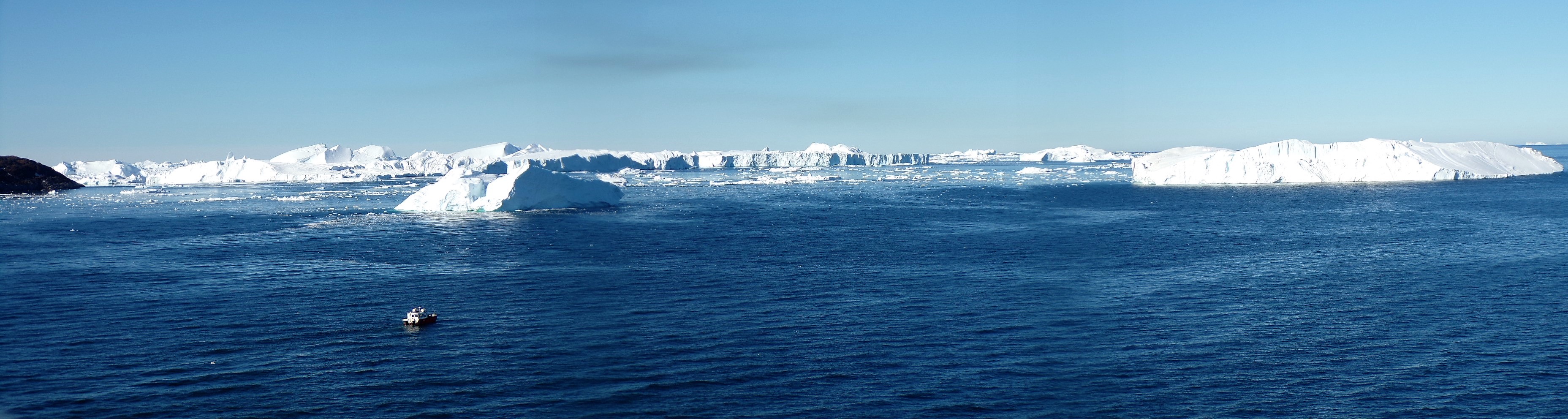
Thankfully, the weather witches granted my wish, and we awoke at 7 a.m. to find a clear blue sky without a cloud in sight. Today, we were off to see the glacier from the sea.
Twelve of us boarded a small boat from the pontoon reserved for Ambience’s tenders on the port side, and we sped off towards a large cluster of icebergs spilling into the bay, about half a mile away. Our pace didn’t slacken as we entered a field of bobbing ice fragments, and the crunch beneath our craft was somewhat unsettling. Soon, we began weaving carefully between increasingly larger chunks as the towering forms of the glacier loomed nearer. Before long, we were among them, the engine slowed, with the skipper scanning for a safe route through the jumble of white giants.
These bergs were quite unlike the rainy-day, blue-tinged ones we’d seen a few days earlier in Narsarsuaq. These were predominantly white and vastly larger. There was still some blue, but it was confined to cracks and crevices in the biggest of them. We also saw brown bergs calved from the glacier’s flanks, coloured by the finely ground rock gathered as the glacier scraped its way to the sea. And then there was black, the most dangerous of all. These were chunks of bubble-free ice, difficult to spot, incredibly dense, and capable of tearing the bottom out of any boat unlucky enough to strike one. The skipper kept a sharp eye out for them.
 We spent a couple of hours carefully navigating this treacherous yet awe-inspiring seascape. It was one of the most unforgettable experiences of all our travels, and the memory will stay with us forever. Rather than attempt a clumsy description of the grandeur of these ice monoliths and the haunting beauty of the world they inhabit, and into which we were briefly welcomed, I’ll let the photos, added on our return to the UK, speak for themselves.
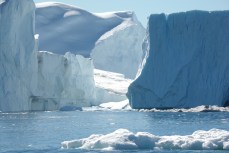
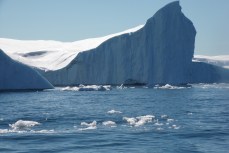
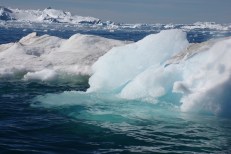
These marvellous masses of ice have made a mammoth journey to reach this point, where our little craft and its vulnerable occupants have paused to capture a few fleeting pixels of frozen time. The face of the glacier lies some 55 kilometres away, and its offspring take, on average, just a couple of days to drift this far. But it’s not only the calving bergs that break records, but the ice sheet itself moves at an astonishing 40 metres per day, making it the fastest-moving glacier in the Arctic.


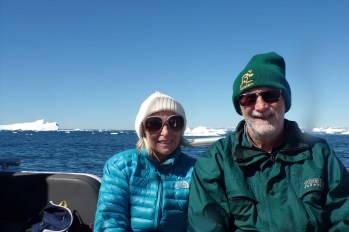
The return to the ship was every bit as exhilarating as the outward journey. Sue and I were the first two aboard the fishing/tour boat and managed to claim two of the six outdoor seats available; the rest of the passengers opted for the comfort and windowed warmth of the cabin inside. Despite the unseasonably high temperature (the locals were grumbling about the 15°C heat), once the boat picked up speed, the wind quickly reminded us of where we were, as bitter as it should be. Still, we were here for the experience, and sometimes that requires a little discomfort in exchange for memorable photographs. It was 1.30 p.m. when we climbed the gantry into the bowels of the Ambience, ready for lunch.
Ilulissat itself had yet to be explored; that was the task for the afternoon. There was a half-hour delay in disembarkation due to the high volume of organised tours taking precedence over ‘open’ passengers. When a tender finally did arrive, it then, rather frustratingly, had to leave again to refuel!
Eventually ashore, we made our way up a small hill to the supermarket square and boarded a complimentary bus into town, which dropped us between two supermarkets. To my surprise, many of our fellow passengers filed into the shops. I couldn’t help but wonder what on earth they were planning to buy. Oddly, one couple emerged carrying a large bag of oranges, surely unnecessary, given they’re freely and abundantly available on board? It was a Sunday, and as alcohol sales are forbidden in Greenland on this day, there was little point in my venturing inside.
We moved on and browsed a few busy, tourist-focused shops, though more for interest than for purchases. Strangely, with such a large cruise ship in port, most of the shops had missed a clear opportunity and remained closed. Spotting a vacant bench high on a rocky hill at the edge of town, we climbed a wooden walkway part of the way before scrambling over a smoothed granite shoulder to reach our resting place for the next half hour.
The unseasonable warmth of a late Arctic afternoon was something to savour, and the panorama before us was truly special. Straight ahead lay the harbour, and out in Disko Bay floated the Ambience, encircled by glistening icebergs of all shapes and sizes. Trails churned by propellers criss-crossed the bay as dozens of small boats busily plied their trade. We watched the tenders steadily ferrying our fellow passengers to and fro, no doubt one of them still heavy with oranges. To our left stretched the ice field, sparkling in all its frozen grandeur; to the right, blocks of colourful buildings gradually gave way to the tough, barren mountainside, increasingly craggy and snow-capped as they disappeared into the distance. Overhead, the occasional aircraft sliced through the azure blue on its descent to a landing strip hidden from view.
Behind us, we glimpsed a moment of everyday life: an Inuit man smoking contentedly on the veranda, soaking up the sun and his cigarette. His wife arrived, arms full of shopping, perhaps a little annoyed that the oranges had sold out, and greeted him with a warm kiss before disappearing inside. Below, on the rock, their sledge dog dozed restlessly, struggling with the heat and my soft whistles as I tried to capture his photo. But all good things come to an end; there was still a town to explore and a tender to catch.
Descending into what in Europe would be considered a large village, we re-entered the ‘city’. Near the Tourist Information Office, we joined a dozen or so other information-hungry travellers on a bench and connected to the free Wi-Fi. Back in the UK, Sarah spotted we were online and promptly video-called us. For fifteen minutes, we caught up on family news and smugly noted that it was raining back home.
We made our way back to the port, pausing at another little walrus tusk carving workshop, and managed to catch the penultimate tender back to the ship.
That evening, during dinner, an announcement crackled through: a large pod of whales was breaching on the starboard side. We were seated on the port side. Immediately, most of the restaurant emptied as diners dashed out in excitement, only to return to cold meals and no whales. Our table of six, having opted to remain and eat, was soon rewarded: whales appeared outside our window. We later learned the announcer had muddled port and starboard, a mistake that explained the disappointed faces returning to lukewarm plates.
To a southerner, the nights here are extraordinary, even a little disconcerting. The sun remains stubbornly high in the sky. Tonight, the heavens were a vivid, midsummer blue, and it felt like mid-afternoon, though it was well past midnight. Indoors, your body pleads for sleep, your eyes heavy. Yet step out on deck and something shifts; it feels all wrong, and suddenly you’re wide awake. Am I really that easily fooled?
4th July 2022: Sea Day
Where have all the icebergs gone? Another glorious, cloudless day, but missing one vital Arctic ingredient: those lovely, white lumps of nature we’ve come to adore in just a few short days. Perhaps now I begin to understand those so-called ‘crackpot’ explorers we’ve been hearing from in the Palladium, dragging heavy sledges across treacherous, colourless terrain, only to declare they’d gladly do it again. Have they never thought of swapping the sledge for a cruise ship?
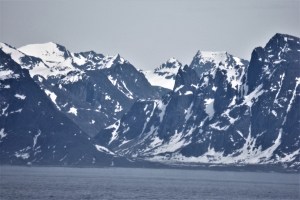
Today, we re-crossed the Arctic Circle, heading south towards Greenland’s capital, Nuuk. The ship is making steady progress, steaming 25 nautical miles down the coast at a comfortable 11.5 knots. The seemingly close mountain range we are passing appears to be only a couple of miles away, a deceptive illusion that speaks to the stark height and sheer scale of this bleak, unforgiving coastline. It is not, one suspects, a place for any sensible warm-blooded creature.
Over a pleasant lunch in the Buckingham Restaurant, we found ourselves seated with four fellow passengers we hadn’t yet met, always an interesting mix of small talk and shared observations. Midway through the meal, the captain’s voice came over the Tannoy. In a calm and measured tone, he announced that there are currently 25 cases of COVID-19 on board, with five confirmed that very day. He reassured us that cleaning protocols have been increased, and urged all passengers to wear masks while moving about the ship. A very responsible message, one only hopes it doesn’t fall on deaf ears.
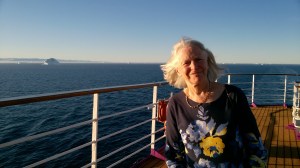
We attended an excellent afternoon lecture in the Palladium given by one of the polar explorers, who plans to return to Antarctica this autumn. It was notable and reassuring that most of the audience had chosen to wear face coverings.
Later, as Sue returned from her own programme of activities, she noticed that menus were being delivered through barely opened doors to the cabin next to ours and another a little further down the corridor. Were they isolating, or simply being extra cautious?
After the evening show, we stepped out onto the deck to find that the rain and mist had returned. Though it was technically still light, the atmosphere felt more like twilight than the ‘midnight sun’ we’d grown used to.
 Palmer Family
Leave a comment