1st July 2022

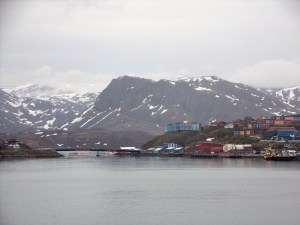 Today was the brightest day we’ve had in a while, with only the lightest drizzle to contend with, quite acceptable, considering our latitude.
As we anchored off the port of Sisimiut around 6.30 am, Sue and I were still snug and warm under the duvet. However, our slumber was broken by an announcement from the Captain over the Tannoy: “Thar be whales off the starboard side!” I sprang into action, barely dressed, camera in hand, and shot out onto the deck. Regular spouts from a humpback whale and her calf could be seen above a small, low island close to the ship. They appeared to be heading for open water. I took a chance to see where they might surface next, and bingo! I fired off two shots, both framed and in focus.
There was no dramatic breaching or tail-flapping; the mother had clearly been startled by our presence and was quietly leading her calf away to safety. A wonderful start to the day, could it get any better?
We had arranged a morning boat trip to an abandoned fishing village, around eight miles down the coast. When whaling became unprofitable for the local community in the 1970s, they turned to fishing. For a time, they processed up to 1,000 tonnes a year, but even that couldn’t compete with the output of the larger fishing operations. All but one of the village’s 131 residents eventually relocated to Sisimiut. The last inhabitant died in 2010. These days, the village is used by the education authorities to teach children survival skills, and the church is still occasionally used for weddings.


There were four excursions to the village, and significantly, we were on the final one, departing the Ambience by local boat at 10.30 am along with ten other excited shipmates. These local fishing boats are surprisingly fast, skimming and bouncing across the easing drizzle as we cut a frothy trail in no time at all to this almost-forgotten home of Greenlandic ghosts, and our French guide, Adam.
Interestingly, none of the island guides we’ve encountered so far have been native Greenlanders; rather, they’ve been Danish students, here for a few summer months to support the tourism trade. Adam, however, proved to be the most amiable and best-informed of the lot. He knew his subject well and answered all our questions with ease.

Disembarking from our little craft, we followed a well-trodden trail from building to building, pausing at each for Adam to explain who had once lived there, or what purpose it had served. Some of the structures have been maintained, but most are slowly succumbing to the harsh climate. Life here was unimaginably difficult; few children survived beyond six months, and the small cemetery we visited stood as a poignant reminder of that grim reality.
The village’s last surviving inhabitant is a 92-year-old woman who now lives in Sisimiut. It is she who provided Adam with much of his in-depth knowledge, for which he was grateful. Sadly, he has no plans to return for next year’s tourist season, a real loss, given his warmth and insight.
As we explored the abandoned buildings, I was reminded of my visit to Chernobyl. However, unlike Ukraine, nature is not reclaiming this place nearly as swiftly, and the harsh conditions here allow little to grow.

The mainly wooden structures are decaying in slow motion, which will likely allow the village to remain a viable tourist attraction for a few more years yet.
After a couple of hours exploring, we boarded our little fishing speedboat and set off at a pace towards Sisimiut. Sue and I sat at the front of the craft, alongside the skipper and his teenage daughter. During our conversation, Sue asked whether we might see any whales on the return journey. The skipper, with a generous smile, replied that as we were the final group of the day and there was no pressure on time, we might as well go and find some whales.
And that’s exactly what we did!


The first pod of Minke whales was spotted by the dramatic spouts they sent soaring several metres into the air. Remarkably, they didn’t dive until we had drawn well within camera range. The next pod we sighted was much farther off, and by the time we’d raced to their location and begun circling in anticipation of their resurfacing, we had to concede disappointment; they clearly had no wish to be seen, and weren’t.
As we passed a small islet, no larger than a decent-sized UK garden, the skipper pointed out several dogs racing along the rocky shore. He explained that their owner had released his sledge dogs to roam freely on the island for the summer. He visits regularly to feed them, and they are collected in time for their winter work.
Shortly afterwards, we disembarked at the dockside in Sisimiut, exhilarated and grateful for such a memorable outing.

Joining a throng of Ambience passengers, along with those from a slightly smaller Norwegian ship, we wandered through this busy yet charming and colourful fishing port. Nestled on the hillside beneath the newer, larger church is a cluster of historic buildings now serving as museums. Inside, we explored exhibits that told the story of the region’s history and culture, with a particular focus on the Inuit population and the whaling industry.
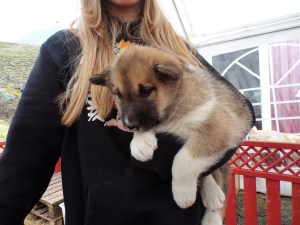
We also had a look around the smaller, older church and a traditional winter turf house, before enjoying a real treat, meeting one of the local sledge dogs who had given birth to five gorgeous puppies just a week earlier. Naturally, we gave them plenty of fuss and strokes!
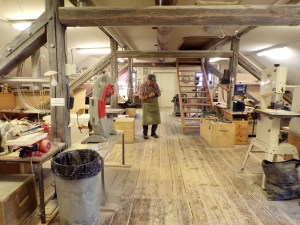
This town is better geared towards tourists than any other we’ve encountered so far. Alongside the landing pontoons, a few local Inuit had set up small stalls selling beadwork, wood and bone carvings. The port itself boasted several shops clearly aimed at visitors. In one of them, I came across a small workshop where a couple of Inuit craftsmen were shaping walrus tusks into trinkets. One of the gentlemen beckoned me over to watch as he carved a ring featuring the head of a polar bear. He worked swiftly, and it was clear he took great pride in his skill with this unusual material.
We returned to the ship by tender a little too late for lunch, so we opted for burgers, pizza and chips from the grill. Not the healthiest of meals, but after such a busy day, we decided to abandon any lingering guilt; after all, we’d stopped worrying about our massive calorie intake just a few days into the cruise. We’ll diet when we get home. Won’t we?
The evening show was a farce centred around a birthday party, thoroughly enjoyable and just the thing to send everyone off to bed, or on to late-night activities, with a smile.
2nd July 2022: Ilulissat

On our way to breakfast, we were greeted by a scene that could have come straight from a David Attenborough Blue Planet documentary. At anchor in the bay just off the bustling port of Ilulissat, we were surrounded by icebergs, but most impressive of all was the glacier off to starboard, its towering spires of sparkling white snow and ice dominating the horizon.
It was a sunny day, with a thin veil of milky cloud and a jelly-calm sea. Though chilly on deck, sweaters weren’t necessary. The city itself is the largest we’ve encountered so far on our Greenlandic adventure. Its limits stretch along the shoreline for a good third of the bay, hemmed in by the outflow of the glacier on one side and rugged, inhospitable terrain on the other.
New buildings are springing up in various parts of the town, construction that, I’d imagine, is confined to just a few precious summer months.

After breakfast, we did a couple of laps around the decks and then played a few games of table tennis before heading for an early lunch at 11:30 am. We were scheduled for a trek to the ice fjord and needed to be ashore by 1:30 pm.
However, the tender taking us to the port was held up in the outer harbour for quite some time, as smaller local craft zipped in and out of the inner harbour, preventing our larger and slower ‘hippo’ from entering and manoeuvring to its designated pontoon. Several turboprop aircraft, each bearing the striking red-and-white logo of ‘Air Greenland’, flew low overhead as we wallowed patiently at the entrance to the marina.
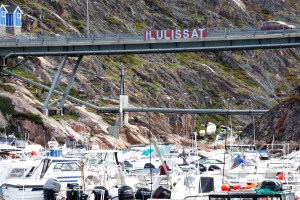
Eventually, we chugged into what felt like a very crowded boating car park. This was a working port, not one designed for pleasure craft; the vessels packed in around us were all robust working boats, used for fishing or ferrying their owners to far-flung, remote settlements. A few doubled as tourist carriers, but none looked built for leisure.

After arriving ashore, we made our way uphill to a large square, enclosed on three sides by a busy Spar supermarket. From here, we caught a free shuttle bus that took us a couple of miles to a drop-off point beside the unusually shaped Ilulissat World Heritage Museum.
Along the way, we passed the area where locals tether their sledge dogs. With no nearby island to let them roam freely, dozens of huskies were chained just off the roadside, each with enough length in their tether to prevent fights. A large plastic tub nearby presumably held their food. Most of the dogs were lying in the sun or dozing contentedly, while a few untethered puppies scampered about, play-fighting under the warm rays. It was a curious sight for us, but entirely normal, and indeed essential, in a place where sledge dogs can mean the difference between life and death during the depths of winter.


Next to the museum, a long wooden walkway meandered down the rock-strewn, boggy bed of an ancient glacier that had long since melted. We had brought face nets with us to protect against mosquitoes, but despite the bright, sunny, and warm weather, there were few to be seen, so we didn’t need them.
As we slowly approached the foot of this once-moving ice giant, the side of the glacier that had so impressed us when we first woke up came into view. It was slowly making its way towards the bay, calving enormous, misshapen blocks of snow and ice into the freezing waters below. It was stunning, I thought, as my camera began to glow hot with the excited clicks of shots, but the best was yet to come.
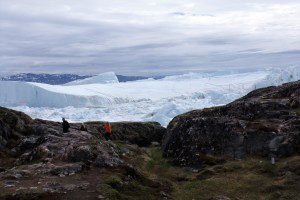
Reaching a small inlet scattered with orphaned chunks of ice, we came across a series of steps that climbed steeply up the side of the carved valley. Upon reaching the top, we emerged into a scene of breathtaking white magnificence. In front of us, the two arms of the glacier converged into one mighty, destructive force, tearing the layers of snow, carefully laid down over millennia, into a jumbled, sparkling symphony of chaos. Every conceivable shape was present, from the flat and smooth to the jagged and rounded. It was as though nature had created something beautiful, only to decide it was time to start again!

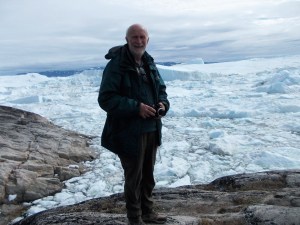
After taking many more photos, we carefully descended the hillside’s granite-like rock face until we were level with the glacier’s surface. In the past, elderly women from a village that once stood near the newly-trodden walkway would throw themselves off this cliff to spare their communities the burden of their care. It was a sombre thought to hold, especially when surrounded by such beauty and just a step away from destruction.
My heart leapt into my mouth when a sizable block of ice, only a metre or so from my feet, rolled over with a groan as it melted and adjusted its buoyancy. Phew!

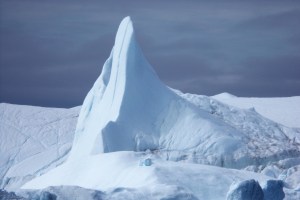
Sitting down on a flattened section of rock to take in the view, I fired off yet more shots with my camera. Occasionally, this blissful, contemplative peace would be interrupted by random cracks and groans as the mass of ice rumbled its way toward self-destruction, a stark reminder that we wouldn’t be welcome here for much longer.
Climbing back to the top of the hill, we took one final, long look at the vastness of this awe-inspiring work of nature, fixed it firmly in our minds, and set off back along the wooden path to comfort and order.
We had planned to visit the World Heritage Museum before returning to the ship via shuttle bus and tender, but time was not on our side. We managed to climb onto the roof of this quirky building and walk its length before checking the ‘tender timetable’ and discovering that we had just half an hour to catch the last regular boat to the ship. Fortunately, a bus appeared just in time to whisk us to the port, where we grabbed seats on that final vessel.
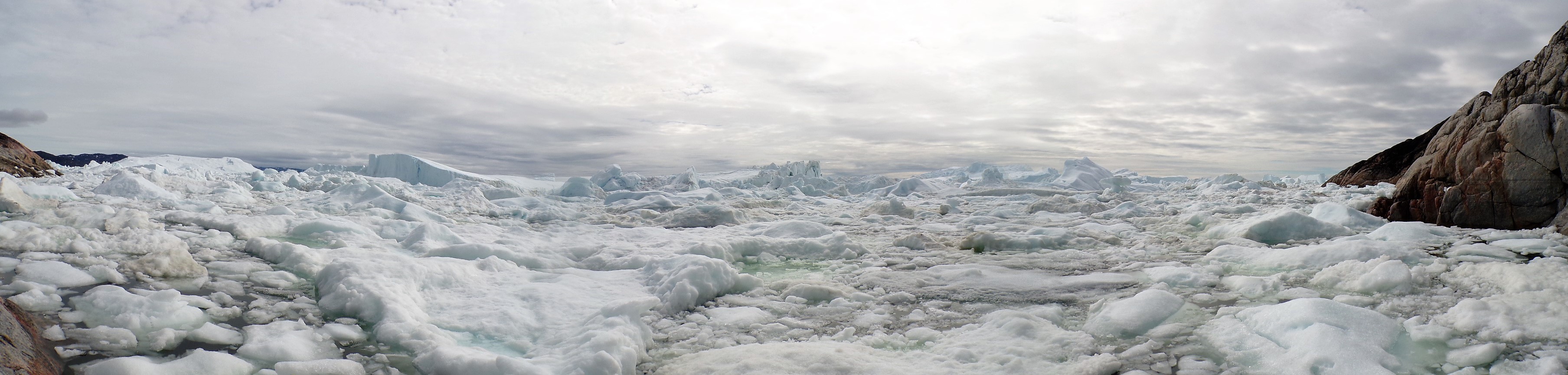
Instead of the evening show, Sue chose to watch the film West Side Story, while I opted to take advantage of the ‘midnight sun’ and sit on the deck at the stern of the ship, marvelling at the changing hues and shapes of the glacier as the sun slowly snaked its way across the heavens.
Luckily, we will be staying in the port/city of Ilulissat for one more day. Let’s hope it’s a sunny one.
 Palmer Family
Leave a comment