29th June 2022
This morning we were awake from 5 am. After a quick breakfast, we made our way down to the Palladium to wait for our Boat Trip Among the Icebergs. We had originally booked an excursion to visit the ancient, abandoned settlement of Erik the Red in Qassiarsuk, just a short boat ride away. Unfortunately, that tour was cancelled a few days ago due to safety concerns with the landing pontoon, which was deemed too dangerous to use. As a replacement, we opted for the iceberg tour, and we were scheduled to be on the first boat of the day, departing the ship at 6:30 am.
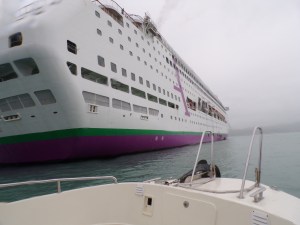 In Greenland, excursions involving sea travel rely on local fishing boats and only proceed if the vessels are not needed for their primary purpose, catching cod. As a result, it’s never guaranteed how many boats, if any, will be available to ferry eager tourists. Often, none show up. But today, we were lucky: we were in the first group of eight iceberg enthusiasts to board a small fishing smack, embarking directly from Deck 4 of the Ambience.
Unluckily, the rain was heavier than yesterday. Our little boat, though compact, had a surprising turn of speed. Cramped into its cockpit with the windscreen wipers flicking furiously, we sped away from the comfort of our cruiser and into the mist and rain.
Before long, we entered the iceberg field, vast chunks of ice silently drifting, calved unseen from a glacier many miles inland at the head of the fjord. Thankfully, our seemingly fragile vessel slowed, and we carefully stepped out onto its narrow, slippery deck to take in the breathtaking scene. For the next hour, we weaved through towering blocks of ice, many of them dwarfing our boat. The atmosphere was otherworldly, the silence broken only by the hum of the engine and the occasional drip of water. I felt so small and exposed, utterly insignificant and vulnerable amid nature’s frozen giants.


The beauty of these immense monoliths defies description; it truly has to be witnessed to be understood. Their shapes are sculptural, each one a frozen masterpiece. Some are pristine white, gleaming even under a grey sky, while others are streaked with a striking, almost unnatural blue, the kind of blue that feels lit from within.
Perhaps irritated by our presence, a flock of seabirds suddenly erupted from the top of one massive floe. As one, they rose into the air and flew silently away, skimming low over the freezing, leaden sea like ghostly sentinels vanishing into the mist, off, it seemed, into the murky depths of Valhalla.
Eventually, our boat glided to a gentle stop beside one of the smaller blue icebergs, though “small” is relative; it still loomed like a colossus beside our little craft. Against the drab, rain-heavy sky and the gunmetal sea, its vivid hue was startling, especially next to its stark white siblings. We reached out and ran our fingers across its cold, clear surface. It was smooth and slick as glass. Even up close, it shimmered blue, radiating an eerie glow that seemed to come from the heart of the berg itself.
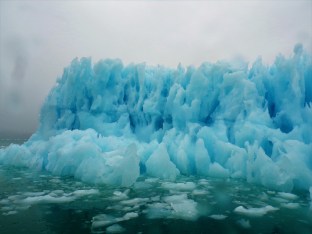
This particular iceberg would have satisfied quite a few gin and tonics, if only we’d had a glass and a slice of lime. Its radiant blue hinted at something both ancient and refreshing.
It must have rained nonstop because we returned soaked, but oddly, it didn’t matter. Yes, it was mildly frustrating to be constantly wiping rain from camera lenses and phone screens in an effort to preserve the memories, but nature is easily forgiven. It had given us something unforgettable, a glimpse into one of its rawest and most magnificent creations. The scale, the silence, the surreal glow of the ice, it was so mind-blowing that the persistent drizzle simply faded into the background.
We didn’t see the seals or whales that had been optimistically promised, but animals are never on a timetable. Instead, we were granted an hour in one of the world’s most fragile and extraordinary places. Considering the accelerating effects of global warming, I count myself among the lucky few. And when we do eventually return home and I find time to weave some of the photos into this blog, you’ll begin to understand why.
Back on board by 8 a.m., we hung up our damp clothes to dry and headed to breakfast, reliving the experience with steaming coffee and a renewed sense of awe. A couple of hours of cabin relaxation later, and by 11:30 am, we felt recharged enough to catch a tender to the shore for a visit to the small settlement of Narsarsuaq.
The town’s history is surprisingly modern, built around an airfield constructed by the Americans in 1942. Though now under Greenlandic control, the airstrip remains in use today. Our tender landed in a modest harbour about a mile from the centre, a quiet cluster of low buildings spread along the only stretch of hard-surfaced road. The place has a frontier feel, functional and windswept, with a quiet resilience that says much about the people who live here.

From the tender, we caught the shuttle bus to the airport museum. Despite the persistent drizzle, many passengers chose to walk. The museum, surprisingly free and impressively large for such a small settlement, offered a detailed glimpse into the area’s past. Most of the exhibits focused on the construction of the runway and the American military presence during and after 1942. There were also engaging displays on local wildlife and aspects of Inuit culture, all simply but effectively presented.
I had hoped to find something about Erik the Red’s presence in the region, perhaps a few artefacts or information panels, but there was nothing to be seen. Still, the museum was worth the visit. As we browsed, Sue and I took a liking to a painting, a vivid landscape that seemed to capture the spirit of Greenland. We bought it as a keepsake, and while it was being carefully wrapped, we stepped back outside to explore more of this remote, linear settlement.
Earlier in the day, we had intended to hike up Signal Hill for a panoramic view over the runway and fjord, but the low clouds and steady rain made that idea less appealing. Instead, we joined a few fellow cruisers on a more modest walk beyond the airport, climbing a gentle rise to gain a better sense of the surroundings. Along the way, we paused frequently to photograph wildflowers, tiny bursts of colour against the muted landscape. At one point, Sue embarked on an impromptu rock-collecting expedition, the results of which, of course, ended up in my rucksack.
On our way back, we collected our painting and caught the shuttle bus just in time to make the tender back to Ambience. We arrived on board slightly damp and a little windswept, just in time for a very welcome late lunch.
That evening, we ate dinner late, sharing a table with a pleasant couple from Brighouse whose easy conversation helped the time slip by. Afterwards, we made our way to the theatre to watch the ship’s dance troupe perform a high-energy show set to the rock music of the seventies. It was a marvellous production, lively, nostalgic, and packed with superb music. As we climbed the stairs back to our cabin, familiar tunes still echoed in our heads. It had been a long, memorable day, and this was the perfect way to end it.
30th June 2022|: Sea Day
We are now heading north towards Sisimiut, which lies roughly halfway up Greenland’s western coast. We allowed ourselves a lie-in and didn’t take breakfast until around 9 am. It was a clear day, the sea rolling with a steady swell, noticeable, but not enough to be felt onboard, and the air had turned noticeably chillier than anything we’d experienced so far.

We were steaming a couple of miles off the coast, but the bleak and rugged shoreline was clearly visible. We’ve travelled through some of the world’s most inhospitable and mountainous regions, the Himalayas, Andes, and Rockies among them, but Greenland feels like it ranks several notches higher on the “desolate places to live” scale. Fishing and hunting have traditionally been the main reasons to inhabit this ‘rocky freezer’ of an island, but with increasing restrictions on whaling and hunting, the indigenous population is now looking towards tourism and mineral exploitation as new sources of income.
Global warming will undoubtedly aid this shift, as the ice sheet continues to recede, making mining more viable and allowing greater access for tourists. Those wanting to witness icebergs and explore land-based activities linked to the ice cap will increasingly head further north, to communities largely made up of Inuit people. Tourism may bring prosperity, along with modern attitudes and external influences. Swings and roundabouts?
A highlight of the day was guest speaker Wendy Searle, the award-winning polar explorer. She gave a compelling account of her solo journey to the North Pole and the immense hardships she endured. An inspiring and humbling listen.
As we pushed steadily northward, the coastline remained stark and forbidding, and the icebergs grew in size, some seemingly as vast as small islands. Sensibly, we kept a healthy distance.
As usual, we rounded off the night with a show in the theatre; tonight’s performance, Concerto, featured a medley of songs from the ship’s superb singers. A great end to a thought-provoking day.
 Palmer Family
Leave a comment