10th June 2022
Today, at around 8:30 a.m., we left Ranohira and set off towards the beautiful coastal town of Ifaty. Unfortunately, Sue had eaten something that disagreed with her and developed a mild case of food poisoning, which began to take effect during the night. However, after a shower in the morning, she felt well enough to face the long bus journey.
Another member of our group had also fallen ill with similar symptoms and, despite taking antibiotics, was unable to continue. Sensibly, she and her partner decided to remain at the hotel until we return in two days.
With nearly a full day’s drive ahead of us, a kind couple from Wales gave up their front seats so Sue could lie down. For the first hour or so, the roads were in good condition, with few potholes, and the journey was relatively comfortable. However, as we entered mile after mile of scrubland, the road surface deteriorated, and Sue began to regret her decision.
This part of Madagascar is renowned for its sapphires. Many of the small towns we passed through were lined with shops and makeshift shacks trading in these precious gemstones. We saw small clusters of tiny, one-roomed dwellings, temporary shelters for the hardworking miners. The sapphires lie some 10 to 12 metres below the surface, buried in tons of gravel that must be dug and sifted by hand.
One section of the road, which crossed a small river, had been destroyed by cyclones earlier in the year. As a result, we had to make a short detour and carefully navigate a shallow part of the watercourse before continuing our journey. As we descended to river level, we saw intense activity along the riverbed. Hundreds of people were digging through the gravel, searching for elusive blue gems and carrying away their finds in large plastic containers. It’s far easier to let the river erode the surface down to the gravel than to use a pick and shovel!
We stopped for a while to stretch our legs and take some photos.
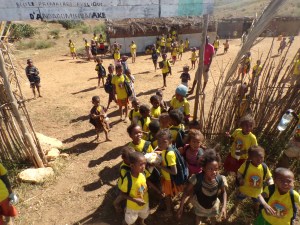
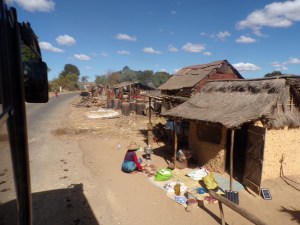
As we continued our journey, we entered the driest part of the island. The shrubs and trees here were stunted, and the parched red soil seemed to cry out for moisture. The settlements in this region were visibly impoverished, and fetching drinking water often required walking several kilometres.
It now became clear why the guides had asked us not to discard our empty water bottles. They had refilled the dozen or so we’d used with tap water from our previous hotel. As our coach pulled up just outside these villages, the local inhabitants sprinted towards us, squealing with delight as the bottles were handed out through the windows. The expressions on their faces as they received this life-giving gift will remain with me for the rest of my days. We so easily take this precious resource for granted in the UK.
As we neared the coast, the road improved, and Sue felt well enough to take in the passing scenery. However, it wasn’t long before we left the tarmac once again, turning onto another dirt track. To our relief, this detour led to a lunch stop, an unexpectedly modern restaurant set within picturesque gardens. The French menu took a bit of deciphering, but the setting and welcome break were much appreciated.
Before reaching our final destination, we made a prolonged stop in Ifaty to allow some members of the group to withdraw cash from an ATM, while others went to a bank to exchange money. Currency exchange in Madagascar involves an excessive amount of paperwork and unnecessary bureaucracy, and the process took nearly an hour. Sitting on a stationary coach in a bustling Madagascan town is no great pleasure, so I passed the time by handing out a few pens to passing children and then joined a few others at the back of the coach, amusing ourselves by guessing the occupations and stories of the adults walking by.
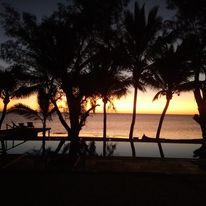
Unusually for this trip, we arrived at our accommodation, the Bamboo Club Hotel, while the sun was still up. We were each assigned individual bungalows; ours was a spacious family unit with two large double beds and a single. With Sue still not quite feeling herself, we each took a double bed, and she soon drifted off to sleep. Leaving her in peace, I stepped outside and enjoyed a spectacular sunset over the infinity pool and the ocean beyond. Later, I joined the rest of the group for dinner in the hotel restaurant and lingered in the bar, chatting, until around 9:30 p.m.
11th June 2022
Although we weren’t travelling by coach today, we did have another form of transport lined up: the zebu taxi. The alarm was set for 5:00 a.m. in order to meet at 6:00 a.m. for hot drinks in the restaurant. Sue, thankfully, was feeling better and eager to join the morning excursion to the thorny forest of the Reniala Reserve.
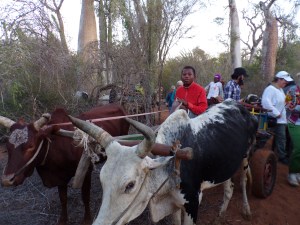
It was just becoming light when we boarded a small, wobbly cart pulled by two zebus. We did our best to make ourselves comfortable using several thin cushions scattered across the wooden crate of a carriage. With a tug on the guide rope and a prod from a short stick, our zebu driver urged his animals into motion. The start was jolting as we joined a cavalcade of other ‘taxis’ rattling along a narrow, dusty track, the overhanging bushes on either side frequently encroaching, threatening to scratch or tear anything in their path. It was easy to see why we’d been warned to wear long sleeves and hats!
We wove our way through the bushy scrubland, our driver persistently coaxing the animals to stay on course with well-aimed prods to their flanks. At times, we were flying along at quite a pace, both of us gripping the side rails to avoid being thrown out. It was far from comfortable, but great fun all the same.
As the sun began to climb in the sky, we finally reached our destination: a sandy clearing surrounded by cactus-like trees and striking baobabs. In true wagon train fashion, we came to a halt and disembarked from our vehicles, thoroughly jolted, but smiling after the ride.
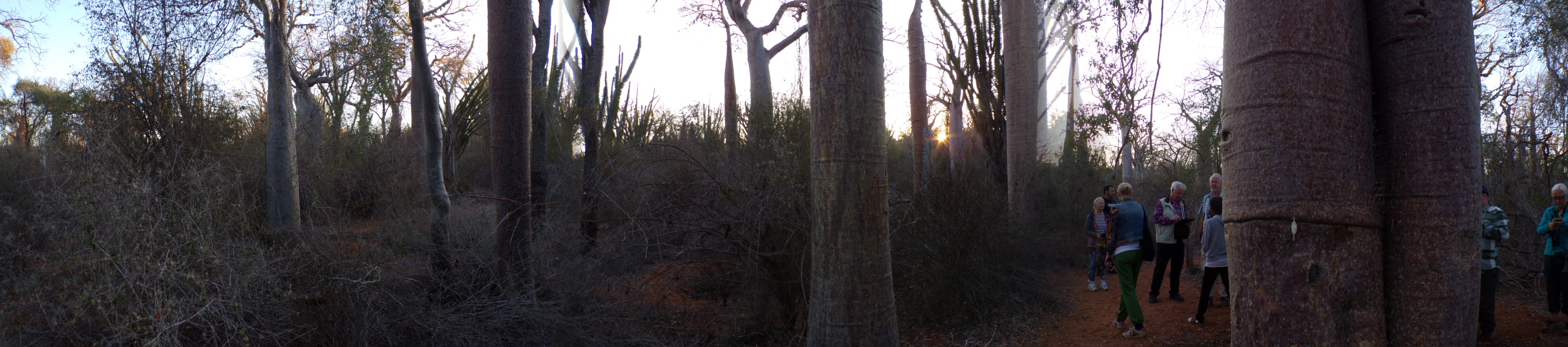
Our hike through the forest was led by a knowledgeable female ranger with a good command of English. As we wound our way through the thorny maze, we stopped frequently to examine each new plant species we encountered. The ranger would name each one, explain its uses, and offer any necessary warnings. Her insight added a great deal to our understanding of the landscape.
From time to time, we paused to observe and photograph the local insect and bird life. These discoveries were often pointed out by two male rangers who acted as outriders, moving ahead of the group to seek out creatures of interest for us Europeans. Scorpions, large spiders, cockroaches, and grasshoppers were in plentiful supply, though bird sightings were few and far between.

Of all the tree species, I found the baobabs particularly fascinating. Here, they grew in abundance, many tightly packed together and contorted into bizarre, otherworldly shapes. Until now, we had only seen the more traditional, upright examples, but these added a new and unexpected dimension to our experience. One even resembled a canoe!
Finding our way back to our unique ‘taxis’, we climbed once more into our wooden crates for a bone-rattling, breakneck dash back to the hotel. Whether on a tight schedule or simply taking pleasure in the thrill, our drivers appeared determined to give us a white-knuckle slalom ride. On more than one occasion, I feared we would tip over.
Back at the hotel, we devoured a much-needed late breakfast. Sue then retired to the bungalow for a rest, while I took a solitary walk along the beach and cooled off with a swim in the sea after a productive shell-collecting session. Neither of us bothered with lunch.
Later in the afternoon, Sue and I strolled along the beach again, hoping to find something of interest at the stalls, but she wasn’t tempted by anything on offer. The local beach hawkers, while mildly irritating, weren’t overly persistent, which was a relief. As the sun dipped below the horizon, we climbed the steps back to the hotel, weaving through the crowd of sun-kissed photographers hoping to capture the perfect sunset shot. We ordered our evening meal and retired to rest until it was time to eat.
The following morning, we breakfasted on bread, fruit, and eggs before heading back to our bungalow. I had planned a walk for the afternoon, but the morning’s activity had taken its toll on Sue, so I left her to sleep while I ventured once again to the beach to collect shells and enjoy another swim.
Unfortunately, the evening meal turned into a bit of a saga. We had pre-ordered our food earlier in the day, as we were advised that the restaurant would be especially busy at 7:30 p.m. when our group was due to dine together. Still feeling under the weather, Sue opted for a simple bowl of chips, while I ordered a starter and a main course. After the usual half-hour wait, my starter arrived, along with Sue’s chips. I waited patiently for my main course while we were entertained by a lively and colourful Malagasy folk band and dance troupe.
As the next round of food began to arrive for others, mine, along with the orders of the couple sitting next to me, failed to materialise. Another half-hour passed. The couple received part of their order, but I remained empty-plated. I managed to grab a waiter who reassured me my meal was on its way. Sue, by this point, had gone to bed.
Time dragged on. I was repeatedly told the meal would arrive in ten minutes. Most of our group had now left the restaurant, fully satisfied. When it was just me left, after a further fifteen minutes, I’d had enough. Frustrated, I confronted the staff and asked to see the manageress. Requesting an itemised bill, I was dismayed to find I’d been charged for a meal I hadn’t even ordered the previous evening. Calmly but firmly, I listed what I was actually going to pay for, handed over the cash, and marched off—still without the zebu steak and vegetables I had so looked forward to. I left the manageress to face the increasingly irate couple beside me, who had also been let down by the service.
 Palmer Family
Leave a comment