30th September 2021
A Testing Day
Before breakfast, we had to take our UK government-mandated Covid ‘Fit to Fly’ tests, a process that felt only slightly less dramatic than diving underwater. The test itself was straightforward. Although we were officially supposed to stream a video of the procedure, our Fit to Fly organiser simply required a photograph of the completed test cassette beside our passports. We left the tests to develop in the room while we headed downstairs for breakfast. On our return, the results were satisfyingly negative. We sent the required photos and, for peace of mind, I followed up with a phone call to check they had arrived and that the necessary certificates would be issued. They duly landed in my inbox by 11 a.m.
While we waited, Jamie spent the morning on the small beach by the harbour, while I completed my UK Locator Form using the hotel Wi-Fi and then walked to the little church on the hill, visible from most parts of the town, yet somehow still elusive on the three previous occasions Sue and I had visited São Miguel.
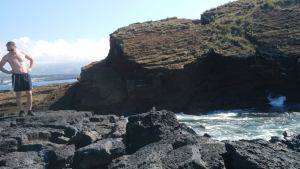
 We met again just before midday to continue exploring the remaining corners of the island. Our first stop was São Roque, just outside Ponta Delgada, where part of an extinct submerged volcano juts out of the shoreline. Only a jagged slab of basalt rising skywards can be seen; the rest of the crater rim hides beneath the waves, which were particularly rough. After scrambling over rocks in search of the best photographic angle, we moved on.
 A little further along the coast road, we stopped at a small bar hoping for lunch, but had to settle for drinks. We sat outside in the warm sun alongside a group of road workers. We have yet to witness any actual roadwork taking place on the island; the crews seem to have caught the ‘British disease’: staring into holes, leaning on shovels, or sitting in their vehicles munching snacks. Finishing our drinks, we left them to their “hard work” and drove on to the Volcanological and Geothermal Observatory of the Azores on the edge of Lagoa.
We were fortunate to be the only visitors, and the curator offered us a personal tour. His explanations of the islands’ volcanic origins were excellent, and I think he was rather impressed by the number of volcanic regions we have travelled to. He even showed us the centre’s unique mineral collection. Sue would have absolutely loved it, and it would undoubtedly have added several extra hours to our visit.
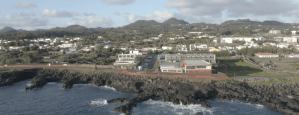 Continuing along the coastal road, we passed several inviting sandy beaches where the Atlantic breakers rolled in. The smell drifting from a restaurant opposite a public car park reminded us that it was lunchtime, and the waves would have to wait. Our enthusiasm for ordering ‘extras’ led to an extended battle with a mountain of garlic bread and French fries. Only in the USA and Canada have we experienced such gargantuan portions as standard.
Changing into our swimming gear afterwards, we headed for a long-awaited dip, only to be greeted by a rumble of thunder and a menacing dark cloud sweeping down from the mountains. The heavens opened just as we reached the water’s edge, forcing a rapid retreat to the car as a monsoon-like downpour arrived.
In diminishing rain, we drove on to Vila Franca do Campo, climbing over yet more coastal rock formations before pausing for refreshments in a bar ingeniously constructed entirely from wooden pallets: fencing, tables, seating, even the raised platform. Sarah went through a phase of building pallet furniture years ago; she would have been inspired by this resourceful barkeep.
Back at the hotel, we dined that evening in one of the narrow, cobbled side-alley restaurants. Tables in these places are precious, particularly in the evenings when Azoreans seem to book a table for the entire night. For the second time on our trip, we secured a place only by promising to vacate it within an hour and a half. The meal was memorable. As Jamie had never tried it before, I persuaded him to order soup served in a loaf. Expecting the hollowed-out bread to be only half full, we were astonished to find it filled to the brim. We had one each. Delicious though it was, polishing off the main course afterwards proved a major challenge, one I confess I couldn’t meet.
We ended the evening in a harbourside bar watching Premier League football on the obligatory large screen. By the time we strolled back to the hotel, around 11.30 p.m., the locals were streaming out of their apartment blocks heading for bars and restaurants, children in tow, eager to enjoy the fairground rides that had magically appeared. One wonders how such nocturnal habits affect school performance the next morning.
1st October – A Visit to a Winery
 Our aim today was to sample the wines of the only winery in the Azores, Quinta da Jardinete, located about 35 minutes away near Fenais da Luz. It didn’t open until 10.30 a.m., so after breakfast we took a leisurely drive over the central highlands and spent some time scrambling over rocky inlets, taking yet more photographs of waves crashing over basalt formations.
At the appointed time, we asked Google Maps to guide us to the winery. On arrival, however, we couldn’t see anything resembling one. Was Google having a joke at our expense? We turned into a nearby farm track, only to realise our error when the surface became deeply rutted and hemmed in by high walls, leaving no room to manoeuvre. We crept forward until we found a small opening where we could execute a careful about-turn.
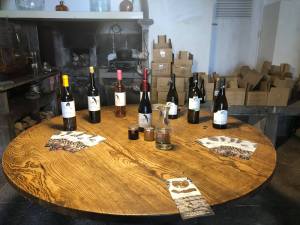
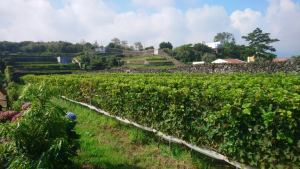 Returning to the point where Google triumphantly announced, “You have reached your destination,” we decided to ring the winery, only then spotting a wine bottle mounted high on the wall of the building beside us. After a short wait, someone appeared to greet us, and as the only visitors, we were treated to a personalised tour of the vineyard and distillery. The winery, a family venture founded in 1989, enjoys a monopoly as the sole wine producer in the Azores. They are still experimenting with grape varieties and blends. We sampled several wines, mostly dry but very pleasant. Had we visited earlier in our trip, we might have bought a few bottles for the hotel, but our carry-on luggage was too limited for taking any home.
 With lunchtime approaching and our stomachs clamouring for attention, we headed back to the coast and discovered an intriguing harbour lido, where Atlantic waves thundered through a gap in the natural rock wall. Local swimmers were delighting in the churning water. The sun was shining, and we weren’t going to repeat the previous day’s mistake. We quickly changed and enjoyed a wonderfully refreshing swim before any dark clouds could spoil the moment. Afterwards, we rinsed off under a stream of fresh water gushing from a rock beside the harbour wall. Lunch at a café overlooking the lido was again plentiful. Jamie took another dip afterwards, while I undertook the far more strenuous task of sunbathing on the concrete wall.
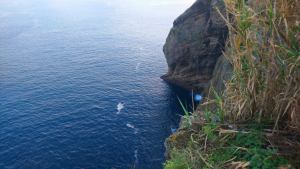
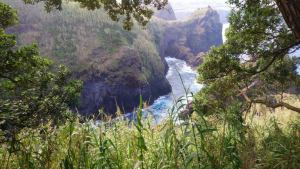 Later, we set Google Maps to guide us to the “Elephant Trunk”, a cliff formation we had glimpsed from the lido. A short drive along another farm track brought us to an old whalers’ lookout perched on the highest point of the cliff. Here, a whaler would once light a fire to alert the rowing crews, then use a flag to direct them towards any passing whales. A rough trail led across fields to the cliff edge, where a simple concrete marker indicated the spot. To see the ‘trunk’, one would have to lean out perilously far over the drop, a risk neither of us was willing to take. After exploring a small abandoned farmhouse, we returned to the car.
 Back at the hotel, we downloaded our boarding passes and certificates in preparation for tomorrow’s flight home. That evening, we dined at a restaurant near the port, ordered sensible portions, and then returned to the hotel bar to watch more football before turning in slightly earlier.
2nd October – Journey Home
 Our flight wasn’t until 6.10 p.m., so we decided to make the most of our final hours on the island. Just 500 metres from the hotel was a small pineapple plantation, which we visited on foot. It opened at 9 a.m. and, even arriving straight after breakfast, we weren’t the first there. The self-guided tour took us through the greenhouses and a small shop selling pineapples and juice, although, surprisingly, no pineapple-based spirits, unlike similar places I’ve visited elsewhere.

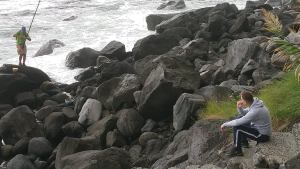 After checking out, we drove in the rain past the airport to the small cliffside village of Relva to see the stone washing tubs fed by a spring. Parking in the village, we were surprised to discover that the tubs lay at the bottom of a steep, treacherous path. The fishermen’s wives who once used them must have been incredibly fit to haul wet laundry back up again. I was exhausted simply carrying a breakfast-laden stomach. At the base of the cliff, two anglers stood on the rocks, apparently catching a fish with every cast as the waves crashed around them.
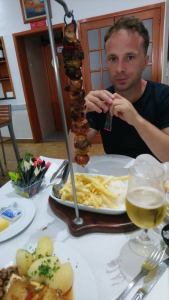
 As we returned to the car, the heavens opened in a torrential downpour, so we sheltered in a small café for coffee and to watch Manchester United draw 1–1 with Everton. When the sun finally reappeared, we made our way to a restaurant on the airport road overlooking the coast. Our substantial meal had to last us until the following day, so we approached it with the seriousness it deserved.
We dropped the car off where we had collected it and took the complimentary coach to the airport, navigating passport control by 4 p.m. After showing the Covid test certificates on our phones, we boarded 20 minutes late but still landed at Stansted on time at 11.50 p.m. The queue for immigration was horrendous, and when I finally reached the desk, the officer looked only briefly at my passport. What, then, was the point of all the documentation?
I dropped Jamie home by 2.10 a.m. and was asleep in my own bed by 2.30 am. A wonderful trip to a scenic, peaceful, and truly exotic island. Ssshhh, don’t tell anyone, or they’ll all turn up and spoil it.
 Palmer Family
Leave a comment