16th January 2020

Slowly, we made our way, churning and mixing the waters into a lengthening brown ribbon stark against the river’s natural khaki hue. It was easy to track our passage; our wake was a distinct scar on the water’s surface.
At first, the islands and riverbanks were too distant to reveal much detail, appearing as nothing more than green slabs set upon a caramel base. Overhead, a promising dawn sky of greys and blues stretched across the horizon. It was already hot and, as my camera lens could attest, very humid.
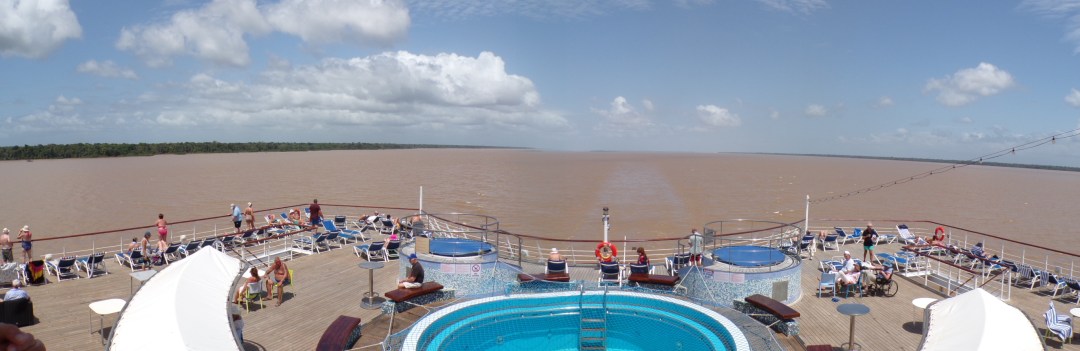
Soon, we arrived at a mid-stream anchorage point between two very rusty and battered river luggers who, like us, were waiting for customs to clear their passage upstream. The pilot station was situated on the nearest bank; you could tell from its stilted height above the water that the river here was tidal, and it was out. Soon, the pilot boat chugged its way towards the Magellan, depositing two Brazilians on board. These were customs officers; they had a reputation for being unpredictable and officious in their work. As it turned out, it was 3.45 pm before we discharged the officials back to their desks and rubber stamps. Rattling the anchor chain safely back inside, we left the less fortunate luggers behind; no doubt they were worthy of even more attention than a cruise liner.
Throughout all this, life on board continued as if we were still ploughing our way blissfully across the Atlantic. Meal times, lectures, clubs, etc., etc., didn’t pause for an instant. The early rush to ‘experience’ the river melted away quickly for most of our fellow passengers. There are only so many photos of a distant pilot station you can take, and the local wildlife was not coming out to play, so they got on with the serious side of cruising, being entertained and fed.


Now that we were once again making progress upstream, cameras and binoculars became essential. As the ship followed deep water channels, first one bank, then the other, would drift tantalisingly close, frustrating those with quick-snap cameras who had to scurry from side to side to capture glimpses of stilted shacks, half-hidden among the trees and shrubs. Though the rainforest was now within even the smallest camera’s range, wildlife sightings were sparse, limited mostly to birds wheeling overhead.
We passed many small boats skimming their way up or downstream, hugging the forest edge as they went about their daily routines. Most of their occupants took a moment to wave at the enormous blue vessel intruding on their tranquil world. One particularly bold adventurer puttered toward us in his tiny boat, waving vigorously in a display of bravado before wisely turning back to safety.
The rainforest is vast, we know this, but experiencing it firsthand from Magellan’s decks made its scale feel almost surreal. From horizon to horizon, muddy water stretched fore and aft, with only a continuous ribbon of dense green marking the boundary between river and sky. It was as if we had been dropped into a prehistoric world, riding a lumbering dinosaur as it meandered through the jungle in search of its next meal.
Shortly after breakfast, we arrived at Santarém. Situated at the confluence of the Tapajós and Amazon Rivers, this city was once home to the Tapajós Indians. Today, it serves as a crucial hub for river commerce, its only road connection leading to Belém.

The Magellan dropped anchor about half a mile from shore, where two nimble tugs expertly manoeuvred a floating pier into place, preparing for the usual mass exodus of passengers eager to explore. The sky was a dazzling blue, and as expected, when hovering just three degrees off the Equator, the heat and humidity were relentless. Those hoping to snap a quick photo upon disembarkation were in for a disappointment; any camera that had been basking in air-conditioned comfort immediately fogged up in the Amazonian air, its lens stubbornly refusing to clear despite frantic wiping.
We had signed up for a tour called “Lake Maicá and Piranha Fishing”, an adventure that promised much and, for once, delivered.
Our group of about 14 boarded a small white boat from the floating pier. It was a familiar sight, similar vessels busily crisscrossed the vast expanse of water around us while others bobbed lazily, moored to jetties lining Santarém’s waterfront. Eager to escape the oppressive sun, we made a beeline for the lower deck, claiming plastic stacking chairs reminiscent of those found in many British gardens, functional but precariously prone to sliding on a rocking boat.
The upper deck, with its elevated vantage point, called for exploration, but the fierce heat made any prolonged stay unbearable. Even for someone as foolhardy as myself, ‘he who dares’ quickly learned that in the Amazon, daring was best left for the fish.


First, we lingered for a while at the “Meeting of the Waters”, a well-known phenomenon where the clear blue-green waters of the Tapajós River flow side by side with the muddy brown Amazon without mixing. This striking division is due to differences in temperature, speed, and density between the two rivers, creating a natural spectacle that stretches for miles.
As we drifted along this liquid boundary, we caught glimpses of grey river dolphins, or botos, surfacing briefly before vanishing beneath the waves. They were hunting, their sleek bodies slicing through the water in pursuit of fish, undeterred by the distinct separation of their hunting ground.
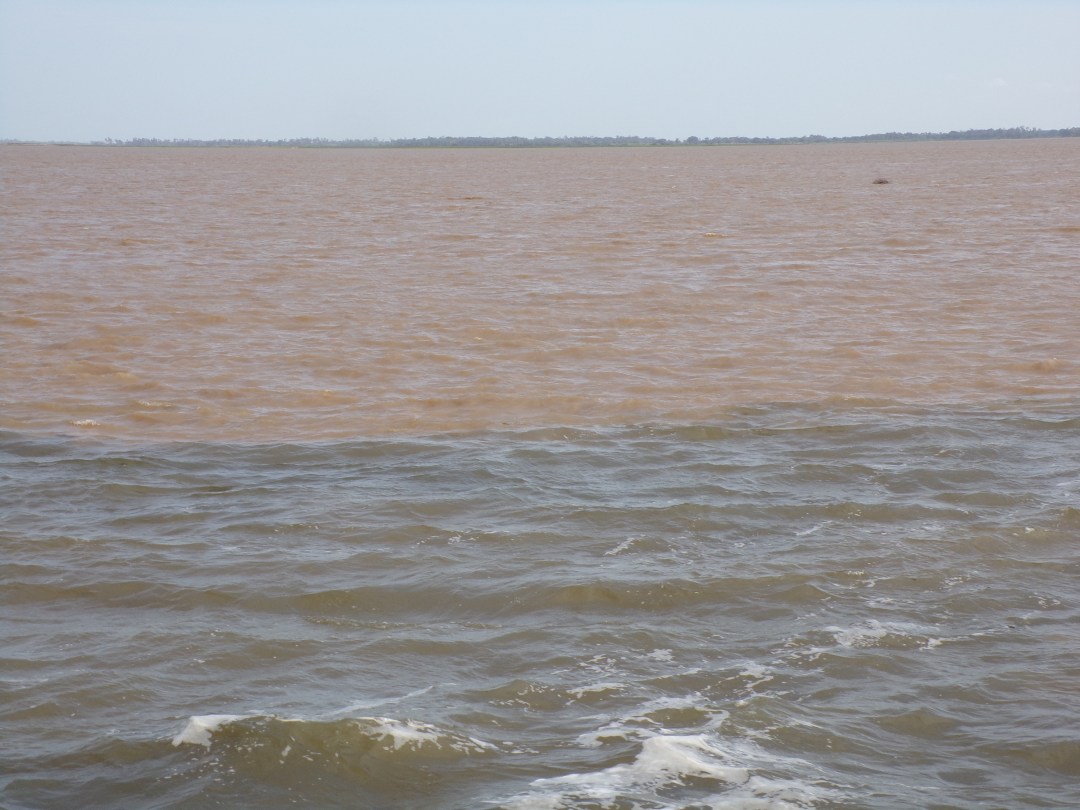
As we entered the Tapajós River en route to Lake Maicá, the river narrowed considerably, allowing us a much closer look at both the wildlife and the riverside dwellings. The dense jungle pressed in, revealing glimpses of white egrets, red and green parrots, and vultures perched in the canopy. Along the riverbanks, water buffalo, goats, and horses stood grazing or cooling off in the shallows, their movements slow and deliberate in the midday heat.
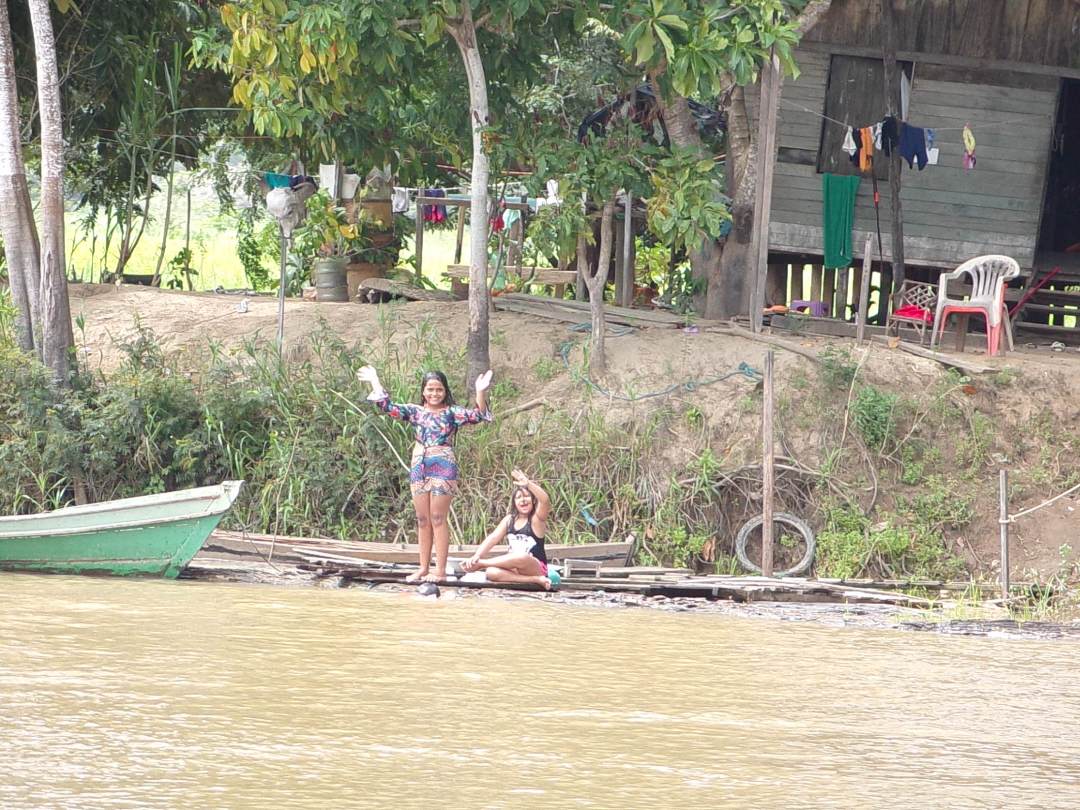
Human habitation appeared in patches between stretches of wild jungle greenery. The houses were mostly simple wooden shacks; some balanced precariously on stilts, others nestled among the trees. Families could be seen going about their daily routines, washing clothes in the river, mending fishing nets, or simply lounging in hammocks, enjoying a break from the heat. Most greeted us with friendly waves, and some even called out, their words lost in the rumble of our boat’s engine. Despite the apparent hardships of life here, their smiles suggested a deep-rooted contentment.
Slender wooden canoes, little more than narrow slivers of timber, zipped past us with their distinctive whining propellers, churning up frothy trails as they darted between the trees and disappeared down hidden tributaries. Others sat still, tucked into shaded inlets where lone fishermen, absorbed in their task, barely acknowledged our passing. For them, the river was more than a scenic backdrop; it was life itself, and the promise of tonight’s meal was far more important than the passing of a tourist boat.


We arrived at one of these intersections between the main river and a smaller tributary, where the waters were still and dark, sheltered beneath the overhanging jungle canopy. Our boat glided to a halt, the crew moving with practised ease as they secured the bow rope to a flimsy, half-submerged branch, a precarious-looking anchor, but one that held firm.
With quiet efficiency, the crew handed out simple fishing rigs, small rectangular blocks of wood wrapped with nylon line, a weight, and a hook already baited with a chunk of raw meat. No fancy rods or reels here, just instinct, timing, and a steady hand.
This was what I had come for, the contest between man and one of the river’s most notorious predators. With eager anticipation, I dropped my bait into the murky water, feeling the tension in the line as it sank into the unknown. Let battle commence.
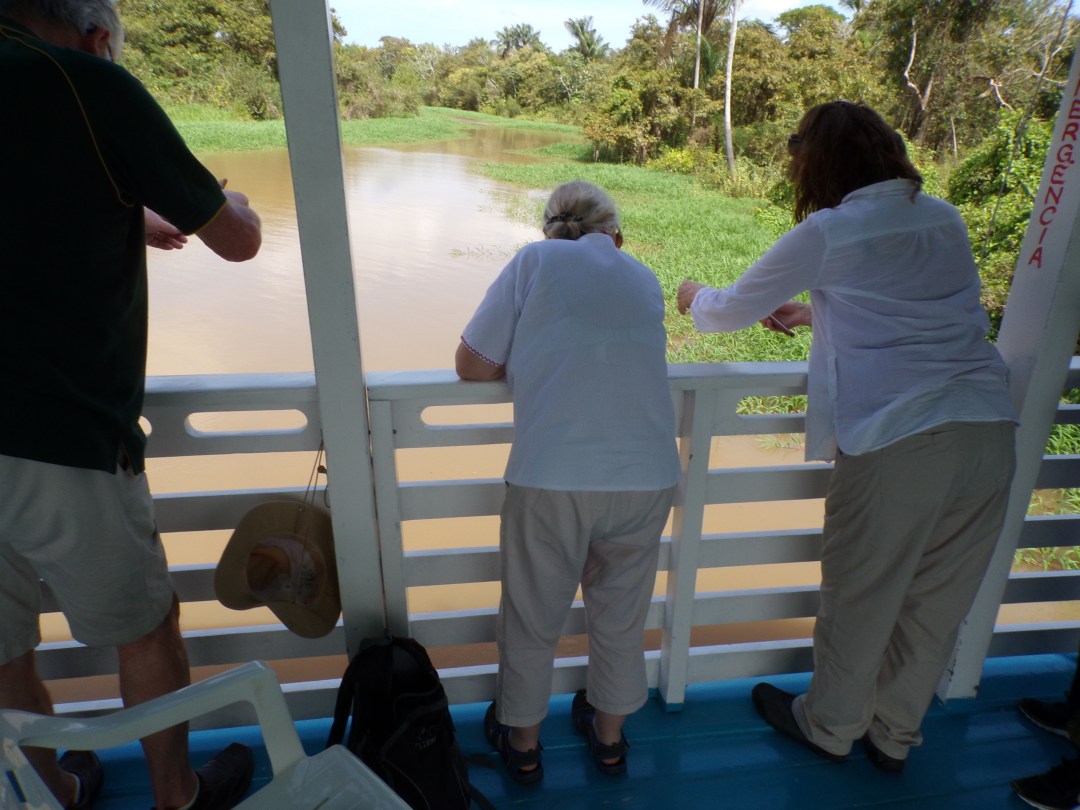
Spending too long strategising my approach, I found myself at a disadvantage; by the time I had made my move, all the prime fishing spots along the deck had already been claimed. Annoyed, I was forced to settle for a less-than-ideal position near the front of the boat, fully exposed to the blistering Amazonian sun. Sue, on the other hand, had wisely positioned herself in the shade, perched in what I considered a superior fishing location.
We had just half an hour to rid the Amazon of one of its legendary hazards.
The first strike came quickly, a gentleman to my right, equally cursed with a poor fishing spot, snagged something. Excitement rippled through the group as he hauled in his prize, but it turned out to be a disappointing non-biting species. The second strike was more successful; the lady to my left pulled up a red piranha, a decent-sized specimen, and the air buzzed with congratulations and eager photography.
Then, at last, my moment arrived.
A faint nibble on my line, barely perceptible, but I was ready. With lightning-fast reflexes honed over years of dodging cricket balls and flicked roast potatoes at rugby club dinners, I set the hook with precision. The fight was on!
Breaking the surface in a splash of defiance, my opponent emerged, a white piranha, its razor-sharp teeth gleaming menacingly. This was no ordinary fish; this was a creature capable of tearing flesh from bone, a born predator, but today, it had met its match.
Hauling my catch onto the boat, I stood for a moment, victor and vanquished, and locked eyes. In his, I saw the glimmer of resignation. He knew. He had fought bravely, but the battle had been lost.
And then, in an act of great warrior mercy, I did what few would dare. I gave a solemn thumbs-up, and with a final nod of respect, I returned him to the depths.
Let them tell the tale, in fishy circles, of the Brit who showed mercy.

On our return to the ship, we drifted past the same ramshackle settlements, their inhabitants still engrossed in the rhythms of daily life. Yet, as before, they took a moment to wave and smile, their hospitality undimmed by our earlier passage.
A pair of boisterous children, eager to impress, flung themselves into the murky water with carefree abandon, their limbs slicing through the surface in a display of youthful bravado.
I watched, both amused and horrified.
Don’t they know what lurks beneath? Piranhas, with their razor-edged teeth and caimans, lurking just out of sight, waiting.
Or perhaps they do know, and simply don’t care.
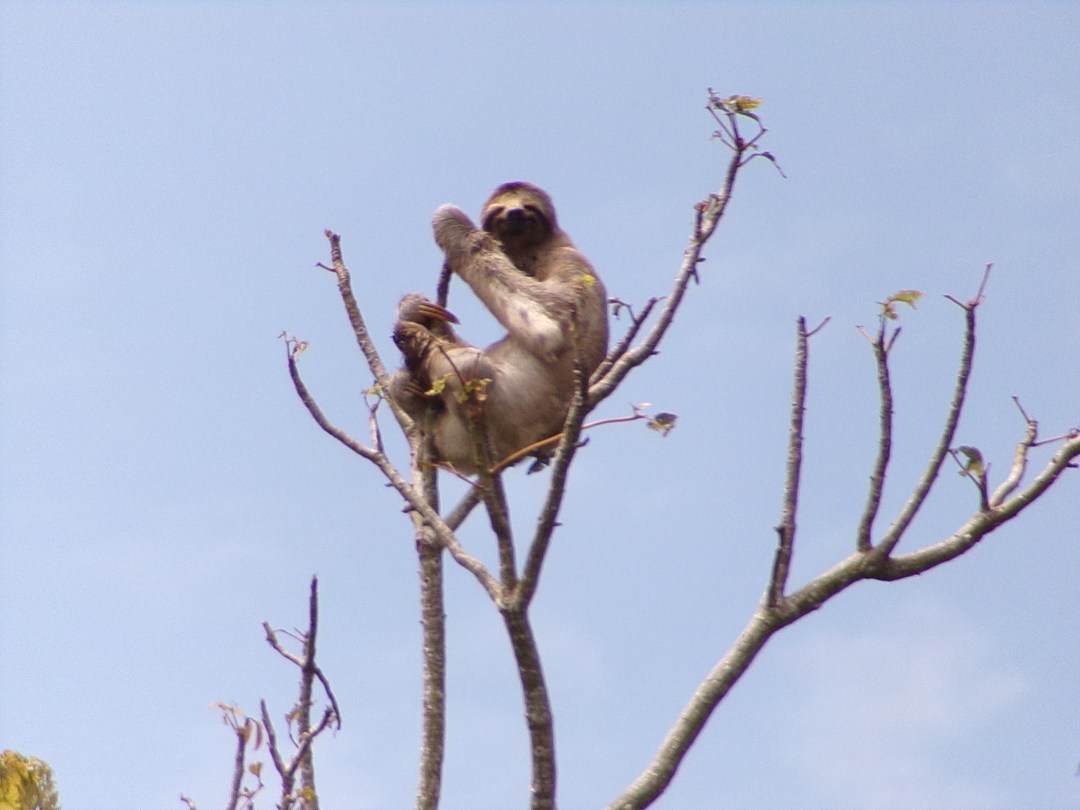
We came across three sloths nestled in the branches of a towering tree, their movements, if any, imperceptibly slow in the suffocating midday heat.
Above them, a vulture wheeled lazily in the sky, its dark silhouette cutting across the blinding sun. It wasn’t us the bird was interested in.
One sloth, seemingly the boldest of the trio, had climbed to the highest, most exposed branch, a skeletal limb devoid of leaves. It was a perfect perch for admiration, and from below, cameras clicked eagerly, capturing its relaxed indifference to the world.
I had to wonder, was it showing off? Enjoying its moment in the spotlight, basking in the attention of those gawking below?
But had it thought to look up?
Had it noticed the other set of eyes locked onto it, ones not filled with awe but with hunger?
Again, we passed the grey river dolphins, still busy with their hunt. Unlike their ocean-dwelling cousins, their longer, more slender snouts were perfectly adapted for ferreting into holes along the submerged riverbanks, flushing out hidden fish. Their movements were swift but deliberate, their presence fleeting as they surfaced only briefly before disappearing back into the murky depths.
Later, as we entered the wider Amazon, we were treated to an entirely different spectacle, a pod of black dolphins. These weren’t hunting; they were playing. With boundless energy, they leapt and twisted out of the water, their sleek bodies catching the light for a fraction of a second before vanishing again.
It was impossible to tell whether they were showing off for us or simply lost in their joy, but it didn’t matter. For a few magical moments, we shared their frivolity.

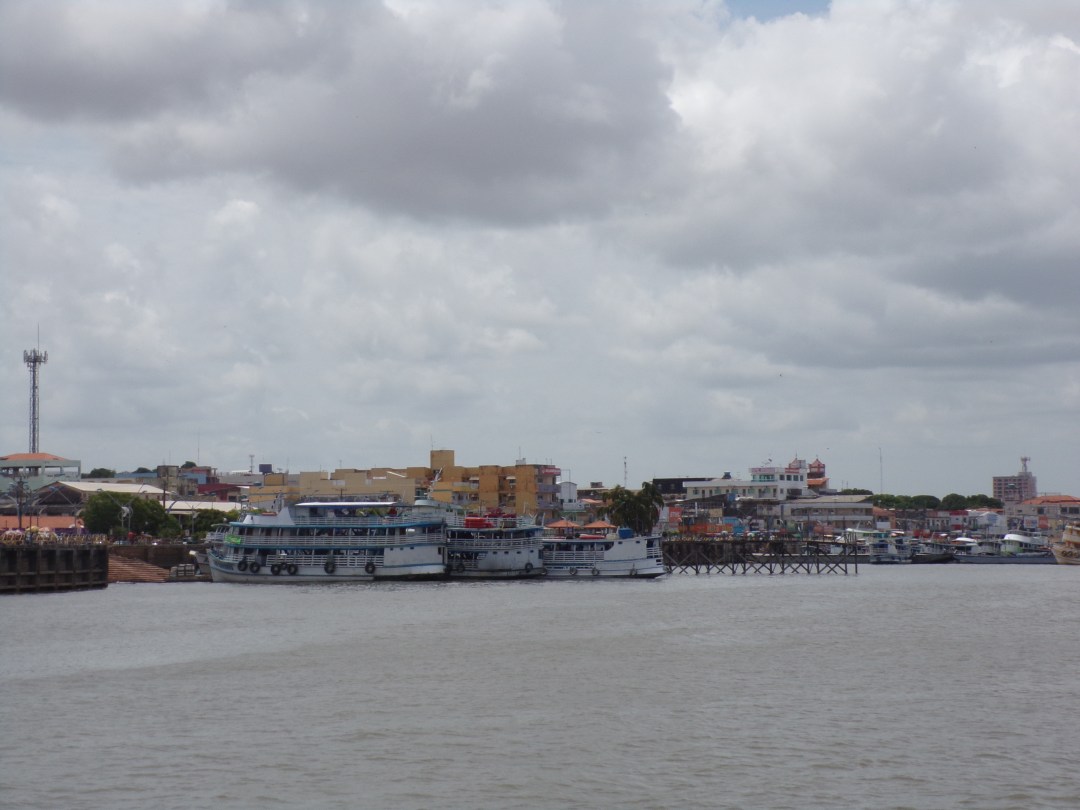

Our return route took us closer to the city, passing its many waterside businesses and river ferries. One such vessel, visibly old and rusting, had been involved in the deadliest maritime disaster on the Amazon. It had tragically sunk sometime in the 1980s with the loss of over 300 lives. Coming to rest in one of the river’s deepest sections, some 300 metres down, it was remarkably salvaged and refloated by the American company that owned it. Incredibly, it has remained in operation ever since, something that would be unthinkable in Europe.
Back aboard the Magellan, we browsed the lunch buffet before catching one of the ship’s tenders to the city pier. Our mission: to secure two dried piranha trophies in honour of the Battle of the Tapajós River, along with a piranha-themed T-shirt. Caught the fish, bought the trophy, and wore the T-shirt!
With our task complete, we tendered back. By now, the heat had become so intense that even the river breeze couldn’t stop us from wilting. A shipload of sweating passengers gratefully collapsed into the air-conditioned belly of the floating tin can we called home.
At 6 pm, we set sail once more, bound for our next adventure.
 Palmer Family
Leave a comment